

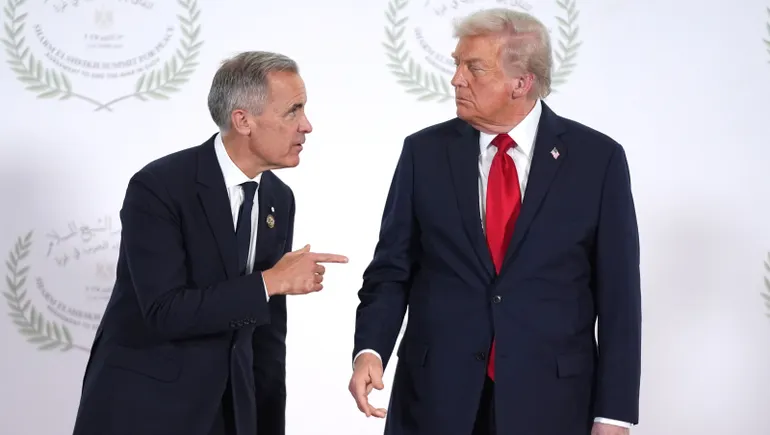
OTTAWA — The economic relationship between North America’s closest neighbors and trading partners has plunged into a deep freeze. Fulfilling a promise made by Prime Minister Mark Carney late last week, the Canadian government has officially enacted a robust slate of retaliatory tariffs against the United States.
The move comes in direct response to broad import levies implemented by the Trump administration over the weekend. With both nations digging in their heels following the abrupt collapse of high-stakes trade negotiations, the escalating tariff dispute threatens to disrupt cross-border supply chains, spike consumer prices, and test the resilience of industries ranging from automotive and steel to agriculture and seafood.
Main Facts: What Canada Is Implementing
Beginning September 8, Canada will levy targeted tariffs ranging from 15% to 50% on a wide-ranging basket of American goods. These countermeasures are carefully calibrated to mirror the rates and product categories currently targeted by Section 232 and Section 338 tariffs enforced by the United States.
Among the most significant measures:
- Steel and Aluminum: Imports of American steel and aluminum will face a steep 50% tariff, doubling Canada’s previous retaliatory levy of 25% and directly matching U.S. sectoral measures.
- Consumer Goods and Derivatives: A 25% tariff will apply to various appliances, dairy products, fish and seafood, and specific steel and aluminum derivative products.
- Electronics and Agriculture: Agricultural equipment, electronics, pulp, and paper will also face targeted duties under the 15%, 25%, or 50% structures.
- Automotive Sector: Canada will maintain its existing counter-tariffs, which heavily target U.S. automobiles, even as the threat of further sectoral duties looms from Washington.
Simultaneously, the federal government in Ottawa announced a massive $7.5 billion support package designed to cushion the blow for Canadian businesses, workers, farmers, and fishers caught in the crossfire of the trade dispute.
"This focused response will protect Canadian workers, farmers, fishers, families, and businesses, defend industries harmed by unjustified U.S. tariffs, and help Canadian producers compete with U.S. products in the Canadian market," the Department of Finance stated in a Tuesday news release.
Chronology of a Breakdown: How Trade Talks Collapsed
The road to the current tariff standoff was paved with rapidly deteriorating diplomatic channels and failed eleventh-hour negotiations.
- Mid-August: Anticipating protectionist moves from Washington, Canadian and U.S. trade representatives engaged in intensive negotiations to avert a broader trade war. Hopes were high that a compromise could be reached to protect integrated North American manufacturing supply chains.
- Late Last Week (Pre-Weekend): The Trump administration briefly delayed a planned wave of 50% tariffs on Canadian imports for three days to allow for final, exhaustive discussions. However, the talks hit an insurmountable wall.
- Friday: Prime Minister Mark Carney made the dramatic decision to recall Canadian negotiators just hours before the U.S. tariffs were scheduled to take effect. Carney cited newly introduced terms from the Trump administration that he characterized as "uneconomic, unfair, and [undermining] the net benefits to Canada." Carney vowed at the time that Ottawa would respond "dollar for dollar."
- Over the Weekend: The U.S. tariffs officially went into effect, drawing immediate condemnation from Ottawa and setting the stage for Canada’s counter-measures.
- Monday: Pointing the finger firmly at Canada for the breakdown in diplomatic channels, President Donald Trump escalated the rhetoric further, announcing plans for additional 50% tariffs targeting Canadian cars, trucks, auto parts, and steel. As of early this week, however, these latest threats have not been formally codified, leaving market analysts uncertain about how they will integrate with existing sectoral duties.
- Tuesday: The Canadian Department of Finance officially published the details of the September 8 counter-tariffs and the $7.5 billion domestic support package, locking the two nations into an active trade dispute.
Supporting Data and Sectoral Impact
The economic interdependence between the U.S. and Canada is vast, making broad-brush tariffs particularly disruptive. Cross-border trade routinely crosses the multi-billion-dollar threshold daily, heavily anchored by the automotive, energy, and manufacturing sectors.
Affected Sectors and Tariff Rates
| Product Category | New Canadian Counter-Tariff Rate | Targeted U.S. Equivalent / Context |
|---|---|---|
| Steel & Aluminum | 50% | Matches U.S. Section 232 and recent adjustments |
| Appliances & Dairy | 25% | Mirrors U.S. targeted levies on consumer and agricultural goods |
| Fish & Seafood | 25% | Countermeasures protecting domestic fisheries |
| Automobiles | Maintained / Existing | Existing counter-tariffs remain active amid new auto-threats |
| Electronics & Paper | 15% – 25% | Varies by sub-category to match U.S. schedules |
The decision to pair these retaliatory tariffs with a $7.5 billion stabilization fund underscores Ottawa’s anxiety regarding domestic fallout. Industries such as dairy farming and seafood processing operate on tight margins and rely heavily on export markets or competitive pricing against subsidized American alternatives. By injecting capital directly into these impacted sectors, the Canadian government hopes to prevent widespread layoffs and corporate insolvencies while the trade dispute persists.
Official Responses
The political fallout from the collapse of talks has yielded sharp rhetoric from both capitals, with each side accusing the other of acting in bad faith.
Ottawa’s Perspective
Canadian officials framed the retaliatory measures as a necessary defense of national sovereignty and economic fairness.
"When the United States asked too much and offered too little, we chose to stand up for Canadians," said François-Philippe Champagne, Canada’s Minister of Finance and National Revenue. "Our dollar-for-dollar, rate-for-rate counter-tariffs as well as a multi-billion-dollar support package will protect workers, farmers, families, and businesses as we build a stronger, more resilient, and more diversified Canadian economy."
Prime Minister Carney’s administration has consistently emphasized that while Canada values its historic alliance with the United States, it will not accept trade terms that disproportionately harm Canadian workers or compromise long-term economic prosperity.
Washington’s Perspective
Conversely, the White House has placed the blame squarely on Ottawa for walking away from the negotiating table. U.S. officials maintain that the proposed terms were designed to correct long-standing trade imbalances and protect domestic manufacturing, particularly in the steel and automotive sectors.
Following the breakdown of talks, President Trump doubled down on protectionist measures, warning that continued resistance from Canada would only result in deeper economic penalties, including the threatened 50% levies on vehicles and heavy auto components.
Implications for Supply Chains and the Future
As the September 8 implementation date for Canada’s tariffs approaches, economists, supply chain managers, and industry leaders are bracing for turbulence.
1. Supply Chain Disruption
Modern manufacturing—particularly in the automotive and aerospace sectors—relies on parts crossing the U.S.-Canada border multiple times before a final product is assembled. Imposing 25% to 50% tariffs on raw inputs like steel and aluminum, alongside derivative parts, will dramatically increase production costs. Companies will be forced to either absorb these costs, pass them on to consumers, or rapidly restructure their supply chains to source materials domestically or from alternative international markets.
2. Consumer Price Inflation
With tariffs acting as a direct tax on imported goods, consumers on both sides of the border are likely to feel the pinch. Everyday appliances, dairy products, electronic goods, and vehicles could see noticeable price hikes in the coming months, adding inflationary pressures to economies already navigating complex macroeconomic challenges.
3. Diplomatic Uncertainty
The breakdown in negotiations signals a potentially prolonged period of friction between two nations that have historically enjoyed one of the most stable and open trading partnerships in the world. With the U.S. threatening further automotive tariffs and Canada refusing to back down from its dollar-for-dollar strategy, the path back to the negotiating table remains obscured.
For now, businesses in both countries are left scrambling to adapt to a shifting regulatory landscape, hoping that diplomatic channels can eventually be reopened before permanent structural damage is done to the integrated North American economy.
