

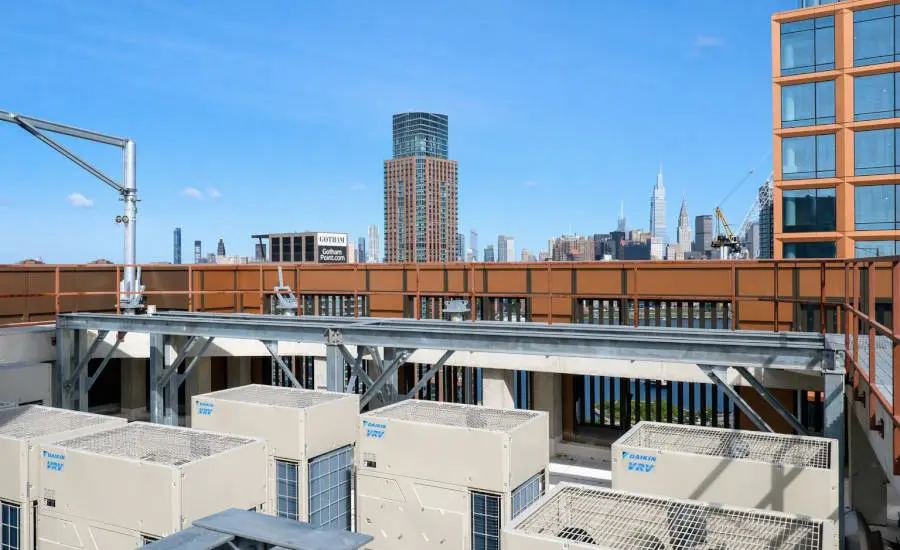
NEW YORK — Over the past twenty years, the architectural DNA of the commercial built environment has undergone a radical, irreversible transformation. Gone are the days of the monolithic corporate monolith, where uniform rows of private offices and identical cubicles stretched endlessly under a single, centralized HVAC regime.
Today’s commercial real estate landscape is a dynamic, multi-functional ecosystem. A single modern enterprise center may seamlessly house open-plan coworking spaces, private executive offices, state-of-the-art conference rooms, high-intensity fitness centers, vibrant culinary cafés, and heat-generating data and server rooms all under one roof. Meanwhile, contemporary hospitality venues cater to guests whose individual comfort preferences vary dramatically from room to room, and educational institutions experience wild, hourly fluctuations in occupancy density. Compounding this, mixed-use developments continue to surge in popularity, stacking residential apartments, retail stores, and commercial office spaces within the footprint of a single building structure.
These diverse architectural spaces do not just serve radically different purposes—they demand entirely distinct heating and cooling environments.
"Modern buildings are not one single thermal indoor environment," explains AP Sharma, Director of Product Marketing for VRV at Daikin Comfort Technologies North America, Inc. "They’re a moving mosaic of microclimates."
This reality marks a fundamental, paradigm-shifting departure from the way commercial heating, ventilation, and air conditioning (HVAC) systems were historically conceptualized, engineered, and installed. For generations, architecture and spatial design were forced to bend and compromise around the rigid spatial requirements of bulky mechanical systems. Today, advanced Variable Refrigerant Volume (VRV) and Variable Refrigerant Flow (VRF) technologies are rewriting that narrative, offering a modular, intelligent approach that adapts dynamically to the building, rather than forcing the building to accommodate the HVAC system.
Main Facts: The Structural and Thermal Paradigm Shift
At its core, traditional commercial HVAC engineering relied heavily on centralized air-handling units, massive mechanical rooms, extensive and intrusive ductwork networks, and substantial structural accommodations. These legacy systems were typically engineered to blast conditioned air uniformly across massive zones, treating a building as a single, homogenous block.
In contrast, modern VRV/F technology relies on a decentralization of thermal management. By utilizing compact refrigerant piping, modular outdoor equipment, and intelligent, data-driven controls, VRV/F systems decouple human comfort from the heavy structural burdens of the past.
As building owners face mounting pressure to balance occupant wellness, stringent energy-efficiency regulations, architectural flexibility, and long-term sustainability, adaptability has risen to the top of the commercial real estate priority list. For structural engineers, MEP (Mechanical, Electrical, and Plumbing) contractors, and architects alike, VRV/F represents a profound evolution in commercial comfort design—one focused not merely on brute-force air conditioning, but on resolving the precise, individualized challenges each unique building presents.
Chronology: From Static Ductwork to Dynamic Microclimates
To understand the magnitude of the shift toward VRV/F technology, it is helpful to trace the chronological evolution of commercial climate control over the last century:
- The Mid-to-Late 20th Century (The Era of Centralization): Commercial architecture was defined by heavy reliance on central air distribution. Large chillers, boilers, and massive duct runs dominated building designs, requiring vast ceiling plenums and dedicated mechanical floors. Zoning was rudimentary, typically relying on mechanical dampers to crudely redirect airflow across large floor plates.
- The Turn of the Millennium (The Rise of Mixed-Use and Flexibility): As urban centers densified and the nature of work shifted, mixed-use real estate developments and flexible workspace models gained traction. Legacy HVAC systems struggled immensely to keep pace with wildly divergent internal loads, leading to chronic hot-and-cold spots, tenant complaints, and profound energy inefficiencies.
- The 2010s (Early Adoption of Inverter and Zoning Innovations): Variable-speed compressor technology began to mature, allowing systems to modulate capacity rather than simply cycling on and off. However, widespread adoption of fully decentralized refrigerant-based multi-zone systems was still limited by early software limitations and industry inertia.
- The Modern Era (Intelligent, Data-Driven Microclimates): Today, VRV/F systems operate as interconnected, data-driven digital networks. Every indoor unit functions as an intelligent node communicating in real time with outdoor compressors. Predictive control algorithms, advanced variable-speed inverter technology, and heat recovery capabilities have transformed HVAC from a background utility into an active participant in building performance and architectural preservation.
Supporting Data: Efficiency, Peak Loads, and Real-World Performance
Comfort is only one half of the modern commercial equation; energy efficiency and operational expenditure dictate the financial viability of real estate assets.
Historically, commercial HVAC systems have been sized to handle extreme meteorological outliers—namely, the absolute hottest day of summer and the coldest day of winter. However, meteorological data demonstrates that these peak design conditions represent only a minuscule fraction of a building’s total annual operating life.
"For the remaining portion of the year, those traditional systems are cycling on and off, which is not efficient and also creates wear on equipment and… unnecessary peaks in energy demand," Sharma notes.
This cyclical on-and-off operation creates massive energy spikes and accelerates mechanical wear and tear. VRV/F technology addresses this inefficiency directly through advanced inverter-driven compressors. Instead of operating in a binary "on/off" state, VRV/F systems continuously modulate their refrigerant output, running at the precise, fractional capacity required to match real-time building loads.
Furthermore, heat recovery VRV/F systems take thermodynamic efficiency to an entirely new level. Rather than rejecting heat extracted from one zone of a building out into the atmosphere, heat recovery technology captures that thermal energy and redirects it to other zones within the building that require heating. For example, in a contemporary multi-story office building, thermal energy extracted from sun-drenched perimeter offices on the south side can be intelligently transferred to warm interior or north-facing zones. This closed-loop resource sharing transforms what was once wasted energy into productive, cost-saving heating output.
Official Responses and Industry Perspectives
The rapid adoption of VRV/F across North America is being driven by professionals on the front lines of design, engineering, and manufacturing who recognize that the old rules of commercial construction no longer apply.
"For years, architecture had to bend around HVAC," Sharma emphasizes. "VRV/F completely decouples comfort from these structural burdens."
Industry experts point out that the shift is equally psychological for mechanical contractors. No longer viewed strictly as installers of sheet metal and piping, modern contractors are evolving into multidisciplinary problem-solvers.
"As buildings become more complex, the role of the HVAC contractor has evolved along with them," Sharma observes. "Today’s contractors are working alongside owners, architects, and engineers to balance occupant comfort, energy performance, constructability, and the unique constraints of each building. VRV/F has really shifted the mindset of HVAC professionals from being purely installers to becoming space problem-solvers."
This evolution demands a higher standard of technical expertise in the field. Installing and commissioning modern VRV/F systems requires meticulous refrigerant piping practices, rigorous pressure testing, and a comprehensive understanding of advanced digital controls and system diagnostics.
"Success is no longer defined simply by whether the equipment runs," Sharma stresses. "Success is defined by whether or not the building performs the way it was designed to from the first day."
Implications: Solving Complex Renovation and Operational Challenges
The true test of any modern HVAC technology lies in its real-world application, particularly within the realm of building retrofits and historic renovations. Across major metropolitan areas, property owners are increasingly looking to modernize aging commercial assets without executing gut-rehabs that destroy historical architecture or disrupt revenue streams.
The Retrofit Challenge
In many existing buildings, retrofitting traditional, bulky ducted systems is practically impossible. Tight ceiling cavities, limited roof structural capacity, and historic architectural features make installing conventional sheet metal both exorbitantly expensive and structurally destructive.
"Replacing older HVAC systems with a traditional ducted solution often means major renovations, low ceiling heights, lost usable space, and high installation costs," Sharma explains.
Because VRV/F systems rely on slender, flexible refrigerant piping rather than massive duct networks, engineers and contractors can bypass these spatial bottlenecks with ease. This flexibility allows project teams to modernize thermal infrastructure while preserving historic architectural details, maximizing usable square footage, and retaining valuable ceiling height.
Case Study: Phased Hospitality Renovations
Consider a recent hotel renovation project in the Southwestern United States that faced a formidable combination of design obstacles. The property featured severely restricted ceiling space, virtually no room for new ductwork, and an overriding operational requirement: portions of the hotel had to remain fully open and operational to guests throughout the entire construction timeline.
Had the project team opted for a conventional ducted HVAC system, it would have necessitated extensive ceiling demolition, reduced guest room availability, and catastrophic revenue-draining shutdowns. Instead, the project engineers selected a Daikin VRV system.
By utilizing compact refrigerant piping in place of bulky duct runs, the system integrated seamlessly into the existing structural bones of the building. Furthermore, the modular nature of the outdoor equipment allowed the installation team to execute the project in precise, manageable phases. As a result, the hotel continued welcoming guests and generating revenue while modernization work progressed seamlessly behind the scenes.
Once operational, the independent zoning capabilities of the VRV system allowed guest rooms, corridors, and high-traffic common areas—all of which experience wildly fluctuating thermal loads—to maintain exact microclimate control without interfering with one another.
"In the end, Daikin VRV wasn’t just an equipment selection—it was what made the renovation feasible," Sharma concludes. "It was designed to help maintain comfort, manage disruption, and preserve usable space in a way that would have been extremely difficult with traditional HVAC systems."
Conclusion: The Future of Commercial Comfort
As urbanization accelerates and tenant expectations for personalized comfort reach an all-time high, the commercial built environment will only grow more intricate. Whether engineering an all-electric commercial footprint from the ground up or executing a delicate, phased historic preservation project, modern building challenges demand modern mechanical solutions.
Flexibility is no longer a luxury for real estate developers and MEP engineers—it is the foundational metric that determines whether a complex commercial project can succeed. By embracing intelligent, data-driven VRV/F systems, industry professionals are proving that comfort and efficiency are not mutually exclusive, ushering in a new era where buildings finally adapt to the humans inside them.
Additional Information Notice: Before purchasing any commercial or residential HVAC appliance, building owners and facility managers are strongly advised to review important disclosures regarding estimated annual energy consumption, yearly operating costs, and seasonal energy efficiency ratings available directly from certified equipment retailers and manufacturers.
