

By Sheena Vasani
If your passport is currently gathering dust or sitting proudly at the top of your packing pile for an upcoming international adventure, you likely already know the logistical nightmare that is keeping modern electronics powered. In an era where our daily carry includes smartphones, wireless earbuds, smartwatches, portable power banks, and tablets, finding a reliable wall socket abroad is only half the battle. The real challenge lies in bridging the physical gap between incompatible international sockets and your collection of USB cables.
For travelers looking to streamline their gear without sacrificing charging capability, Anker has long been a trusted name in portable power solutions. Now, one of the brand’s most celebrated travel accessories—the Anker Nano Travel Adapter—is back down to its best price to date.
Currently discounted to just $19.99 (a $6 savings off its standard MSRP), the compact 5-port powerhouse is available at major retailers including Amazon and Best Buy, as well as directly through Anker’s official storefront using the promotional code WS7DV2BNB82J. Hailed as a standout choice in seasonal travel gear roundups, this pocket-sized adapter offers a masterclass in efficient engineering for the frequent flyer.
Main Facts: What Makes the Anker Nano Travel Adapter Stand Out?
The Anker Nano Travel Adapter is designed to solve a very specific set of travel headaches: universal plug compatibility, multi-device charging, and extreme space-saving dimensions.
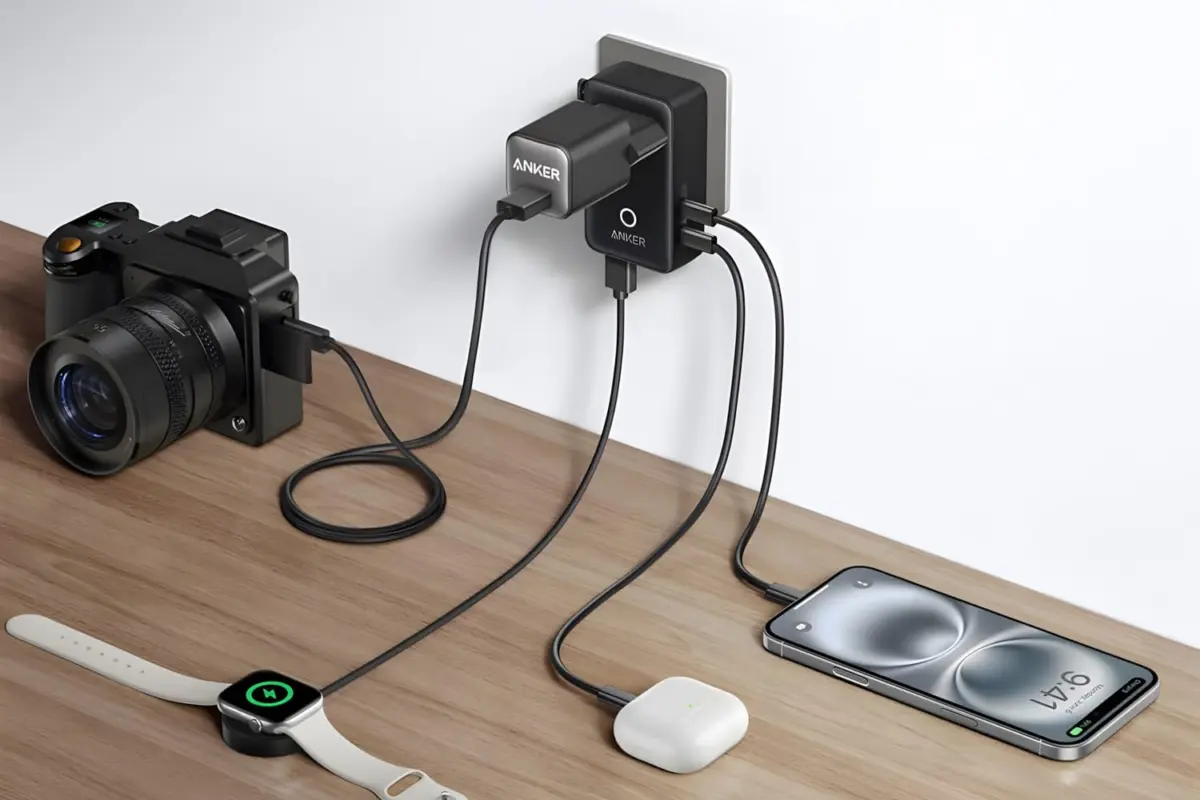
Rather than forcing users to carry a chaotic collection of bulky, interchangeable plug attachments that easily get lost at the bottom of a backpack, the Nano integrates everything into a single, cohesive unit. According to manufacturer specifications, the device features four distinct sets of built-in, slide-out prongs. This mechanical design grants it compatibility with electrical outlets across more than 200 countries and regions worldwide, spanning major travel hubs in Europe, the United Kingdom, Australia, Asia, and the Americas.
Beyond its physical adaptability, the Nano acts as a robust multi-port charging station. It is equipped with:
- Two USB-C ports: Capable of delivering up to 20W of power individually, perfect for fast-charging modern smartphones.
- Two USB-A ports: Ideal for legacy cables, smartwatches, and smaller accessories.
- One integrated AC outlet: A pass-through standard wall socket that allows users to plug in a traditional laptop charger or other high-draw AC plugs simultaneously.
In total, the adapter is engineered to safely manage up to five devices at once, making it an indispensable tool for hotel rooms, airport terminals, and cafes where open wall outlets are notoriously scarce.
Chronology: The Evolution of Compact Travel Power
To understand why the Anker Nano Travel Adapter is making waves in the tech community, it helps to look at the historical trajectory of travel adapters.

The Era of Clunky Universal Kits (Early 2000s – 2015)
For decades, international travel adapters were notoriously frustrating. Consumers relied on multi-piece plastic kits involving a central cube and three or four loose, snap-on modules. These kits were prone to cracking under pressure, losing individual pieces in hotel bedsheets, and taking up an excessive amount of luggage space. They also rarely offered built-in USB ports, meaning travelers still had to pack individual USB wall bricks for every single device.
The Rise of USB Integration (2016 – 2021)
As smartphones became ubiquitous, third-party manufacturers began building USB-A ports directly into travel adapters. While this eliminated the need to carry separate phone chargers, these early multi-port adapters were often heavy, poorly balanced, and tended to sag or fall completely out of loose international wall sockets under their own weight.
The Modern GaN and Nano Revolution (2022 – Present)
Leveraging advancements in semiconductor technology and compact circuit design, brands like Anker began prioritizing high-density power delivery within ultra-minimalist form factors. The introduction of the Nano Travel Adapter line represents the culmination of this evolution. By prioritizing a slim profile—measuring roughly an inch thick with its prongs retracted—and balancing multi-port capability with smart thermal regulation, Anker has shifted the paradigm from makeshift travel accessories to essential, premium personal tech.
Supporting Data and Technical Specifications
When evaluating travel tech, raw numbers matter. The Anker Nano Travel Adapter packs impressive engineering into a surprisingly diminutive shell.
- Weight: 3.8 ounces (roughly 108 grams), making it significantly lighter than the average smartphone.
- Dimensions: Approximately 1 inch thick when prongs are safely folded flush against the body.
- Power Output: A single USB-C port delivers up to 20W of output. In real-world testing, a 20W output is sufficient to juice up a modern smartphone (such as an iPhone) from zero to 50 percent battery in under 30 minutes.
- Capacity: Up to 5 devices can be charged simultaneously (2x USB-C, 2x USB-A, and 1x AC pass-through outlet).
- Pricing History: Normally retailing for around $25.99, the current promotional price of $19.99 matches the lowest recorded price point for the black colorway across major e-commerce platforms.
Crucial Safety Caveat: Voltage vs. Adaptation
One of the most common pitfalls for international travelers is misunderstanding the difference between a plug adapter and a voltage converter. The Anker Nano Travel Adapter is strictly an adapter, not a converter.
This means it alters the physical shape of the plug to fit foreign wall sockets, but it does not step down electrical voltage (e.g., converting 220V–240V down to North America’s standard 110V–120V).
While most modern personal electronics—including laptops, smartphones, tablet chargers, camera battery docks, and Nintendo Switches—feature internal power supplies that automatically handle dual voltages (typically labeled as "100-240V, 50/60Hz"), high-wattage heating appliances do not. Travelers must exercise extreme caution before plugging devices like hair dryers, curling irons, electric toothbrushes, or traditional electric razors into the AC pass-through port. Unless those appliances explicitly state they support local voltages, using them abroad through a standard adapter can lead to blown fuses, ruined equipment, or electrical fires.
Official Responses and Industry Reception
Tech reviewers and consumer advocates have widely praised the Anker Nano Travel Adapter for its thoughtful design choices, particularly its focus on safety and physical stability.
In product reviews across major gadget publications, engineers have highlighted Anker’s inclusion of proprietary thermal monitoring systems. The Nano incorporates smart temperature control mechanisms designed to prevent overheating during sustained, multi-device charging sessions—a common failure point for generic, unbranded travel adapters purchased hastily at airport souvenir shops.

Furthermore, user feedback emphasizes the utility of the adapter’s low-profile footprint. Because it rests relatively flush against the wall when plugged in—unlike longer, top-heavy adapters that exert torque on wall receptacles—it remains securely mounted even in older, worn-out hotel outlets that struggle to hold heavier plugs.
Anker representatives have continually emphasized that the company’s "Nano" design philosophy focuses on maximizing power output while minimizing spatial footprint, catering specifically to the minimalist packing movement that dominates modern tourism.
Implications for Travelers and the Tech Market
The enduring popularity and frequent discounting of versatile travel accessories like the Anker Nano highlight broader shifts in how consumers pack and consume media on the go.
1. The Death of Single-Purpose Chargers
As USB-C continues its march toward universal dominance—bolstered by regulatory mandates in the European Union and the widespread adoption of the standard across laptops, tablets, and phones—consumers increasingly expect their accessories to be multi-functional. A travel adapter that only provides a single AC pass-through is no longer competitive; modern users demand integrated smart charging ports that can handle mobile ecosystems right out of the box.
2. Streamlining Carry-On Baggage
With airlines enforcing increasingly strict weight and space limits for carry-on luggage, every ounce matters. Heavy, multi-piece adapter kits are rapidly becoming obsolete relics of the past. By packing a single 3.8-ounce device that can safely fuel five separate gadgets, travelers can drastically reduce cable clutter and save precious grams in their bags.
3. The Value of Brand Reliability in Power Delivery
Electrical safety is not an area where travelers should cut corners. Cheap, uncertified travel adapters bought from unverified online marketplaces have a documented history of electrical shorts, sparks, and substandard soldering. By offering a safety-certified, multi-port solution from an established industry leader like Anker at a competitive $19.99 price point, consumers are given a reliable, risk-mitigated alternative to hazardous bargain-bin hardware.
Conclusion
Whether you are planning a backpacking trip across Europe, a business excursion to Asia, or a relaxing getaway in the Caribbean, keeping your digital life powered is essential for navigation, translation, photography, and staying connected back home.
The Anker Nano Travel Adapter strikes an ideal balance between portability, multi-device capability, and safety engineering. At its current promotional price of $19.99—available across Amazon, Best Buy, and Anker’s direct site with code WS7DV2BNB82J—it represents one of the most cost-effective investments a frequent traveler can make to upgrade their packing kit before their next journey.
