

By Anthony Capkun
Published August 12, 2026
Main Facts
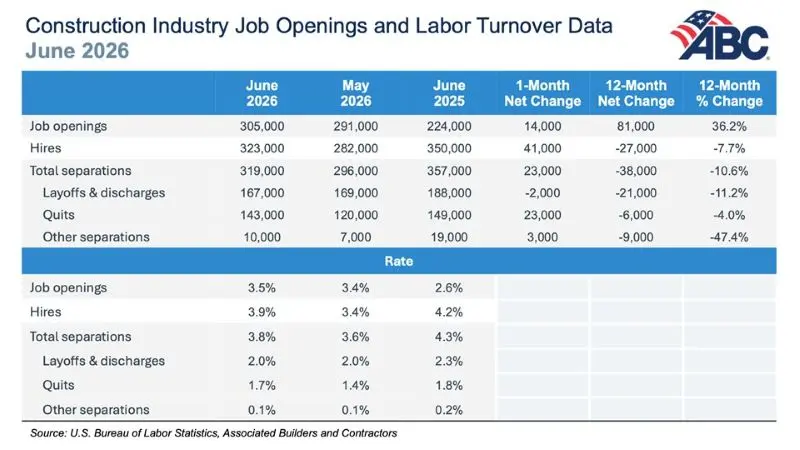
The United States construction industry presented a complex and confounding economic picture at the end of the second quarter of 2026. According to a comprehensive analysis released by Associated Builders and Contractors (ABC)—utilizing foundational data from the U.S. Bureau of Labor Statistics’ (BLS) Job Openings and Labor Turnover Survey (JOLTS)—the construction sector recorded 305,000 unfilled job openings on the final day of June 2026.
This figure represents a notable month-over-month increase of 14,000 openings compared to May, and a staggering year-over-year surge of 81,000 openings, marking a 36.2% jump from June 2025.
However, this outward sign of robust labor demand exists in stark contrast to broader macroeconomic indicators within the built environment. While the number of active job listings climbed dramatically, actual hiring figures moved in the opposite direction. The industry logged just 323,000 hires in June 2026, representing a 7.7% decline compared to the 350,000-plus hires recorded in June 2025.
Compounding this paradox, national construction spending reports for the same period point toward a continuing contraction across both residential and nonresidential sectors. Industry experts emphasize that these conflicting metrics—rising vacancies, falling hires, and declining sector expenditures—highlight deep structural transformations, demographic shifts, and evolving regulatory and compliance landscapes reshaping the American construction labor market.
Chronology
To fully grasp the trajectory of the construction labor market heading into the second half of 2026, it is essential to trace the recent timeline of regulatory shifts, macroeconomic releases, and shifting workforce dynamics:
- Early 2025: The construction industry continues to navigate post-pandemic labor shortages, with contractors reporting persistent difficulties in filling specialized craft positions. Despite elevated interest rates, demand for infrastructure and industrial projects remains resilient, keeping job openings high.
- June 2025: The BLS JOLTS report for this period establishes a baseline of 224,000 job openings and 350,000 hires, demonstrating a relatively fluid, albeit tight, labor market where open positions were steadily converted into active employment.
- Late 2025 to Early 2026: Monetary policy adjustments and rising material costs begin to cool overall construction momentum. National spending on both residential housing and commercial nonresidential projects begins a slow, steady descent.
- May 2026: Preliminary JOLTS data indicates that the cooling trend in macroeconomic spending has not yet slowed down contractors’ desires to recruit. Openings hover near the 290,000 mark, puzzling economists who note the disconnect between slowing project pipelines and aggressive recruiting efforts.
- June 2026: The definitive JOLTS dataset is compiled. It reveals that job openings have climbed to 305,000—a 36.2% year-over-year escalation. Simultaneously, actual hires drop to 323,000 (down 7.7% year-over-year), setting off alarm bells and forcing industry analysts to look beyond standard economic interpretations.
- August 12, 2026: Associated Builders and Contractors publishes its official analysis of the June JOLTS data. ABC Chief Economist Anirban Basu issues a critical advisory warning stakeholders against taking the headline job opening numbers at face value, pointing instead to underlying productivity challenges and workforce availability shifts.
Supporting Data
A granular examination of the JOLTS metrics for June 2026, contrasted against historical benchmarks, illustrates the depth of the current labor market disruption.
The Metrics Breakdown (June 2025 vs. June 2026)
- June 2025 Openings: 224,000
- June 2026 Openings: 305,000 (An increase of 81,000, or 36.2%)
- May to June 2026 Openings Growth: Up 14,000 openings in a single month.
- June 2025 Hires: 350,000 (Estimated baseline)
- June 2026 Hires: 323,000 (A decrease of 7.7%)
Defining JOLTS Parameters
Under the BLS framework, a "job opening" is strictly defined as any specific, unfilled position for which an organization is actively recruiting workers from outside the current payroll. Crucially, a job opening only exists if the position meets three criteria:
- Specific work exists and could start within 30 days.
- The employer is actively taking steps to fill the vacancy (e.g., posting ads, interviewing, utilizing union halls).
- The position is available for immediate hire.
The fact that job openings have surged by over a third in one year while total industry hires contracted by nearly 8% indicates a growing friction in the labor market. Contractors are leaving positions open longer, struggling to find qualified applicants, or finding that the recruitment funnel is yielding candidates who do not meet project requirements.
Official Responses and Expert Analysis
The widening gap between job openings and completed hires has prompted deep concern and extensive analysis from labor economists and construction sector leadership.
Anirban Basu on the "Face Value" Fallacy
Anirban Basu, Chief Economist for Associated Builders and Contractors, urged caution when interpreting the seemingly positive momentum implied by 305,000 open positions.
"One could take these figures at face value and conclude that construction is thriving and driving demand for workers higher," Basu stated in his August briefing. "लेकिन (However)—June’s construction spending report indicates that overall residential and nonresidential construction spending continues to decline."
This divergence forces economists to discard traditional supply-and-demand models in which high job openings invariably equal industry expansion. Instead, Basu pointed to two major structural explanations for why contractors are posting more jobs while hiring fewer workers: the graying of the American workforce and shifts in immigration and labor documentation compliance.
The Aging Workforce and Productivity Deficits
The first major pillar of Basu’s analysis centers on the compounding demographic crisis within the trades. For decades, the construction industry has faced an aging workforce. In 2026, that crisis has reached a critical juncture as waves of highly skilled, deeply experienced baby boomers and early Generation X tradespeople reach retirement age.
Basu explains that the departure of a single veteran master carpenter, project superintendent, or licensed electrician cannot simply be offset by a single entry-level hire.
- "Many contractors view a structural shortfall of skilled labor as their primary challenge because many highly experienced, productive workers are retiring," Basu noted.
- Consequently, a math problem emerges on the jobsite: "It is conceivable that these workers are being replaced with less skilled and productive workers, thereby requiring a few workers to be replaced by many."
If an incoming apprentice operates at half the efficiency of a retiring veteran craftsman, a contractor may be forced to open multiple job requisitions just to maintain baseline project output, artificially inflating the JOLTS job opening metrics without a corresponding surge in actual project volume or net new productive capacity.
Workforce Compliance and Demographic Shifts
In addition to generational retirement trends, Basu highlighted regulatory and compliance realities affecting jobsite demographics. A significant portion of the historical construction labor force—particularly in residential and commercial sub-trades—has historically relied on non-citizen or undocumented labor to meet surging project timelines.
Stricter local enforcement, shifting federal and state compliance mandates, and evolving verification protocols have altered this landscape. According to Basu, "At least some of these workers are no longer available at jobsites, inducing faster hiring and expanding job openings as contractors work to replace them." When seasoned undocumented or informal workers depart from active jobsites due to policy shifts, general contractors and subcontractors are legally and operationally compelled to post new vacancies immediately to attempt to backfill crews, even if the broader project spending climate is stagnant or declining.
Implications
The structural trends revealed by the June 2026 JOLTS report carry profound implications for the future trajectory of the American built environment, contractor profitability, technology adoption, and public policy.
1. Margin Compression for Contractors
For commercial, industrial, and residential contractors, the disconnect between labor scarcity and falling construction spending is a recipe for severe margin compression. When companies must post and manage hundreds of thousands of unfilled openings while navigating a lower-spending environment, overhead costs rise. Furthermore, onboarding waves of less-experienced workers to replace retiring veterans can lead to lower jobsite productivity, increased error rates, longer project timelines, and potential financial penalties for delays.
2. Accelerated Adoption of Construction Technology
To survive the structural labor shortage, the industry is increasingly forced to look beyond traditional recruitment channels. The reality that "one experienced worker must be replaced by multiple less-skilled workers" provides a powerful economic catalyst for the adoption of construction technology. Contractors are accelerating investments in:
- Modular and Prefabricated Construction: Moving labor-controlled operations into climate-controlled, highly automated off-site factories where fewer skilled workers can produce higher volumes of building components.
- Building Information Modeling (BIM) and Automation: Utilizing advanced software and robotic automation on jobsites to offset manual labor bottlenecks.
- Artificial Intelligence in Project Management: Streamlining scheduling and resource allocation to maximize the efficiency of a leaner workforce.
3. Vocational Training and Workforce Development
The data underscores the urgent, non-negotiable need for expanded vocational education and apprenticeship funding. Traditional educational pipelines have historically funneled students toward four-year university degrees, leaving a generational void in the trades. Industry associations like Associated Builders and Contractors, alongside local labor unions and community colleges, must scale up merit-based apprenticeship programs to bridge the gap between open positions and job-ready talent.
4. Macroeconomic Vulnerability
Finally, the broader U.S. economy relies heavily on construction as a primary economic engine. When residential and nonresidential spending declines simultaneously while labor overheads remain artificially elevated due to structural inefficiencies, broader economic growth can stall. Policymakers at both the federal and state levels will need to monitor these JOLTS indicators closely, balancing infrastructure funding deployment with immigration policies, workforce development grants, and regulatory frameworks that impact jobsite labor availability.
Conclusion
The June 2026 JOLTS report serves as a watershed moment for the U.S. construction industry. Far from being a simple indicator of economic health, the record 305,000 job openings—sitting alongside declining sector spending and contracting hire numbers—reveal an industry undergoing a profound structural transition. As veteran workers retire, compliance environments shift, and productivity equations change, the old playbooks for managing construction labor are no longer sufficient. Navigating the road ahead will require unprecedented investments in workforce training, technological innovation, and strategic operational adaptations to ensure the American construction sector remains resilient in the face of persistent labor market complexities.
