

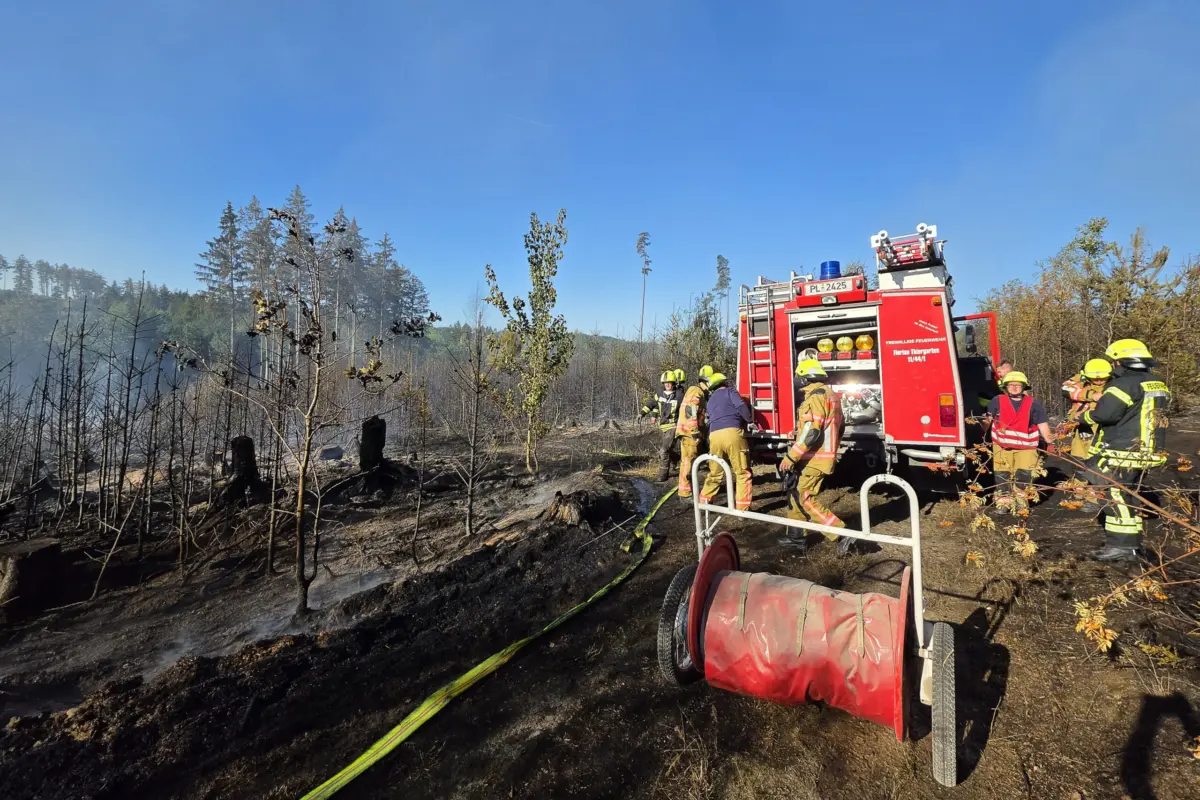
BERLIN/HÜRTGENWALD — More than 2,000 residents in western Germany were forced to flee their homes in the early hours of Friday as a fierce and fast-moving wildfire, fueled by tinder-dry conditions, surged dangerously close to the Belgian border. The blaze, which has already consumed approximately 300 hectares (740 acres) of dense forest in the state of North Rhine-Westphalia, triggered a massive emergency response involving hundreds of firefighters, heavy military equipment, and local civil protection agencies.
Compounding the severity of the crisis, emergency personnel are battling not only the walls of flame but also the hidden hazard of unexploded World War II ordnance buried within the forested terrain, complicating tactical maneuvers and threatening nearby infrastructure, including a former munitions depot.
Main Facts
The unfolding disaster in western Germany underscores the escalating vulnerability of Central European ecosystems to extreme weather patterns and prolonged dry spells.
- The Scale of Displacement: Over 2,000 residents from the village of Gey and surrounding vulnerable zones were ordered to evacuate their residences beginning at approximately 4:00 a.m. local time (0200 GMT) on Friday.
- Geographical Impact: The wildfire has scorched an estimated 300 hectares (740 acres) of forested terrain near the Belgian border in the Huertgenwald region of North Rhine-Westphalia.
- Proximity to Danger: At the height of the crisis, active fronts of the blaze advanced to within 300 meters (1,000 feet) of populated residential areas in Gey.
- Secondary Hazards: Firefighting efforts have been critically impeded by the presence of legacy World War II unexploded ordnance (UXO) scattered across the hilly terrain, with occasional detonations reported as the heat triggers old munitions. Furthermore, an out-of-control fire front advanced dangerously close to a former munitions depot in the nearby town of Düren.
- Resource Deployment: Emergency services have deployed hundreds of personnel, supported by two specialized German army tanks tasked with carving out firebreaks and clearing impassable forest access routes.
- Broad Context: The disaster unfolds against a backdrop of severe drought conditions across vast swathes of Germany, where authorities have maintained elevated forest fire risk warnings throughout the summer season.
Chronology of the Crisis
The trajectory of the disaster reveals a rapid escalation overnight, catching communities off guard as shifting winds drove the flames toward populated areas.
Thursday Afternoon and Evening: The Ignition
While exact meteorological triggers remain under investigation by local authorities, the fire is believed to have started in a heavily wooded, hilly sector near the Belgian border. Pushed by persistent regional winds and feeding on dry underbrush—the result of weeks of minimal precipitation and high ambient temperatures—the fire quickly established a firm foothold in the dense canopy. By late afternoon, emergency services detected multiple active fronts, but rugged topography and thick vegetation made initial containment difficult for ground crews.
Friday, 2:00 AM – 4:00 AM: The Overnight Surge
As night fell, the fire intensified instead of abating, taking advantage of dry air and shifting thermal updrafts. One major front surged relentlessly toward the village of Gey. Realizing the imminent danger to human life, local emergency management teams made the swift decision to order a mandatory evacuation.
At approximately 4:00 a.m., sirens and emergency alerts echoed through Gey. Residents were instructed to evacuate immediately, leaving behind non-essential possessions and carrying only vital identification papers, necessary medications, and essential personal belongings. Displaced citizens were directed toward a specially established emergency assistance center organized within a primary school in a nearby, secure village.
Friday Morning: Critical Proximity and Military Intervention
By dawn, the situation had reached a critical threshold. According to regional public broadcaster WDR, Mayor Stephan Cranen confirmed that while the evacuation of Gey was successfully completed, the firefront had closed to within 300 meters of the village perimeter.
Simultaneously, a separate, out-of-control sector of the fire pushed aggressively overnight toward a former military munitions depot located in the nearby town of Düren. Recognizing that conventional fire trucks could not penetrate the dense, difficult-to-reach forest terrain, authorities called in the Bundeswehr. Two heavy German army tanks were deployed to the front lines, utilizing their heavy tracks and protective plating to crush underbrush, clear access routes, and carve out critical firebreaks to halt the advance of the flames.
Supporting Data and Environmental Context
The current wildfire in North Rhine-Westphalia is not an isolated incident, but rather part of a broader, systemic environmental challenge facing Germany and Central Europe as a whole.
Meteorological Vulnerability
Large swathes of Germany have been grappling with prolonged dry spells characterized by exceptionally low soil moisture levels and high temperatures. These conditions transform forested areas into tinderboxes. The Huertgenwald region—historically known for its dense woodlands and rugged, undulating topography—presents a uniquely challenging landscape for firefighting. The hilly terrain restricts the rapid deployment of heavy water-tenders, forcing firefighters to rely heavily on hoses, backpack pumps, and aerial support where available.
The Legacy of War: Unexploded Ordnance
One of the most perilous dimensions of the North Rhine-Westphalia wildfire is the presence of historical contamination. The Huertgenwald was the site of the infamous Battle of Hürtgen Forest during World War II, one of the longest and bloodiest battles fought by the U.S. Army against German forces.
Because of the dense, difficult-to-navigate terrain, complete clearance of unexploded artillery shells, grenades, and mortar rounds has never been fully achieved in the decades since 1945. As the wildfire swept through the forest floor on Friday, the extreme heat triggered several subterranean and surface-level detonations. These unexpected explosions forced firefighters to temporarily pull back from certain sectors, creating a hazardous environment where combatting the blaze ran parallel to dodging explosive remnants of war.
Official Responses and Public Statements
As the crisis unfolded, regional and local leaders took to public platforms and press briefings to convey the gravity of the situation, urge public compliance, and outline ongoing recovery and containment measures.
Mona Neubaur, Deputy Premier of the state of North Rhine-Westphalia, took to social media platform X (formerly Twitter) to address the unfolding catastrophe. Emphasizing the severity of the threat, Neubaur posted: "This forest fire threatens to hit the local community hard." Her statement reflected the anxiety felt by regional government officials as they monitored the rapid expansion of the fire fronts.
Local leadership also stepped forward to coordinate emergency relief. Mayor Stephan Cranen provided vital updates to regional broadcaster WDR, emphasizing that while the swift coordination of local police, civil defense volunteers, and firefighters ensured that all residents of Gey were successfully evacuated without reported casualties, the operational landscape remained perilous. Cranen highlighted the specific danger posed by the proximity of the flames to the municipal borders and the race to secure the perimeter around the Düren munitions depot.
Operational commanders on the ground noted that the integration of Bundeswehr tanks marked a turning point in the tactical response. By cutting through impenetrable forest corridors, the military hardware allowed municipal firefighters to establish defensive lines that ultimately prevented the fire from breaching the village limits of Gey.
Implications and Future Outlook
The emergency in western Germany carries profound implications for civil protection, climate adaptation, and municipal planning across Central Europe.
The Changing Face of European Wildfires
Historically, catastrophic wildfires have been viewed primarily as a seasonal hazard native to Southern European nations such as Greece, Spain, and Portugal. However, consecutive years of anomalous heatwaves and changing precipitation cycles are shifting the geographical boundaries of high wildfire risk northward. Germany’s forestry and civil protection agencies are now forced to re-evaluate their preparedness models, acknowledging that dense Central European woodlands are increasingly susceptible to high-intensity fires.
Legacy Hazards in the Climate Era
The interaction between modern climate-driven wildfires and historical industrial or military hazards—such as the unexploded ordnance in Huertgenwald—introduces a dangerous new paradigm for emergency responders. Environmental scientists and military historians warn that as climate change dries out soils and increases the frequency of forest fires, buried munitions across Europe pose a latent threat to both firefighters and civilian populations. Moving forward, disaster management protocols in former conflict zones will likely require closer coordination between environmental fire services, explosive ordnance disposal (EOD) units, and military engineers.
Rebuilding and Recovery
As of late Friday, firefighting units remained stationed throughout the Huertgenwald region, engaged in painstaking mop-up operations to extinguish lingering hot spots and prevent flare-ups driven by afternoon winds. While municipal authorities have expressed cautious optimism that the worst of the immediate threat to Gey has passed, residents have been warned that it remains unsafe to return to their homes until structural integrity checks, air quality assessments, and ordnance sweeps are fully completed.
The events in western Germany serve as a stark reminder of the compounding pressures of environmental degradation and historical legacies, testing the resilience of local communities and emergency infrastructure in an era of unprecedented climate challenges.
