

By Anthony Capkun
Published: August 11, 2026
Main Facts
In a milestone development for Maryland aviation, High Flying Hangars has officially broken ground on a major 11.45-acre aviation infrastructure project at the Frederick Municipal Airport (FDK). This venture marks the first new hangar construction at the facility in more than two decades, addressing a critical, long-standing deficit in regional aircraft storage capacity.
Strategically situated at the midfield section of the airport layout, the multi-phase construction project will introduce modern, heavy-duty all-steel hangars designed to accommodate the rising demand from general and business aviation operators. Phase 1 of the development will immediately deliver 44 state-of-the-art steel hangars, while Phase 2 will add approximately 34 additional units, bringing the total footprint to nearly 80 modern aircraft housing facilities.
The project addresses a pressing bottleneck in the northern Washington, D.C., metropolitan market. As corporate flight departments, charter operators, and private aircraft owners increasingly look to bypass the congestion of major commercial hubs, FDK has emerged as a premier regional access point. The introduction of these advanced hangars is poised to dramatically alter the operational landscape of the airport, providing vital infrastructure to support economic vitality, technological modernization, and long-term aviation growth in Frederick County and beyond.
Chronology of Development
The journey toward the August 2026 groundbreaking ceremony has been years in the making, reflecting the complex regulatory, environmental, and logistical hurdles inherent in modern airport master-plan expansions.
Early Planning and Needs Assessment (2020–2023)
For over twenty years, Frederick Municipal Airport operated with a constrained footprint regarding aircraft storage. While demand for hangar space steadily climbed—driven by the broader migration of general aviation traffic away from saturated airspace near Washington, D.C., and Baltimore—available space remained virtually static. Local stakeholders, airport management, and municipal leaders recognized that without new infrastructure, FDK would miss out on vital economic development opportunities. Initial exploratory talks between the City of Frederick and private developers began in earnest, focusing on identifying underutilized midfield land parcels capable of supporting high-density hangar complexes without disrupting active taxiways or runways.
Partnership and Design Phase (2024–2025)
High Flying Hangars emerged as the primary development partner, committing to a multi-million-dollar capital injection to revitalize the airport’s infrastructure. During this phase, engineering teams, architects, and environmental consultants worked closely with the Federal Aviation Administration (FAA) and local zoning boards. The design phase prioritized structural resilience, wind and weather resistance, and optimal aircraft maneuverability. The decision to utilize all-steel construction was finalized to ensure maximum longevity, low maintenance costs, and superior protection against severe weather events common to the Mid-Atlantic region.
Groundbreaking and Construction Kickoff (August 2026)
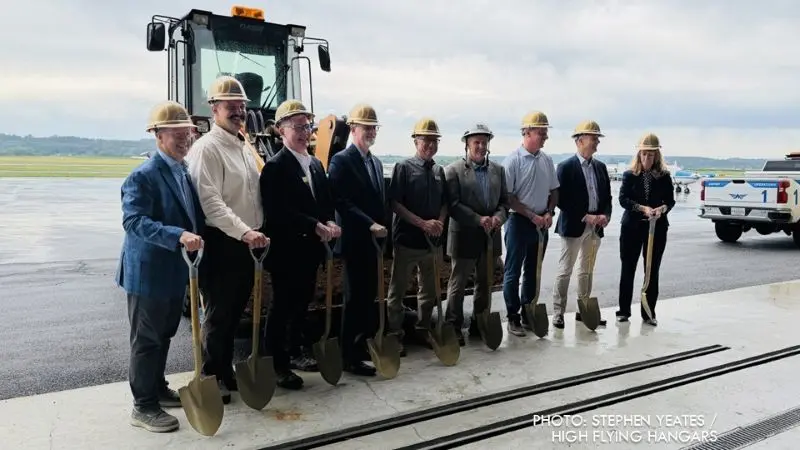
The official groundbreaking ceremony took place on August 11, 2026, drawing a large contingent of local dignitaries, aviation advocates, and corporate leadership. Key figures in attendance included FDK Airport Manager Andrew Moore, High Flying Hangars CEO Kenny Hinkes, Frederick Mayor Michael O’Connor, and various municipal and corporate partners. With shovels in hand, project leaders commemorated the dawn of a new era for the airfield, immediately pivoting construction crews toward site preparation, utility integration, and foundation laying for Phase 1.
Supporting Data and Project Specifications
The scope of the High Flying Hangars development underscores its magnitude as a premier infrastructure investment for the region. Below are the key metrics and structural specifications defining the project:
- Total Project Acreage: 11.45 acres of prime midfield real estate at Frederick Municipal Airport (FDK).
- Total Hangar Units: Approximately 78 all-steel hangars upon full buildout.
- Phase 1 Development: 44 heavy-duty, all-steel hangars designed to meet immediate market demand.
- Phase 2 Development: Approximately 34 all-steel hangars scheduled for subsequent construction.
- Construction Material: 100% heavy-gauge steel framing and paneling, ensuring high wind load tolerances, fire resistance, and minimal structural degradation over decades of use.
- Geographic Market Reach: Frederick County, the broader Maryland biotechnology and technology corridors, and the northern Washington, D.C., metropolitan business aviation sector.
- Timeline Context: The first new hangar construction initiative at FDK in over 20 years.
The choice of all-steel construction is particularly noteworthy in contemporary airport development. Steel structures offer expansive clear-span interiors devoid of internal load-bearing columns, allowing for maximum flexibility in aircraft positioning. Furthermore, modern insulated metal panels provide superior thermal regulation, reducing heating and cooling costs for tenants who utilize their hangars as active maintenance workshops or executive briefing rooms.
Official Responses and Stakeholder Perspectives
The groundbreaking ceremony served as a platform for civic and corporate leaders to emphasize the profound economic and operational implications of the project.
Andrew Moore, Manager of Frederick Municipal Airport, highlighted the strategic importance of the development during his opening remarks.
"This project represents a significant investment into the growth story of the Frederick Municipal Airport as the preferred access point to the region," Moore stated. He further elaborated on how the airport functions as a vital economic engine, noting that modern facilities are essential to retaining high-net-worth aviation tenants and corporate flight departments that contribute substantially to the local tax base.
Echoing this sentiment, Kenny Hinkes, Chief Executive Officer of High Flying Hangars, pointed to the collaborative effort required to bring the vision to life.
"These hangars are another step in ensuring that the airport continues to serve the needs of a vibrant and expanding community," Hinkes said. He emphasized that his company designed the hangars with an eye toward future aviation trends, including the increasing wingspans of modern turboprops and light jets.
Local civic leaders, including Frederick Mayor Michael O’Connor and regional economic development directors—represented at the ceremony by community stakeholders such as Richard Griffin, Andrew Moore, Peter Bremh, Kenny Hinkes, Randy Sibold, Joe Roetering, Norm Long, and Jodie Bollinger—hailed the project as a textbook example of successful public-private partnership. By leveraging private capital to upgrade municipal aviation assets, the city minimizes taxpayer risk while maximizing the economic potential of the airfield.
Broader Implications for Regional Aviation and Economy
The completion of the High Flying Hangars development at Frederick Municipal Airport carries far-reaching implications that extend well beyond the airfield perimeter.
Alleviating the Greater D.C. Airspace Squeeze
The Washington, D.C., and Baltimore metropolitan areas suffer from a chronic shortage of affordable, high-quality general and business aviation infrastructure. Major commercial hubs like Dulles International (IAD) and Baltimore/Washington International (BWI) prioritize commercial airline traffic, often pricing out or restricting access for smaller corporate and private aircraft. Reliever airports like FDK play an indispensable role in absorbing this overflow. By providing nearly 80 brand-new, modern hangars, FDK positions itself as a top-tier destination for corporate aviation assets, tech entrepreneurs, and regional commuters who rely on private flight for business agility.
Catalyst for Local Economic Development
Aviation infrastructure is a proven multiplier for regional economic growth. Companies looking to relocate or expand their headquarters frequently evaluate the proximity of robust corporate aviation facilities. The availability of secure, premium hangar space at FDK makes Frederick County an increasingly attractive proposition for aerospace firms, defense contractors, biotech companies, and executive leadership teams. Furthermore, the construction phase itself stimulates local employment, engaging regional contractors, steel suppliers, electrical engineers, and heavy equipment operators.
Future-Proofing FDK
For two decades, the stagnation of hangar construction threatened to cap FDK’s growth potential. Aircraft owners forced onto long waiting lists often looked to neighboring counties or states to house their investments, taking local tax dollars and fuel sales with them. This development fundamentally reverses that trend. By modernizing its real estate offerings, FDK secures its financial sustainability, ensuring that lease revenues can be continually reinvested into runway maintenance, lighting upgrades, and safety enhancements.
As construction crews push forward with Phase 1, the aviation community watches with high anticipation. The High Flying Hangars project is not merely a collection of steel buildings; it is a vital foundation for the future of flight in central Maryland—signaling that Frederick Municipal Airport is open, equipped, and ready to soar into the decades ahead.
