

By Anthony Capkun
Published: October 1, 2026
The metal construction and engineering sectors are undergoing a period of rapid technological maturation, regulatory tightening, and logistical transformation. Addressing these shifting tides head-on, Metal Construction News (MCN) has officially released its comprehensive October 2026 edition.
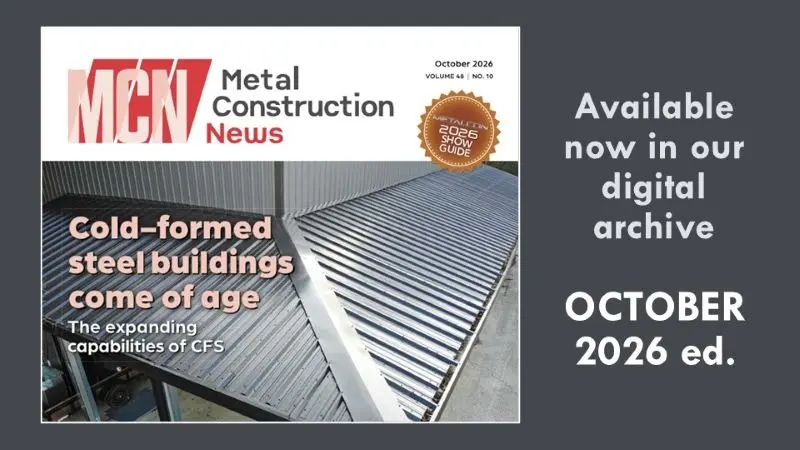
Available both in print and through the publication’s expansive digital archives, this month’s issue offers deep-dive features tailored to contractors, architects, engineers, and facility managers. From the evolution of cold-formed steel (CFS) framing to the complex logistical hurdles of multisite labor tracking and the urgent demand for hurricane-resilient building envelopes, the October 2026 publication serves as an essential manual for the modern construction professional.
Main Facts: What’s Inside the October 2026 Issue
The October edition arrives at a critical juncture for the industry, coinciding with the rollout of the highly anticipated METALCON 2026 trade show and conference. MCN’s editorial team has curated a balanced mix of technical deep-dives, operational management strategies, and regulatory updates.
Key editorial focal points in the October 2026 issue include:
- The Evolution of Cold-Formed Steel (CFS): How modern engineering, parametric modeling, and prefabrication capabilities are pushing CFS buildings into entirely new vertical and horizontal markets.
- The METALCON 2026 Comprehensive Show Guide: A complete roadmap to the year’s premier metal construction event, detailing floor plans, major exhibitors, hands-on workshops, masterclasses, and specialized educational tracks.
- Thermal Dynamics and Roof Failures: A technical examination proving that ice damming in massive metal distribution centers is not merely a water-infiltration annoyance, but a catastrophic thermal envelope failure.
- The Labor Tracking Crisis: An operational look at how multisite contracting, inaccurate time-mapping, and transit-hour tracking distort project bidding and threaten contractor profit margins.
- Next-Generation Safety Equipment: Evaluating the widening chasm between bare-minimum OSHA compliance and genuinely advanced ergonomic and protective gear in 2026.
- Coastal Resilience and Fenestration: Why architects designing along the hurricane-prone Atlantic and Gulf corridors must prioritize AMCA 550-certified louvers to prevent catastrophic interior water intrusion.
Chronology of Industry Shifts Leading to the October 2026 Release
To understand the weight of the topics covered in this month’s MCN issue, one must examine the chronological progression of challenges that have shaped the metal construction landscape over the past several years:
- 2023–2024 (The Post-Pandemic Supply Chain Adaptation): The industry grappled with volatile material costs and unprecedented labor shortages. Contractors increasingly turned to pre-engineered metal buildings (PEMBs) and cold-formed steel to reduce on-site labor requirements and shorten construction schedules.
- 2025 (The Regulatory and Climate Pivot): Extreme weather events increased in frequency along North American coastlines, prompting building code authorities to re-evaluate wind-driven rain and wind-borne debris standards. Simultaneously, energy codes grew stricter regarding thermal bridging in large industrial warehouses.
- Early 2026 (The Rise of Multi-Location Logistics & Advanced PPE): As construction firms scaled operations across regional boundaries, administrative bottlenecks in labor tracking began eroding project profitability. Concurrently, worker safety standards evolved rapidly, moving past legacy compliance toward active, tech-integrated personal protective equipment (PPE).
- October 2026 (Consolidation and Showcase): MCN’s October release consolidates these operational, climatic, and structural breakthroughs just as the industry gathers for METALCON 2026, offering stakeholders a definitive blueprint for the remainder of the decade.
Supporting Data and Technical Analysis
The articles featured in the October 2026 issue are grounded in hard data, shifting industry standards, and structural realities.
1. Cold-Formed Steel (CFS) Comes of Age
For decades, structural steel held a near-monopoly on mid-rise framing, while light-gauge steel was largely relegated to non-load-bearing interior partitions. According to MCN’s lead feature, software advancements in computer-aided engineering (CAE) and Building Information Modeling (BIM) have radically altered this dynamic. Cold-formed steel can now support higher dead-and-live load ratios, span greater distances, and integrate seamlessly with prefabricated panelization systems. This evolution has expanded CFS applications into multi-family residential complexes, healthcare facilities, and low-rise commercial structures previously dominated by traditional framing methods.
2. The Thermal Reality of Ice Damming
Maintenance departments at large-scale distribution centers frequently treat winter ice damming as a localized roofing leak or a minor nuisance to be cleared with heat cables. The October issue challenges this outdated perception, framing ice damming as a primary thermal envelope failure. When continuous insulation (ci) is compromised or attic/roof plenum ventilation is mismanaged, heat escapes through the roof deck, melting lower snow layers that subsequently refreeze at the eaves. For large distribution footprints—often exceeding hundreds of thousands of square feet—these thermal leaks degrade insulation integrity, accelerate corrosion, and compromise structural fasteners.
3. Multisite Labor Leakage
Labor remains the single most volatile line item on any contractor’s balance sheet. MCN’s analysis of multisite work uncovers a pervasive financial drain: untracked transit time and misallocated project hours. When field crews bounce between multiple job sites within a single week, manual timesheets routinely fail to accurately record travel hours, equipment staging time, and cross-project administrative tasks. According to construction management metrics highlighted in the issue, even a 3% discrepancy in labor tracking across regional portfolios can wipe out a contractor’s net profit margin during competitive bidding cycles.
4. Coastal Vulnerability and AMCA 550 Certification
With extreme weather events costing billions annually, building envelope protection has taken center stage. Traditional louvers designed solely for air intake and exhaust often fail during severe coastal storms when hurricane-force winds drive torrential rain horizontally. The MCN feature on coastal architecture emphasizes the critical role of AMCA 550-certified louvers (Air Movement and Control Association). Unlike standard models, AMCA 550-tested louvers are engineered to prevent water penetration under high-velocity wind conditions, protecting mission-critical internal electrical and HVAC infrastructure from catastrophic water damage.
Official Industry Responses and Expert Perspectives
Industry leaders, associations, and event organizers have welcomed the timely insights provided in the October 2026 edition, particularly in light of ongoing technological adoptions.
"The convergence of advanced engineering software and automated cold-formed steel manufacturing has completely rewritten what is possible in low- and mid-rise construction," noted an industry structural engineer speaking on the October release. "We are no longer just building faster; we are building smarter, lighter, and with vastly superior thermal efficiency."
Regarding the operational challenges highlighted in the labor and safety features, regional project managers have echoed MCN’s findings.
"In 2026, managing a workforce across state lines or multiple metro areas requires more than spreadsheets," shared a senior operations director at a national metal contracting firm. "If your time-tracking systems cannot distinguish between active installation, pre-fabrication shop work, and transit delays, your next project bid is essentially a guessing game. MCN has done a phenomenal job spotlighting these invisible profit killers."
Furthermore, building envelope consultants have praised the publication’s focus on AMCA 550 compliance. As municipal building departments along the Gulf and Atlantic seaboards adopt more stringent hurricane mitigation codes, architects desperately require clear, reliable guidance on fenestration standards that protect against wind-driven deluges.
Implications for the Future of Metal Construction
The release of Metal Construction News’ October 2026 issue is more than a monthly periodical drop; it is an indicator of where the built environment is heading over the next five to ten years.
- Heightened Demand for Digital Integration: The labor-tracking dilemmas outlined in the issue suggest that the metal construction sector must rapidly accelerate its adoption of geofenced mobile time-tracking, automated ERP integrations, and real-time fleet management. Contractors who cling to legacy administrative methods risk being outbid by leaner, tech-forward competitors.
- Stricter Climate-Driven Building Codes: As weather anomalies become the new baseline, the discussion surrounding ice damming as a thermal failure and the necessity of AMCA 550 louvers points toward an era of uncompromising performance standards. Building codes will likely mandate continuous thermal scanning and rigorous envelope testing during post-construction commissioning.
- The Expansion of Offsite Prefabrication: The maturation of cold-formed steel highlights a broader industrial trend: the migration of construction labor from the unpredictable job site to the controlled, highly efficient environment of the pre-fabrication plant.
- The METALCON Catalyst: By pairing these critical insights with the METALCON 2026 Show Guide, MCN provides industry professionals with an actionable platform to inspect these technologies firsthand, network with innovators, and implement systemic changes within their respective organizations.
Accessing the October 2026 Edition
Industry professionals, researchers, and stakeholders wishing to read the features in full can access the complete October 2026 edition online via the Metal Construction News Digital Editions Archive.
Metal Construction News extends its gratitude to the industry contributors, technical experts, and advertising partners whose insights made this landmark issue possible. As the metal construction sector continues to evolve, publications like MCN remain vital navigational beacons for building a safer, more efficient, and structurally resilient future.
