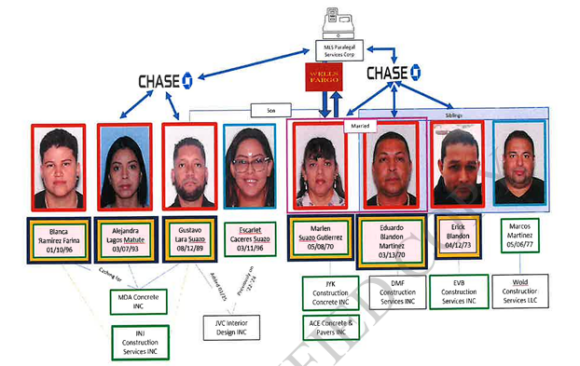
TALLAHASSEE, Fla. — Following an exhaustive, years-long multi-agency investigation spanning Palm Beach and Broward counties, Florida law enforcement and regulatory authorities have dismantled a sprawling criminal enterprise. Seven individuals have been formally charged in connection with an intricate $100 million workers’ compensation payroll fraud scheme.
The operation allegedly relied on shell companies, vastly underreported payrolls, illicit insurance certificate rentals, and an underground, unlicensed money-service business that distributed cash directly to workers to evade regulatory oversight and insurance premiums.
The takedown highlights the severe vulnerabilities within the state’s construction and labor markets, where illicit actors can artificially undercut legitimate, law-abiding contractors. Authorities have already seized more than $2.4 million in illicitly obtained assets and cash, while pushing for the forfeiture of nearly $3 million more.
Main Facts of the Case
The criminal ring operated with high organizational precision, utilizing a network of front companies to siphon millions of dollars away from legitimate insurers and the state’s workers’ compensation system.
According to court filings in Palm Beach and Broward counties, the defendants orchestrated the scheme through several key mechanics:
Shell Company Creation: The conspirators established a series of dummy corporations, including entities identified in court documents as JYK Construction Concrete, Ace Concrete and Pavers, DMF Construction Services, and EVB Construction Services.
Underreported Payrolls: These shell companies secured minimal workers’ compensation insurance coverage by submitting drastically falsified payroll figures to insurance carriers.
Certificate "Renting": Once the minimal insurance policies were active, the defendants "rented" their certificates of insurance to various subcontractors for a hefty fee. This allowed uninsured subcontractors to bid on and work on construction projects while appearing legally compliant on paper.
Unlicensed Money-Service Operations: To complete the cycle, the network processed and cashed payroll checks for the contractors through an underground financial operation based out of an office in West Palm Beach. Workers were paid entirely in cash, effectively hiding the true volume of labor and wages from state and federal tax authorities, auditors, and insurers.
Targeted Insurers: A comprehensive complaint filed in the Palm Beach County Circuit Court reveals that a broad spectrum of insurance carriers fell victim to the underreported payrolls. The affected insurers include Pie Insurance, Obsidian Specialty, Kemper Auto Insurance, James River Insurance, ICW Group, Allstate Insurance, MidSouth Mutual Insurance, Kinsale Insurance, Accredited Surety and Casualty, and Gemini Insurance Co.
The suspects face a severe array of state charges, including operating an unlicensed money service business, organizing a scheme to defraud, workers’ compensation fraud, and money laundering.
Chronology of the Investigation
The unraveling of the $100 million enterprise was not an overnight success; it was the product of a patient, meticulous two-year surveillance operation conducted by state, county, and local law enforcement teams.
The Groundwork and Surveillance
For nearly 24 months, investigators tracked the movements, financial transactions, and communications of the key players. Financial records, bank accounts, and physical surveillance painted a clear picture of a well-coordinated operation. Investigators observed the suspects operating out of a central hub in West Palm Beach, where payroll checks were routinely processed and converted into physical cash for distribution to workers in the field.
The Legal Counter-Offensive (March)
As the investigation reached its climax earlier this year, the Broward County Sheriff’s Office took aggressive financial action. In March, the agency petitioned the court to force the defendants to forfeit nearly $3 million in cash and assets believed to be directly tied to the proceeds of the enterprise. This 208-page forfeiture complaint laid out the mechanics of the money-service business cycle in granular detail, exposing how funds were funneled through the network.
Indictments and Pleas
Following the asset seizure petitions, state prosecutors formally brought charges against the seven suspects. Legal proceedings in South Florida courts quickly followed. According to local reports from the South Florida Sun Sentinel, individuals such as Gutierrez—who allegedly oversaw several of the shell companies—and Gustavo Suazo—who managed others—were named alongside co-defendants Matute, Blandon, and Farina.
To date, Gutierrez, Suazo, Matute, Blandon, and Farina have formally entered pleas of not guilty. Legal representation for the defendants has begun pushing back against the state’s narrative; notably, an attorney representing Suazo has denied his client’s involvement in any illicit activities, arguing in court filings that the state has failed to state a legally sufficient claim for the forfeiture of his assets.
Beyond the primary criminal indictments, court records indicate that Gutierrez’s legal troubles extend into civil court. A separate fraudulent misrepresentation civil complaint was filed in Broward County by a local flooring company owner, who alleged that one of Gutierrez’s companies slapped him with a lawsuit for construction work that was never actually contracted or performed.
Supporting Data and Financial Footprint
The sheer scale of the fraud places it among the largest workers’ compensation schemes uncovered in recent Florida history.
$100 Million in Illicit Movement: According to state officials, the underground money-service operation moved nearly $100 million through its financial pipeline, acting as an informal bank for the construction and concrete subcontracting sector in South Florida.
$2.4 Million Seized: Law enforcement agencies have successfully seized more than $2.4 million in cash and property directly connected to the criminal enterprise.
$3 Million Forfeiture Target: The Broward County Sheriff’s Office’s sweeping 208-page forfeiture petition aims to strip the defendants of an additional $3 million in accumulated wealth and assets.
Multiple Victims: At least ten major insurance companies were exposed to high, uncompensated risk due to the fraudulent understatement of payrolls by the network’s shell entities.
Official Responses and Public Statements
The bust drew strong reactions from top Florida law enforcement and legal officials, who emphasized the corrosive effect such fraud has on the broader economy and public safety.
Florida Attorney General James Uthmeier issued a stern rebuke of the defendants’ actions in a public statement released following the announcement of the charges:
"This criminal enterprise systematically exploited Florida’s workers’ compensation system for personal gain," Uthmeier said. "They undercut legitimate contractors, defrauded insurance companies, and operated an illegal money-service operation that moved nearly $100 million."
Investigators and prosecutors underscored that insurance fraud is not a victimless crime. By bypassing the mandatory costs of workers’ compensation insurance and avoiding proper tax withholding, the defendants were able to drastically underbid ethical contractors who followed the letter of the law. This dynamic creates an uneven playing field that threatens honest businesses while jeopardizing the financial security of workers who are left without proper coverage in the event of an on-the-job injury.
Broader Implications for the Insurance and Construction Industries
The prosecution of this $100 million scheme sends shockwaves through Florida’s booming construction and insurance markets, highlighting several systemic issues that regulators and industry leaders continue to battle:
1. Market Distortion and Unfair Competition
Legitimate contractors operating in Florida face steep overhead costs, primary among them being statutory workers’ compensation insurance premiums. When illicit networks "rent" out insurance certificates using shell companies with falsified payrolls, they allow underground subcontractors to underbid law-abiding companies by 15% to 30%. This forces honest businesses to either lose out on vital contracts or compromise their own operational integrity to compete.
2. Vulnerabilities in the Certificate Verification Process
The scheme exposes structural loopholes in how general contractors and project owners verify the authenticity of subcontractor insurance coverage. By obtaining legitimate, albeit heavily underreported, baseline policies, the fraudsters manufactured superficial credibility that allowed them to pass initial compliance checks before subverting the system through cash-based labor pools.
3. The Rise of Underground Financial Networks
The integration of workers’ compensation fraud with an unlicensed money-service business underscores a sophisticated evolution in white-collar crime. By bypassing traditional banking channels to pay workers entirely in cash, criminal networks successfully evade the algorithmic flags typically raised by financial institutions regarding suspicious cash deposits and withdrawals. This dual-threat model—combining insurance fraud with shadow banking—provides a blueprint that task forces will likely watch for in future investigations.
4. Increased Scrutiny on Insurers and Subcontractors
In the wake of this high-profile case, insurance carriers writing policies in Florida are expected to tighten their auditing procedures. Underwriters will likely increase scrutiny on accounts showing sudden, massive discrepancies between reported payroll and the scale of the contractor’s physical operations. Similarly, general contractors may face heavier compliance burdens when vetting lower-tier subcontractors to ensure certificates of insurance reflect true operational payrolls.
As the criminal cases against Gutierrez, Suazo, and their co-defendants proceed through the Palm Beach and Broward county courts, state prosecutors plan to press forward with their forfeiture claims to permanently strip the network of its ill-gotten gains.