By Karina Adams | Metal Construction News Published: September 2026
Main Facts: The Intersection of Speed and Structural Integrity in Modern Metal Construction
The metal construction industry has long faced a persistent operational dilemma: how to accelerate project delivery and enhance customer responsiveness without compromising structural integrity, material quality, or long-standing brand reputation. For decades, traditional manufacturing and fabrication workflows have relied on meticulous, time-consuming processes that, while reliable, often struggled to meet the increasingly compressed timelines demanded by modern commercial and industrial clients.
Enter FastForm™, an innovative offering from Schulte Building Systems (SBS) designed to bridge the gap between rapid deployment and uncompromised quality. Formally highlighted in a prominent industry webinar series hosted by Metal Construction News—originally recorded on September 10, 2026—FastForm™ represents a paradigm shift in how contractors and builders approach custom metal building solutions.
At its core, FastForm™ is engineered to provide a faster, more flexible methodology for serving customers. Industry professionals attending the webinar were introduced to the core mechanics of the system, which leverages advanced digital integration, streamlined fabrication pipelines, and optimized component design. Crucially, the system achieves these efficiencies without sacrificing the robust strength, high-grade materials, and engineering reliability that the SBS brand has built its reputation upon for years.
Chronology: The Evolution Toward Rapid-Deployment Systems in Metal Construction
To fully understand the significance of innovations like FastForm™, it is necessary to examine the chronological progression of efficiency measures within the metal construction sector over the past decade.
The Early 2010s: The Rise of Prefabrication Standardisation
Following the post-recession recovery, the metal construction industry heavily leaned into standardization. Prefabricated metal buildings (PEMBs) became the industry standard for industrial warehouses, distribution centers, and light commercial spaces. However, customization remained a bottleneck; altering standard profiles often introduced weeks of delays into project schedules.
The Mid-to-Late 2010s: Digital Modeling and BIM Integration
Building Information Modeling (BIM) revolutionized coordination. Contractors began utilizing 3D models to catch clashes early, particularly concerning complex structural interfaces like girts, purlins, and wall panels. While planning improved, fabrication turnaround times remained largely tethered to traditional shop-floor sequencing.
The COVID-19 Pandemic and Supply Chain Disruptions (2020–2022)
Global supply chain volatility exposed the fragility of traditional manufacturing pipelines. Lead times for steel coils and fabricated components skyrocketed. The industry was forced to re-evaluate how fabrication plants scheduled production, prioritized orders, and sourced materials. Agility became a matter of survival.
The Post-Pandemic Push for Operational Velocity (2023–2025)
As market demand rebounded, labor shortages across the construction and manufacturing sectors intensified. Contractors demanded tools that required less field modification and faster installation times. Manufacturers began heavily investing in software-driven automation on the shop floor to reduce human error and accelerate throughput.
September 2026: The Introduction of FastForm™
Marking a major milestone in this evolutionary timeline, the September 10, 2026 webinar showcased FastForm™ as a direct response to ongoing industry pressures. By integrating customer-facing quoting and ordering software directly with automated manufacturing workflows, SBS positioned FastForm™ as a modern solution for contractors seeking speed, flexibility, and absolute structural reliability.
Supporting Data: Broader Trends Shaping the 2026 Metal Construction Landscape
The release and adoption of tools like FastForm™ do not happen in a vacuum. They are reflective of broader technological and operational trends sweeping through the metal construction industry in late 2026. According to recent industry reports and features highlighted across Metal Construction News, several key data points and innovations are driving the sector forward:
1. The Integration of Drones in Quality Control and Planning
As detailed in recent editorial coverage featuring industry experts like Julia Guerra of FlyGuys and Anthony Capkun of Metal Construction News, drone technology has transitioned from a novelty to an essential operational asset. Contractors are increasingly utilizing unmanned aerial systems (UAS) to:
Perform real-time topographic site assessments before steel erection begins.
Monitor structural progress and erection sequences from difficult-to-reach angles.
Conduct thermal imaging and envelope quality control checks on newly installed metal roofs and wall panels, significantly reducing liability and improving overall safety on sprawling construction sites.
2. Overcoming Complex Architectural and Structural Hurdles
Modern building designs are pushing the limits of what metal construction can achieve. Recent project showcases—such as the complex engineering feats highlighted in modern stadium and arena construction—reveal that today’s owners expect more than just functional space; they demand soaring, unobstructed views, multi-tier cantilevered roofs, and complex integrated media structures. This places immense pressure on structural framing components to perform under heavier, more dynamic loads.
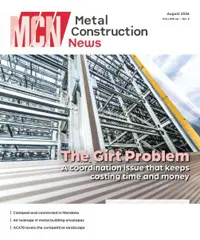
Furthermore, ongoing technical challenges continue to plague standard practices. For instance, the August 2026 issue of Metal Construction News spotlighted persistent industry challenges such as "The Girt Problem"—a notorious coordination hurdle between primary framing and secondary wall girts that frequently results in costly on-site modifications and schedule overruns. Innovations in software-driven manufacturing are increasingly tasked with eliminating these exact alignment errors before components ever leave the shop floor.
3. Energy Efficiency and Air Leakage Control
With stricter building energy codes coming into effect across North America throughout 2026, controlling air leakage in metal building envelopes has become a top priority. Manufacturers are pairing rapid-deployment structural systems with highly insulated, continuous-insulation (ci) wall panels and advanced thermal-break purlin tape to ensure that speed of construction does not compromise long-term thermal performance.
Official Responses and Industry Perspectives
The reception of new manufacturing methodologies like FastForm™ highlights a broader cultural shift within the metal construction sector. Industry leaders, engineers, and contractors are increasingly vocal about the necessity of balancing speed with uncompromising quality.
"In today’s fast-paced commercial market, clients are no longer willing to wait extended periods for custom structural solutions. However, pushing for speed has historically introduced risks related to quality control and engineering tolerances. The challenge has always been to innovate the manufacturing process without watering down the structural DNA of the building," notes a leading structural engineering consultant familiar with modern metal fabrication.
Schulte Building Systems has consistently emphasized that FastForm™ was developed with this exact philosophical balance in mind. By maintaining rigorous quality assurance protocols while streamlining the digital interface between the customer’s initial design requirements and the plant’s production floor, SBS aims to alleviate the stress points typically experienced by general contractors and metal building dealers.
Feedback from contractors participating in the September 2026 webinar series underscored an enthusiastic appetite for tools that reduce administrative and fabrication lag times. Many noted that reduced lead times directly translate to lower financing costs during the pre-construction phase and higher project turnover rates year-round.
Implications: What FastForm™ and 2026 Innovations Mean for the Future of Metal Construction
The introduction of systems like FastForm™ and the rapid adoption of digital tools (such as construction drones and advanced BIM coordination frameworks) carry profound implications for the future trajectory of the metal construction industry.
1. Redefining Client Expectations
As manufacturing automation and digital ordering platforms become more sophisticated, customer expectations will inevitably shift. "Fast turnaround" will transition from an elite selling point to an expected baseline requirement. Contractors who align themselves with suppliers that utilize streamlined, flexible systems will hold a distinct competitive advantage in securing lucrative commercial, industrial, and institutional bids.
2. Mitigating the Labor Shortage Crisis
With the construction industry facing a persistent shortage of skilled labor, efficiency must be engineered into the products themselves. Systems that reduce the need for complex on-site cutting, welding, and field modifications—while guaranteeing structural alignment—directly combat labor deficits. When components arrive pre-engineered for rapid assembly, crews can complete projects faster and with fewer personnel on site.
3. Sustainability Through Precision
Speed and efficiency are intrinsically linked to sustainability. Streamlined manufacturing processes generate less scrap material during fabrication. Furthermore, when digital modeling and rapid-form systems work in tandem to eliminate coordination errors (such as the aforementioned girt and framing misalignments), the amount of wasted steel and energy spent on remedial site work drops dramatically.
Conclusion
The metal construction industry of late 2026 is defined by an aggressive pursuit of smarter, safer, and more agile workflows. Through initiatives like the Metal Construction News webinar series and product evolutions such as Schulte Building Systems’ FastForm™, the industry is proving that rapid deployment and uncompromising structural integrity can coexist. As contractors continue to embrace these technological leaps—from aerial drone mapping to streamlined custom fabrication—the built environment will rise faster, stronger, and more efficiently than ever before.