

By Global Business and Technology Desk
Published: 2026
Main Facts
Amazon.com Inc. is aggressively scaling its ambitious drone delivery operation, Prime Air, with plans to introduce the service to cities across at least five additional US states over the coming months. This major push marks a decisive phase in turning what was once a futuristic, decade-old research-and-development concept into a reliable, mainstream commercial utility.
Under the newly announced expansion timeline, Prime Air drones are slated to begin fulfilling package deliveries by the end of the year. The initial wave of this rollout will originate from specialized fulfillment hubs in suburban Chicago and Atlanta, as well as the metropolitan areas of Cleveland and Syracuse, New York.
These new locations will augment Amazon’s existing airborne delivery footprint, which currently spans 11 US operations, including the Houston and Dallas metroplexes and suburban Phoenix. While an official company spokesperson has declined to specify the exact number of new launch sites that will be fully operational by the year’s end, Amazon leadership has confirmed a staggering broader projection: the drone service is ultimately slated to reach nearly 500 cities and towns across the United States. If realized, this footprint represents a sixfold expansion over the company’s current operational geography, putting aerial logistics on the doorstep of roughly 30 million Americans by the end of 2026.
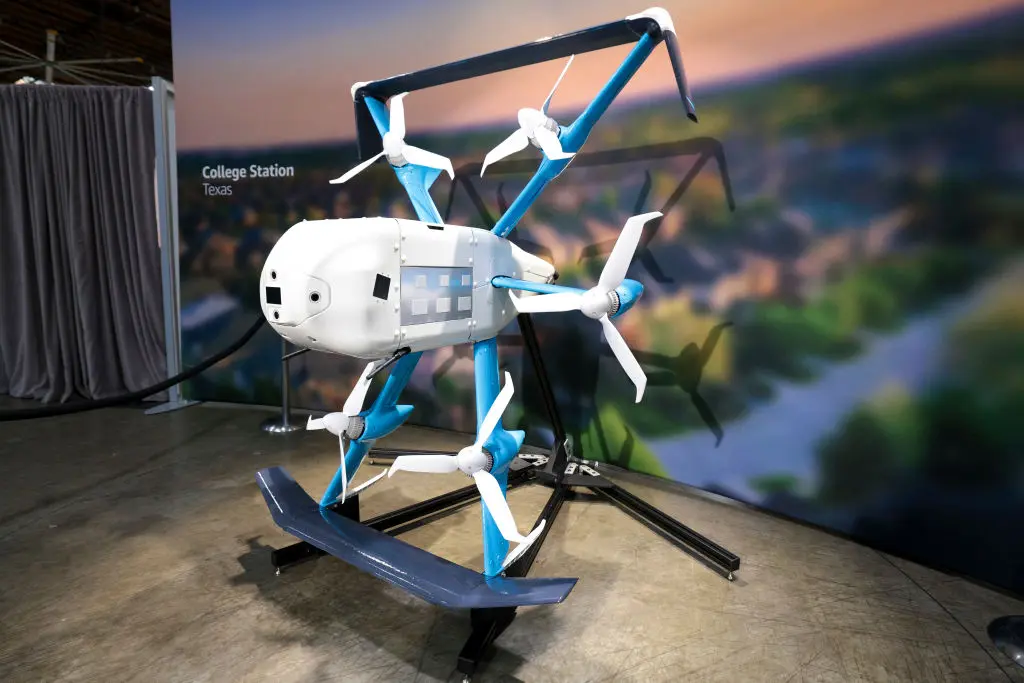
At the heart of this expansion is Amazon’s proprietary MK30 drone. Engineered entirely in-house, the MK30 is an advanced six-propeller aircraft capable of vertical takeoff and landing (VTOL)—operating much like a helicopter—with a flight range of approximately 7.5 miles. The aircraft has already logged hundreds of thousands of successful commercial deliveries this year alone. This surge represents an exponential acceleration from the comparative trickle of flights recorded during the project’s early experimental phases in California and Texas, many of which have since been shuttered.
From a consumer standpoint, the pricing structure for Prime Air remains designed to encourage high-volume ordering. Members of Amazon’s ubiquitous Prime subscription service pay a flat fee of $2.99 per drone delivery, which is entirely waived for qualifying orders totaling $50 or more. Non-Prime customers, meanwhile, can access the rapid aerial delivery service for a flat fee of $4.99.
Chronology of an Ambition: From 2013 Vision to 2026 Reality
The road to widespread commercial drone delivery has been long, fraught with technical setbacks, regulatory hurdles, and shifting market strategies.
The Genesis (2013)
The modern era of consumer drone delivery was effectively born in December 2013, when Amazon founder Jeff Bezos appeared on 60 Minutes to unveil Prime Air. In a sweeping television interview, Bezos predicted that autonomous aerial vehicles would be dropping packages onto customer doorsteps within four to five years. At the time, the announcement was widely viewed as a brilliant public relations stunt or science fiction, but it immediately triggered an arms race in retail logistics.
The R&D Decade and Safety Realities (2014–2023)
Throughout the subsequent decade, Amazon’s engineering teams churned through multiple generations of drone prototypes. However, the path to commercialization was far from smooth. The program suffered high-profile engineering setbacks, regulatory roadblocks with the Federal Aviation Administration (FAA), and a series of well-documented crashes during test flights.
Most notably, aerodynamic instability in adverse weather conditions—including a high-profile incident involving an aircraft crashing in the rain—forced temporary halts to testing and deep recalibration of flight safety parameters. Furthermore, engineers and urban planners alike quickly reckoned with the reality that strict safety regulations, noise pollution concerns, and congested airspace would severely limit airborne delivery. Consequently, Amazon pivoted away from dense urban centers, focusing its efforts primarily on sprawling suburban environments where risks to pedestrians and property are significantly minimized.
Scaling Up and the Modern Era (2024–2026)
By 2024, the technology had matured sufficiently to transition from perpetual beta testing to actual commercial deployment. The introduction of the MK30 aircraft proved to be a turning point, offering superior stability, quieter acoustics, and weather-resilient flight capabilities compared to its predecessors.
By mid-2025 and into 2026, Amazon and its primary retail rival, Walmart Inc., simultaneously signaled aggressive multi-market expansions. Amazon began retrofitting traditional suburban warehouses to accommodate specialized drone-launching gantries and maintenance bays. The current 2026 announcement to expand into five new states and nearly 500 municipalities cements this era not as a technological experiment, but as an entrenched operational reality.
Supporting Data and Market Dynamics
Amazon’s aggressive push into the skies does not happen in a vacuum. It is part of a broader, hyper-competitive race to redefine the final mile of logistics, pitting retail titans against one another in suburban and rural airspace.
+--------------------------------------------------------------------------+
|                  US Retail Drone Delivery Footprint (2026)               |
+--------------------+----------------------------+------------------------+
| Company            | Primary Partner / Vehicle  | Projected Reach        |
+--------------------+----------------------------+------------------------+
| Amazon             | In-house (MK30 Drone)      | ~30M people (by 2026)  |
| Walmart            | Wing (Alphabet), DroneUp   | ~1 in 10 US residents  |
| Wing (Alphabet)    | Standalone Logistics       | >40M people (by 2027)  |
+--------------------+----------------------------+------------------------+
The Competitive Landscape: Amazon vs. Walmart and Wing
While Amazon relies exclusively on its custom-built MK30 aircraft and deploys directly from its own suburban fulfillment centers, its chief rival, Walmart Inc., has taken a collaborative approach. Walmart has partnered with established drone operators—including Alphabet Inc.’s Wing and logistics firm DroneUp—to launch aerial operations directly from staging areas set up in suburban supermarket parking lots.
Walmart’s expansive drone strategy, accelerated through late 2025 and 2026, positions the retail giant to offer airborne delivery to metropolitan markets home to roughly one in every ten people in the United States. Alphabet’s Wing announced similarly aggressive growth projections, stating it was on track to operate out of more than 270 Walmart and retail partner locations, placing its service within reach of over 40 million Americans.
Amazon’s current trajectory puts it squarely in this league. By targeting an expansion into roughly 500 cities and towns, the e-commerce giant aims to make drone delivery a viable, everyday option for approximately 30 million consumers by the close of 2026.
Unit Economics and Volume Metrics
The economic viability of drone delivery hinges on two critical metrics: flight range and cost per drop. With the MK30’s 7.5-mile operating radius, a single suburban fulfillment hub can blanket vast residential tracts, dramatically bypassing traditional ground-traffic bottlenecks.
By charging $2.99 per delivery (and waiving the fee for baskets over $50), Amazon has engineered a model that subsidizes the high cost of autonomous flight through increased basket sizes. The fact that the company has successfully completed hundreds of thousands of flights this year indicates that consumer adoption in trial markets like the Dallas-Fort Worth metroplex and suburban Phoenix has crossed the threshold from novelty to habit.
Official Responses and Corporate Strategy
Amazon executives have maintained a measured yet optimistic tone regarding the evolution of Prime Air. While public relations representatives have carefully avoided overpromising specific deployment dates for individual micro-markets, internal communications emphasize that the infrastructure is finally mature enough to support mass scaling.
"Our focus has always been safety first, followed by seamless integration into the communities we serve," noted an Amazon logistics spokesperson during the recent announcement. "The MK30 has proven itself in hundreds of thousands of commercial flights this year. Expanding our footprint to five new states and hundreds of new municipalities is the logical next step in fulfilling our promise of ultra-fast, sustainable delivery."
Industry analysts point out that Amazon’s decision to bypass complex regulatory battles in dense urban cores in favor of suburban build-outs is a masterclass in risk management. By retrofitting existing suburban warehouses rather than constructing entirely new greenfield sites, Amazon is keeping capital expenditures relatively low while maximizing the population density of single-family homes—the demographic most suited for backyard drone drops.
Furthermore, corporate strategy documents indicate that scaling Prime Air is viewed not merely as a shipping alternative, but as a crucial pillar in reducing the company’s overall carbon footprint. Replacing diesel-powered delivery vans with electric, autonomous aircraft for lightweight, urgent parcels significantly lowers last-mile carbon emissions per package.
Implications for Logistics, Real Estate, and Society
The rapid maturation of Prime Air carries profound implications across multiple economic sectors, stretching far beyond the boundaries of e-commerce.
1. The Transformation of Suburban Real Estate and Warehousing
The traditional logistics model relied on massive distribution centers strategically placed near major highway intersections, from which gas-powered vans radiated outward. Amazon’s drone expansion reframes real estate priorities. Suburban fulfillment centers equipped with rooftop or yard-based drone launch pads are becoming high-value logistical nodes. Real estate developers in suburban Chicago, Atlanta, Cleveland, and Syracuse are already noting increased interest in industrial zoning capable of supporting high-frequency aviation logistics.
2. Regulatory and Airspace Management Paradigms
As the skies above suburban neighborhoods grow increasingly busy with autonomous delivery craft from Amazon, Walmart, and independent operators like Wing, federal regulators face unprecedented challenges. The Federal Aviation Administration (FAA) is under immense pressure to finalize comprehensive Unmanned Aircraft System Traffic Management (UTM) frameworks. Issues concerning acoustic privacy, wildlife disruption, aesthetic clutter in suburban skies, and mid-air collision avoidance will require continuous oversight as Amazon scales from 11 locations to nearly 500 municipalities.
3. Consumer Expectations and the Death of the "Wait"
Culturally, consumer expectations regarding delivery speeds are undergoing a permanent shift. When a household can order household essentials, over-the-counter pharmaceuticals, or forgotten dinner ingredients and have them lowered into the backyard via cable within 30 minutes for a nominal fee, consumer psychology adapts instantly. This hyper-convenience model threatens to disrupt traditional brick-and-mortar convenience stores and local pharmacies, cementing the dominance of integrated digital marketplaces.
Summary
Amazon’s expansion of Prime Air into five new states and nearly 500 towns and cities by the end of 2026 represents a watershed moment in commercial history. What began 13 years ago as a visionary soundbite by Jeff Bezos has weathered technical crashes, regulatory firestorms, and engineering overhauls to become a tangible, flying reality. As the MK30 fleets take off from suburban hubs in Chicago, Atlanta, Cleveland, and Syracuse, the sci-fi dream of sky-borne package delivery is officially woven into the fabric of everyday American life.
