

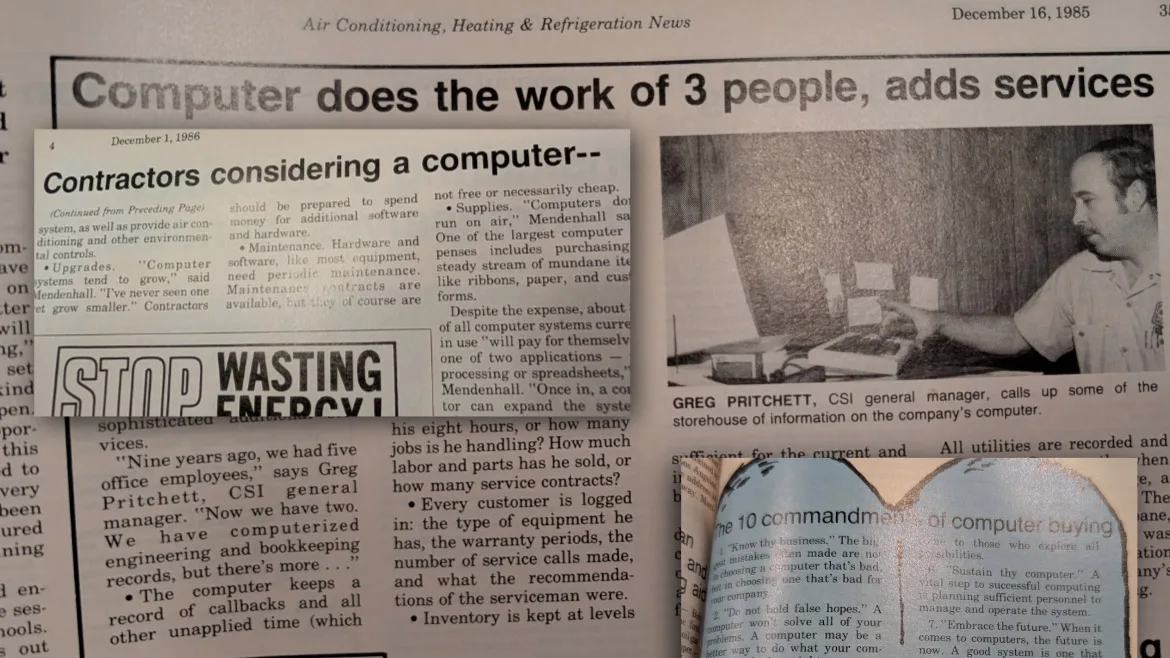
When modern building professionals look at the current state of heating, ventilation, air conditioning, and refrigeration (HVACR), they often fixate on today’s headlines: artificial intelligence, edge-computing sensors, cloud-based building management systems, and aggressive global electrification mandates. It is easy to view these innovations as sudden leaps forward, born entirely out of the twenty-first century.
However, a closer look at the trajectory of mechanical engineering reveals a different narrative. The foundational architecture for nearly every high-tech, energy-conscious, and automated system in operation today was not built in the era of smartphones and smart grids. Instead, it was laid more than forty years ago, during a pivotal decade that fundamentally rewrote the DNA of the trade.
The 1980s transformed HVACR from a largely brute-force mechanical industry into a sophisticated, digital, and energy-conscious ecosystem. Computers entered the fabrication shop floor. Microprocessors began replacing clunky electromechanical controls. Landmark environmental treaties changed the very chemical makeup of cooling. Contractors were forced to fundamentally rethink how they designed, engineered, built, and installed systems.
Looking back, the 1980s were not simply a period of incremental improvements. They represented five major, concurrent revolutions that continue to dictate the parameters of modern HVACR engineering, manufacturing, and field service.
Chronology of a Transformation: The Decade That Changed Everything
To understand how the HVACR industry arrived at its current technological frontier, it is essential to trace the decade’s most critical milestones:
- 1981: The 1981 ASHRAE Show serves as a watershed moment for digital fabrication. Construction Technology Inc. (CTI) demonstrates a computer-controlled layout table capable of automatically scribing sheet metal patterns, signaling the end of exclusive reliance on manual drafting tables.
- Mid-1980s: Sheet metal shops experience a rapid influx of computer-aided manufacturing (CAM), computer-aided design (CAD), plasma cutting systems, and computerized estimating software. Simultaneously, slide-on four-bolt connectors and rolled-on flange systems—such as TDC (Transverse Duct Connector) and TDF (Transverse Duct Flange)—begin replacing traditional transverse duct connection methods worldwide.
- Post-1970s / Mid-1980s: Spurred by lingering economic trauma from the 1970s energy crises, the industry pivots sharply toward efficiency. Variable air volume (VAV) systems proliferate, heat recovery technologies gain commercial traction, and water-based sealants begin replacing volatile, solvent-based products.
- 1987: The international community signs the Montreal Protocol. This landmark environmental agreement marks the beginning of the end for chlorofluorocass (CFC) refrigerants like R-11, R-12, and R-502, launching the industry into its first major global chemical transition.
- Late 1980s: Microprocessor-based electronic controls make their debut in commercial equipment, gradually edging out electromechanical relays. Early building automation systems (BAS) begin appearing in commercial high-rises, initiating the industry’s digital transition.
Supporting Data and Structural Shifts
The structural changes of the 1980s were driven by urgent economic realities and a rapidly shifting regulatory landscape. Data from industrial output and trade adoption rates during this period highlight a stark departure from historical norms.
Prior to the 1980s, sheet metal fabrication was entirely labor-intensive. Skilled craftspeople spent countless hours calculating fittings by hand, laying out patterns on drafting tables, and manually shearing metal. The introduction of CNC (Computer Numerical Control) plasma cutters and software-driven estimating drastically compressed project timelines. What previously took a skilled shop crew days to layout and calculate could now be completed in fractions of an hour, reducing human error and material waste.
Concurrently, the mechanical performance of ductwork underwent a quiet revolution. Traditional methods of assembling rectangular ductwork were labor-intensive and notoriously prone to air leakage. Following the energy shocks of the 1970s, building operators could no longer afford the energy penalties associated with leaky duct systems.
The introduction of rolled-on flange systems (TDC/TDF) and slide-on four-bolt connectors fundamentally altered field dynamics. These systems not only accelerated installation speeds—allowing contractors to meet tightening construction deadlines—but they also achieved a level of airtightness that traditional S-cleaves and drive slips could never match. This leap in duct integrity directly contributed to lower fan static pressures, reduced energy consumption, and quieter overall building environments.
Industry and Institutional Perspectives
While the technological shift was embraced by forward-thinking contractors and engineers, it also sparked significant debate across trade organizations and manufacturing boardrooms.
According to industry chroniclers and trade accounts from the era—such as observations shared by guest columnists in SNIPS NEWS like David Daw—the integration of computer technology was met with a mixture of awe and apprehension. Older generations of sheet metal workers worried that automated layout tables and computer-aided design would erode traditional craftsmanship. However, labor demands soon proved that software and CNC machinery did not eliminate the need for skilled tradespeople; rather, they elevated them, shifting their focus from tedious manual geometry to complex system design and quality control.

From the manufacturing sector, equipment builders faced unprecedented pressure from shifting regulatory horizons. Speaking on the impacts of the emerging environmental consensus surrounding the 1987 Montreal Protocol, chemical and equipment manufacturers realized that their foundational working fluids—CFCs—had a terminal shelf life.
Official statements from early environmental committees and trade associations at the time stressed that transitioning away from R-11 and R-12 was not merely a compliance exercise, but an existential technological pivot. Manufacturers were forced to invest heavily in chemical research and thermodynamic testing long before viable, drop-in replacements were fully realized. This institutional foresight laid the groundwork for subsequent transitions, equipping manufacturers with the research frameworks needed for later HFC phase-outs and today’s ultra-low-GWP (Global Warming Potential) refrigerant transitions.
The Five Defining Revolutions of the 1980s
To fully grasp the magnitude of this era, the 1980s can be broken down into five distinct revolutions that continue to resonate across the modern HVACR landscape.
Revolution No. 1: Computers Enter the Shop
For nearly a century, sheet metal fabrication was defined by physical drafting tools, protractors, and manual layouts. The early 1980s shattered this paradigm. The debut of computer-controlled layout tables at events like the 1981 ASHRAE Show proved that digital processing could govern physical manufacturing. Within a few short years, CAM, CAD, and automated estimating tools became standard operating procedure. Today, virtually every modern fabrication shop relies on CNC plasma tables and digital modeling software—a direct lineage tracing back to the garage-level and early corporate computing experiments of the 1980s.
Revolution No. 2: Duct Construction Was Reinvented
Beyond software, physical assembly methods underwent a massive overhaul. The invention of slide-on four-bolt connectors and integral flange systems (TDC and TDF) eliminated the time-consuming fabrication of separate companion angles. These engineered connection systems drastically reduced field labor hours while slashing duct leakage rates. By addressing the thermal inefficiencies of leaky duct networks, these systems became the global standard for commercial and industrial ventilation.
Revolution No. 3: Energy Efficiency Became the Priority
Before the 1980s, the primary directive of HVAC equipment was simple brute force: could the unit maintain a set temperature regardless of energy cost? The energy crises of the previous decade forced a permanent psychological shift. Efficiency became the primary metric of success. Variable air volume (VAV) systems gained widespread adoption, allowing fan speeds to match actual building loads. Heat recovery systems captured waste thermal energy, and water-based duct sealants replaced toxic, solvent-based alternatives, improving both environmental performance and indoor air quality (IAQ) for shop workers.
Revolution No. 4: Refrigerants Entered a New Era
No single event in the twentieth century impacted the chemical and mechanical design of cooling systems quite like the 1987 Montreal Protocol. As scientific evidence mounted regarding stratospheric ozone depletion caused by CFCs, the HVACR industry faced a mandatory global transition. The research, development, and operational protocols established during this scramble forced contractors and manufacturers to master recovery, recycling, and containment techniques. Every subsequent refrigerant phase-down—from HCFCs to HFCs, and now to HFOs and natural refrigerants—owes its procedural playbook to the crisis management of the late 1980s.
Revolution No. 5: HVACR Became Intelligent
While contemporary industry conversations are dominated by cloud analytics, predictive artificial intelligence, and smart buildings, the seed of digital intelligence was planted in the 1980s. The replacement of pure electromechanical relays with microprocessor-based electronic controls allowed HVAC units to monitor their own operating parameters for the first time. Early building automation systems (BAS) gave facility managers centralized visibility over sprawling commercial real estate. Though rudimentary by modern standards, these early digital controllers initiated the migration from reactive mechanical maintenance to algorithmic operational optimization.
Long-Term Implications for Today’s Trade
As the modern HVACR industry navigates its current wave of transformation—grappling with strict electrification mandates, decarbonization goals, and sophisticated AI-driven building optimization platforms—it is vital to acknowledge the bedrock upon which these advancements rest.
The 1980s may not be remembered for the sleekest aesthetics or the headline-grabbing consumer gadgets of modern smart-home technology. Instead, the decade quietly and fundamentally altered how mechanical systems were conceived, engineered, fabricated, and serviced. It bridged the gap between the industrial age of heavy mechanical trade and the information age of digital building performance.
Ultimately, the technologies defining the cutting edge of HVACR today are not standalone inventions. They are simply the next logical chapters in a continuous story that began more than four decades ago—proving that the modern climate-control industry was truly forged in the crucible of the 1980s.
