

Main Facts
Modern healthcare facilities demand precise, reliable, and sterile environmental controls. At the heart of these complex systems are Air Handling Units (AHUs), which manage temperature, humidity, and pressurization to protect vulnerable patients, particularly in high-stakes environments like operating rooms. However, a deeply nuanced, frequently misunderstood operational failure mode plagues many of these systems: the AHU Recirculating Mode Death Spiral.
This phenomenon occurs when an AHU’s outdoor and relief air dampers are fully closed while its return damper sits completely open, driving the system into an unintentional, fully recirculating configuration. While previous installments in this technical series examined systems utilizing traditional direct airflow tracking between supply and return fans, Case Study 4 investigates a critical variant. In this instance, the facility utilized space-level return Variable Air Volume (VAV) boxes to govern return airflow, leaving the return fan to maintain static pressure independently.
When the economizer was disabled during functional testing at a newly constructed hospital, a chain reaction of uncoordinated damper modulation, sensor drift, and fan antagonism caused the system to collapse. The resulting drop in static pressure triggered a safety shutdown, narrowly averting catastrophic structural damage to the return ductwork.

Chronology of an Operational Failure
To fully understand how a state-of-the-art hospital AHU can cascade into a system-threatening failure, it is essential to trace the chronology of events recorded during functional testing in March under cool ambient conditions.
Phase 1: Stable Baseline Operation (Economizer Enabled)
For weeks leading up to the test, the AHU operated smoothly with its economizer enabled.
- The economizer outdoor air damper (ECON OAD-O) modulated openly to leverage cool outdoor air for cooling.
- The minimum outdoor air damper (MinOAD-O) actively controlled a dedicated duct-mounted airflow measuring station (MinOA-F) to ensure code-mandated minimum ventilation requirements were met.
- The return fan maintained a stable return air static pressure (RA-P SP), allowing return VAV boxes in the served operating rooms to modulate precisely and control space airflows.
- The relief air damper modulated to hold relief plenum pressure, preventing backdrafts.
Phase 2: Disabling the Economizer
Warned by the temperature controls contractor—who had observed a unit trip the day before—the engineering team engaged the Building Automation System (BAS) programming tool to monitor inputs and outputs in real time before manually disabling the economizer.

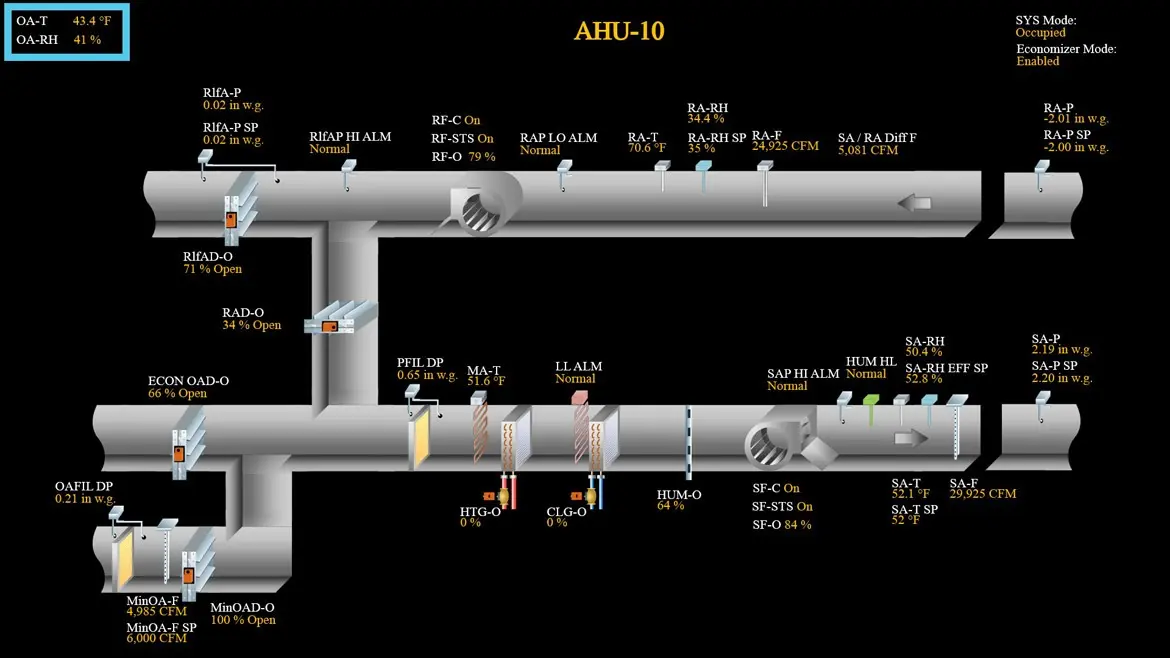
Immediately upon disabling the economizer, the system experienced an unpredicted transitional state (depicted in Figure 3):
- The return air damper (RAD-O) drove fully open.
- The economizer outdoor air damper (ECON OAD-O) drove fully closed.
- The relief air damper prematurely slammed shut, influenced by external variables such as building pressure, ambient wind direction, and return damper flow resistance.
Phase 3: The Snowballing Cascade
Because the outdoor airflow sensor (MinOA-F) momentarily registered readings higher than its designated setpoint, the minimum outdoor air damper (MinOAD-O) began closing to compensate.
This throttling action choked the primary outdoor air path, forcing the powerful supply fan to draw more air backward through the return air system. Sensing a surge in incoming air, the return air VAV boxes in the operating rooms reacted by closing their internal dampers to maintain their individual airflow setpoints.

The consequences compounded rapidly:
- Starving the Return Fan: With the return VAV box dampers heavily restricted, the static pressure in the return duct dropped precipitously. The return fan slowed down in response to maintain its setpoint.
- Fan Antagonism: As the return fan ramped down toward minimum speed, the massive supply fan continued to draw excess air through the path, overpowering the free-spinning return fan.
- The Final Drop: With the return fan bottomed out and the return VAV dampers fully choked, the return duct static pressure crashed so violently that the Return Air Static Safety Switch tripped, shutting down the entire AHU.
Figure 4 maps this precarious state moments before the system safety interlock cut power to protect the infrastructure.
Supporting Data & Architectural Analysis
The operational vulnerabilities exposed during Case Study 4 highlight systemic flaws in how multi-sensor HVAC networks coordinate. Unlike traditional systems where a return fan tracks directly to a measured supply airflow offset, this hospital AHU relied on a decentralized control scheme:

- Decoupled Airflow Tracking: Airflow tracking occurred primarily at the served spaces. Return VAV boxes managed local return airflows, while the AHU return fan merely maintained adequate static pressure to keep those VAV boxes operational.
- Redundant vs. Control Sensors: The AHU’s main return airflow measuring station (RA-F) functioned strictly as a monitoring sensor rather than an active control input, blinding the system to true volumetric imbalances.
- The Danger of TAB Rebalancing: Facility managers must account for future Test, Adjust, and Balance (TAB) efforts. If a technician adjusts operating room VAV setpoints to dial in critical space pressurization, the collective volumetric difference between supply and return VAV setpoints could easily exceed the minimum outdoor airflow setpoint ($textMinOA-F SP$). This mathematical mismatch forces the AHU into a recirculating death spiral, even if every sensor in the building is calibrated and functioning perfectly.
Official Responses and Engineering Remedies
The recurring nature of these failures across multiple installations forced design engineers and facility consultants to rethink AHU sequencing. Left unaddressed, these control loops present severe operational liabilities.
The Proposed Engineering Fix
To make the system resilient against unexpected relief air damper closures, sensor drift, and uncoordinated airflow measurements, engineers proposed introducing strict software guardrails.
Specifically, the control logic required a Minimum Outdoor Air Damper Low Limit (as outlined in Figure 5) to prevent the control loops from ever commanding the minimum outdoor air and relief dampers fully closed simultaneously when the system is not explicitly scheduled for 100% recirculation. By hardcoding a minimum physical position or an override floor based on a thermal or volumetric differential, the control logic strips the BAS of the ability to choke the unit into a death spiral.

The design engineer formally accepted these recommendations, and subsequent implementation proved them entirely viable, neutralizing the antagonistic feedback loop between supply fans, return fans, and terminal VAV boxes.
Implications for Healthcare Facilities and HVAC Design
The implications of Case Study 4 extend far beyond a single hospital’s mechanical room. They serve as a stark warning for HVAC designers, controls contractors, and commissioning agents worldwide:
- Life Safety and Structural Integrity: In this specific instance, the return air static safety switch functioned as intended, shutting down the AHU before damage occurred. However, if a safety switch fails, stutters, or is improperly bypassed during maintenance, the sudden collapse of static pressure can literally implode or structurally collapse large-scale return ductwork.
- The Illusion of Automation: Advanced BAS platforms and sophisticated VAV architectures do not render a system immune to basic fluid dynamics. When control loops operate in silos—such as local VAV boxes reacting to static pressure drops caused by distant damper modulation—unforeseen feedback loops can easily overpower safety margins.
- The Need for Customization: As this ongoing case study series demonstrates, no two AHU failures manifest in precisely the same way. Standard, out-of-the-box sequences of operation frequently fail when subjected to real-world variables like wind pressure, sensor degradation, and complex hospital pressurization requirements. Engineers must custom-tailor robust, fail-safe control logic into every sequence from day one.
As this investigation moves into its next phase, industry experts continue to analyze alternative AHU topologies across other healthcare campuses, proving that the threat of the recirculating mode death spiral remains a pervasive challenge that demands eternal vigilance from engineering professionals.
