

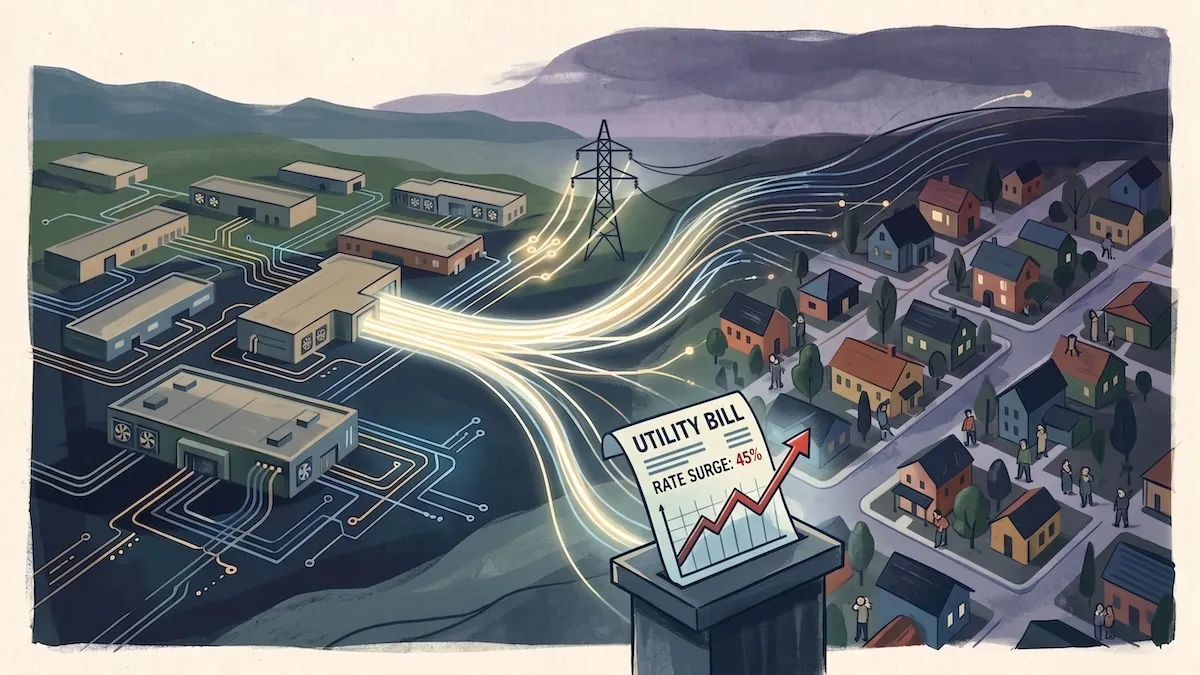
For decades, real estate agents and homebuyers evaluated a property’s ongoing carrying costs through a predictable lens: mortgage principal and interest, property taxes, homeowners insurance, and association fees. While monthly utility bills were always factored into household budgeting, they were generally viewed as stable, minor operational variables.
Today, that traditional calculus is undergoing a radical transformation. As the artificial intelligence revolution and cloud computing fuel a historic wave of digital infrastructure expansion, massive data centers are reshaping local landscapes across the United States. While real estate professionals have grown accustomed to discussing data centers in the context of localized development, noise pollution, obstructed views, and shifting property values, a far more pervasive financial wildcard has emerged: the staggering amount of electricity required to power these facilities and the potential impact that power demand will have on residential utility bills.
The question of whether Big Tech’s energy consumption will ultimately inflate the monthly electricity costs of everyday homeowners and renters is complex. Data centers do not automatically trigger spikes in residential utility bills, and regional electricity prices remain subject to a myriad of economic forces. However, legal experts, consumer advocates, and real estate veterans warn that the unprecedented scale of this development has created a fundamental, high-stakes question about who ultimately foots the bill when regulated utilities spend billions on new power plants and transmission lines.
Main Facts: The Intersection of Big Tech and Residential Power
At the heart of the debate is a simple clash between traditional utility business models and the extraordinary power demands of the modern technology sector.
Electric utilities operate largely as regulated monopolies within defined service territories. Historically, their primary business model has involved building necessary infrastructure—such as high-voltage transmission lines, substations, and generation facilities—and socializing those capital costs among all consumers within their network.
Now, that traditional model is colliding with an unprecedented surge in demand. Modern hyperscale data centers can consume as much electricity as a small city. According to Ari Peskoe, director of the Electricity Law Initiative at the Harvard Law School Environmental and Energy Law Program, the tech industry is attempting to drop the equivalent of entire urban energy loads into rural and suburban communities nationwide.
This multi-billion-dollar infrastructure buildout carries profound implications for housing affordability. Because electricity is a recurring cost of occupancy, any structural inflation in power rates directly impacts a household’s disposable income. For a housing market already strained by high interest rates and soaring insurance premiums, a recurring utility increase of $25 to $50 a month can significantly alter a family’s financial stability and long-term ability to remain in their home.
Chronology and Evolution of the Data Center Crisis
The collision course between local real estate markets and industrial-scale technology infrastructure has evolved rapidly over the past several years, shifting from an isolated zoning issue into a national affordability debate.
- The Early Expansion Era: Initially, data centers targeted specific geographical hubs—most notably Loudoun County, Virginia, which became known as the "data center capital of the world." During this phase, local governments largely welcomed the facilities, drawn by promises of massive commercial tax bases that could offset residential property tax burdens.
- The Statewide Spread: As artificial intelligence models scaled exponentially through the early 2020s, tech companies expanded their search footprint beyond traditional technology corridors into rural and secondary markets across Texas, Ohio, Georgia, and the Mountain West where land was cheap and accessible.
- The Regulatory Awakening (2024–2025): Local resistance intensified as communities faced sudden strains on local power grids and municipal water supplies. Public opposition swelled at town council and zoning board meetings, leading multiple local governments to enact moratoriums on new data center approvals. Concurrently, state regulators and consumer advocates began scrutinizing utility rate structures.
- The Harvard Law Report (2025): Legal research crystallized the systemic risks facing everyday ratepayers. A pivotal 2025 report titled Extracting Profits from the Public: How Utility Ratepayers Are Paying for Big Tech’s Power, co-authored by Peskoe and Harvard Legal Fellow Eliza Martin, reviewed nearly 50 regulatory proceedings. The study exposed how opaque rate structures and confidential side deals could quietly shift infrastructure burdens onto residential customers.
- The Legislative and Tariff Push (Present): Consumer protection agencies, such as the Ohio Consumers’ Counsel, began taking the fight directly to state legislatures. In response, specific states and major utilities—such as AEP Ohio and Virginia’s State Corporation Commission—began establishing specialized tariff frameworks and rate classes designed to insulate residential ratepayers from speculative tech infrastructure costs.
Supporting Data: The Scale of the Load and Market Impact
The sheer volume of capital and power flowing into the data center industry underscores why energy analysts and consumer advocates are sounding alarms.
According to industry projections, global capital investment heading into new data centers is on pace to exceed $1 trillion annually. This sudden influx of hyper-scale demand is already visibly tightening regional wholesale markets.
The financial ripple effects are starkly evident in wholesale capacity markets. For instance, data center load growth was cited as a primary driver behind a staggering surge in the PJM Interconnection’s capacity auction, where auction revenue spiked by $7.3 billion—an 82% increase—reaching a total of $16.1 billion. When wholesale capacity prices and transmission investments spike at this magnitude, the financial pressure eventually filters down to regional distribution networks.
Furthermore, water usage has emerged as a parallel crisis compounding utility and municipal strain. Facilities utilizing evaporative cooling systems consume millions of gallons of water daily, drawing heavily from local aquifers. In places like Parker County, Texas, the competition for water has become so acute that local real estate transactions now require rigorous new water disclosures regarding well depths and shared co-op systems—a variable that real estate professionals report was virtually unheard of a decade ago.
Official Responses and Regulatory Frameworks
Different states and utilities have adopted vastly divergent approaches to balancing the economic incentives of attracting data centers with the necessity of protecting residential ratepayers from unfair cost burdens.
The Strict Protectionist Model: Ohio and Virginia
Consumer advocates argue that without binding safeguards, utilities can build massive infrastructure based on speculative tech forecasts, only for residential customers to be left holding the bag if projects stall or downsize.
To combat this, AEP Ohio implemented a specialized data center tariff. Under this framework, qualifying large-load data centers must pay for at least 85% of their contracted electric capacity for up to 12 years, regardless of whether their actual consumption matches projections. If a project is canceled before energization, the customer is held 100% responsible for the associated buildout costs, mitigating the "stranded-investment problem."
Similarly, the Virginia State Corporation Commission established a distinct GS-5 rate class for very large electricity users, requiring hyperscale customers to commit to multi-year service agreements and cover a minimum percentage of transmission and distribution costs directly attributable to their operations.
The Economic Development Model: Georgia Power
Conversely, utilities like Georgia Power emphasize the broader economic benefits that large industrial loads can provide. The utility argues that data center growth can ultimately lower average costs for existing customers by spreading fixed infrastructure expenses across a vastly larger volume of electricity sales. Georgia Power maintains that its large-load frameworks include upfront payments, long-term contracts, and minimum bills designed to ensure data centers pay their own way.
However, critics remain deeply skeptical of utility assurances, pointing to a lack of public transparency. Peskoe noted that because the specific pricing terms of many side deals are kept confidential under claims of commercial sensitivity, independent verification of whether tech companies are truly covering their full costs remains nearly impossible for the public.
Real Estate Implications: What Agents and Homebuyers Must Watch
For real estate agents, brokers, and appraisers, the rise of the data center economy introduces a complex new variable into the housing market equation. While it is inaccurate to claim that a nearby data center will instantly double a homeowner’s monthly electric bill, the cumulative pressure of energy infrastructure spending must be recognized as part of a broader housing affordability squeeze.
- Monitoring Recurring Costs: Industry veterans emphasize that recurring utility expenses directly affect a buyer’s debt-to-income ratio and long-term housing stability. An incremental rise in monthly electricity rates erodes purchasing power just as surely as an uptick in property taxes or homeowners insurance premiums.
- Localized Grid and Water Vulnerabilities: In hyper-development zones such as Granbury, Texas, real estate professionals are adapting to entirely new due diligence protocols. Agents must now navigate complex municipal water disclosures, well-drilling restrictions, and localized zoning battles that can impact the long-term desirability and resale value of surrounding properties.
- The Counterbalance of Municipal Tax Relief: Conversely, real estate advisors must weigh localized utility concerns against broader municipal benefits. In regions like Loudoun County, Virginia, the monumental commercial tax base generated by clusters of data centers has historically allowed local governments to moderate or even reduce residential property tax rates, demonstrating that the net economic impact depends heavily on local governance and tax distribution.
As the data center boom continues to reshape the American landscape, real estate professionals are finding that advising clients successfully requires looking far beyond the physical boundaries of a property line. In markets experiencing explosive digital infrastructure growth, understanding who is paying for the power grid—and what it will cost to keep the lights on—has become an essential frontier in modern real estate intelligence.
