

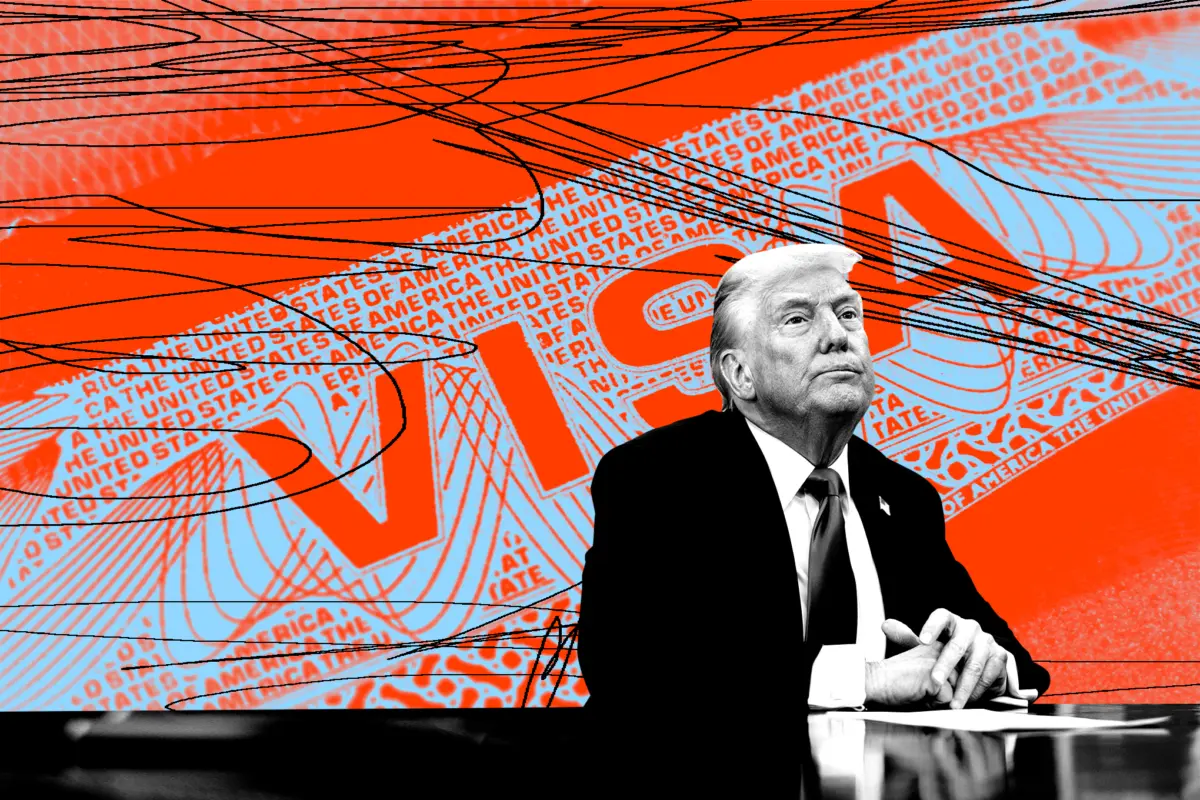
WASHINGTON — In a coordinated series of policy maneuvers enacted over the course of a single Monday, the Department of Homeland Security (DHS) and the State Department launched what policy experts are calling one of the most aggressive transformations of the American legal immigration system in modern history.
The administration announced a staggering fee hike of more than $103,000 for H-1B high-skilled employment visas, while simultaneous reports revealed that the State Department is preparing to revoke the legal status of up to 200,000 asylum seekers. According to historical data and reporting from The Associated Press, this mass cancellation stands to be the largest single-day visa revocation in United States history.
More than a year into President Donald Trump’s second term, the administration’s broader strategy has crystallized. Facing structural and logistical limitations in achieving mass deportation numbers through traditional Immigration and Customs Enforcement (ICE) operations alone, the White House has pivoted toward a multipronged strategy: systematically stripping legal status from existing residents, creating insurmountable financial and bureaucratic hurdles, and coercing noncitizens into "self-deportation" through civil fines and asset seizure threats.
Main Facts
The sweeping regulatory actions taken on Monday center on two primary pillars of the U.S. immigration apparatus: high-skilled employment pathways and humanitarian protection frameworks.
- The H-1B Fee Surge: The Department of Homeland Security confirmed it is moving forward with a revised fee structure that sets the cost for H-1B visas—heavily utilized by the technology, healthcare, and education sectors—at $103,265. This follows a previous federal court battle in Boston that temporarily blocked an earlier iteration of the fee.
- Historic Mass Revocations: The State Department is systematically rescinding between 150,000 and 200,000 nonimmigrant business and travel visas. These visas, issued between 2016 and 2026, belong to individuals who legally entered the United States on temporary grounds but subsequently filed for asylum.
- Targeting Auxiliary Pathways: Government documents and internal hints suggest that the Optional Practical Training (OPT) program—which allows international students to work in the U.S. post-graduation—may soon face a parallel $100,000 levy, effectively pricing out emerging global talent.
- Closing Humanitarian Channels: The administration continues to narrow legal avenues for entry, maintaining strict border restrictions, plummeting refugee admissions, and shifting priorities toward specific demographic profiles, such as white South African refugees, while shutting out applicants from Latin America, Africa, and parts of Asia.
Chronology of Events
To understand how the current legal landscape has shifted, it is necessary to examine the timeline of escalating restrictions during President Trump’s second term:
- Early 2025: Following the inauguration, the administration implements an effective "asylum ban" at the U.S.–Mexico border, severely limiting the intake of migrants seeking protection under international and domestic law.
- June 2026: A federal judge in Boston strikes down the Trump administration’s initial attempt to impose a $100,000 fee on H-1B visas. However, before the injunction takes effect, corporate compliance reports reveal that over 70 U.S. businesses had already paid the exorbitant fee.
- July 2026: The administration broadens its internal enforcement mechanisms, introducing aggressive civil fines and asset-seizure threats directed at undocumented and noncompliant noncitizens to encourage "self-deportation."
- August 2026: DHS signals that the OPT program for international students is under review for a similar $100,000 barrier, sparking widespread anxiety among university administrators and foreign scholars.
- Monday (Current): Within a span of hours, DHS officially announces the updated $103,265 H-1B fee structure, and news breaks regarding the State Department’s plan to invalidate up to 200,000 tourist and business visas held by active asylum applicants.
Supporting Data and Economic Impact
The financial and operational implications of these policy changes extend far beyond partisan debates over border security, touching the fundamental infrastructure of the American economy.
The H-1B Visa and the Tech Sector
H-1B visas are frequently categorized as "Big Tech" instruments due to massive utilization by corporate giants like Amazon, Meta, and Microsoft. However, the impact of steep financial barriers is unevenly distributed across industries.
While tech giants may absorb increased compliance costs as a burdensome corporate tax, the same cannot be said for public institutions and critical infrastructure. During previous iterations of the fee hike, rural hospitals across the American heartland and public school districts in states like Alaska—both of which rely heavily on high-skilled international workers to offset severe local population decline—reported catastrophic disruptions. For a small rural healthcare clinic, a six-figure visa fee per essential physician or specialist is an insurmountable barrier.
The OPT Vulnerability
The Optional Practical Training program currently serves as a vital bridge for international graduates from American universities. By allowing students to work in their fields for 12 months (with extensions up to 36 months for STEM and certain graduate degree holders), the U.S. has historically maintained a competitive advantage in global innovation. Imposing a $100,000 fee on OPT participants threatens to divert top-tier intellectual capital to competing economies in Europe, Canada, and Asia.
The Scale of Visa Revocations
According to data analyzed by The Associated Press, the cancellation of up to 200,000 business and travel visas marks an unprecedented deployment of administrative authority. Critics point out that under standard protocol, nonimmigrant visas granted temporary legal status for specific purposes. However, federal law explicitly provides individuals the right to apply for asylum upon arrival on U.S. soil—a legal reality that the administration is now penalizing retroactively.
Official Responses and Stakeholder Perspectives
The administration defends its actions as a necessary correction to systemic exploitation, while industry leaders, legal scholars, and human rights advocates warn of catastrophic economic and humanitarian fallout.
The Administration’s Defense
The White House and its executing agencies frame the measures as loopholes closure. Federal officials argue that foreign nationals are exploiting nonimmigrant tourist or business visas as a "backdoor" into permanent residency by filing for asylum immediately upon arrival.
"We are coordinating with DHS to identify and revoke the nonimmigrant visas of foreigners who have come to the United States claiming to be short-term visitors, but then file for asylum to stay here permanently," said State Department spokesperson Tommy Pigott in a statement to The Associated Press.
The administration maintains that immigration privileges must be strictly regulated and that those who enter the country must do so through designated, unabused channels—channels that the administration has simultaneously narrowed or defunded.
Industry and Advocacy Outcry
Business coalitions and immigration advocacy organizations have sharply rebuked the administration’s announcements, vowing swift legal challenges.
Todd Schulte, president of FWD.us—an immigration reform organization co-founded by tech executives including Mark Zuckerberg in 2013—condemned the actions as a coordinated effort to dismantle legal immigration.
"This is clearly unlawful," Schulte said. "We don’t have to guess what this is for. This is to get rid of the OPT and H-1B program, which will have upstream and downstream devastating consequences: companies will be started elsewhere, people will be hired elsewhere."
Schulte emphasized that the strategy is not an isolated set of bureaucratic adjustments, but rather an interconnected federal campaign.
"Every single other pathway is harder, outlawed, eliminated, more bureaucratic, more difficult across the board," Schulte noted. "It’s an all-of-government approach."
Legal scholars have similarly raised alarms, noting that penalizing individuals for exercising their statutory right to seek asylum under domestic and international law creates a dangerous precedent that undermines constitutional due process protections.
Details of the administration’s plan indicate that implementation will proceed rapidly across federal agencies, leaving businesses, universities, and legal defense organizations scrambling to mount challenges in federal courts before the directives take full effect. As the legal battles loom, the foundational architecture of American immigration law faces its most severe test in decades.
