

Main Facts
As humanity prepares to return to the Moon on a permanent basis, the space above our celestial neighbor is getting crowded. Historically, space agencies operated under a "one mission at a time" paradigm, sending isolated spacecraft into the cosmic void where they had the entire metaphorical highway to themselves. However, with NASA’s ambitious multi-phase plan to establish a sustained lunar base over the next decade, cislunar space is poised to see a massive surge in traffic.
To prevent catastrophic collisions in deep space, a collaborative team of engineers from Texas A&M University, Purdue University, and NASA’s Johnson Space Center has designed a sophisticated space traffic management system. Outlined in a recent study published in scientific literature, this framework introduces the world’s first conceptual "air traffic control" for lunar orbit.
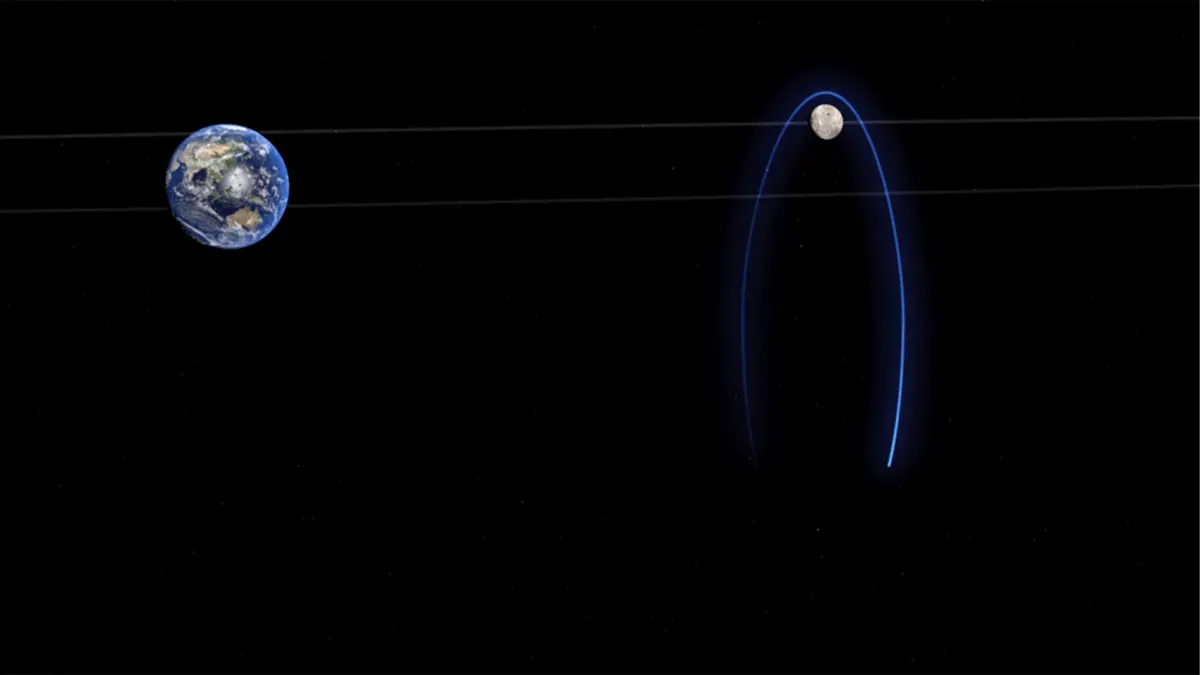
The system specifically targets the Near-Rectilinear Halo Orbit (NRHO)—a complex gravitational pathway that loops around both of the Moon’s poles. While this orbit was initially mapped out to accommodate single, stationary platforms like the now-defunct Gateway space station concept, it must now juggle a complex ballet of crewed Orion capsules, uncrewed cargo freighters, and commercial lunar landers.
Without a terrestrial-style coordination system, the risk of high-speed, catastrophic collisions in lunar orbit becomes unacceptably high. The newly developed simulations successfully demonstrate that multiple spacecraft can share the exact same orbital corridor simultaneously, maintaining safe distances while optimizing fuel efficiency. This traffic control system is scheduled for its inaugural real-world test during the Capstone 02 mission next year, followed by critical evaluations during upcoming Artemis flights slated for 2027.
Chronology: The Evolution of Lunar Logistics
To understand why a lunar traffic control system is necessary now, it helps to examine the timeline of how humanity approaches the Moon:
- The Apollo Era (1960s–1970s): Missions were singular and fleeting. NASA sent isolated Apollo spacecraft directly to the lunar surface or into simple, short-term low lunar orbits. Traffic management was non-existent because only one American expedition operated in the vicinity of the Moon at any given time.
- The Deep Space Lull (1980s–2010s): Aside from occasional orbital mapping probes, deep-space crewed exploration halted. Focus shifted entirely to Low Earth Orbit (LEO), where the Space Shuttle and eventually the International Space Station (ISS) dominated operations. LEO traffic management was heavily aided by global positioning networks and predictable atmospheric drag.
- The Gateway Concept and NRHO Discovery (Late 2010s): NASA and its international partners identified the Near-Rectilinear Halo Orbit as a masterstroke of orbital mechanics. It offered a stable vantage point for deep-space staging without requiring exorbitant amounts of fuel to fight the Moon’s gravity.
- March 2025/2026 Shift: NASA formally announced its pivot toward an integrated, phased lunar base architecture. The strategy discarded the standalone Gateway space station model in favor of a direct-to-surface base deployment. This pivot meant that commercial landers, cargo ships, and crewed Orion capsules would converge on the NRHO simultaneously, sparking the urgent creation of the joint Texas A&M, Purdue, and NASA Johnson Space Center study.
- 2026–2027 (Upcoming): The newly minted space traffic management protocols face their first live-fire trials, beginning with the Capstone 02 mission and culminating in the high-stakes Artemis missions scheduled for 2027.
Supporting Data: The Physics and Mechanics of Cislunar Traffic
Managing traffic around the Moon is fundamentally different—and exponentially more difficult—than handling commercial air traffic at John F. Kennedy International Airport or Heathrow. On Earth, air traffic controllers rely on radar, transponders, and the ubiquitous Global Positioning System (GPS) to track aircraft down to the meter.
In lunar orbit, these luxuries do not exist.

The Navigation Void
"For us on the ground, and for spacecraft in low Earth orbit like the International Space Station, we can know almost exactly where we are thanks to the GPS constellation," explained Diane Davis, associate professor of space engineering at Texas A&M and a co-author of the study. "But in lunar orbit, we don’t have an analogous system yet to give us a good measure of where we are."
Once a spacecraft breaks free from Earth’s protective GPS network, its exact location becomes an educated estimate. Flight controllers must rely on optical instruments aboard the spacecraft or interpret radio signals bounced across millions of miles from the Deep Space Network’s massive antenna arrays located in California, Spain, and Australia.
The Hazards of the NRHO
The Near-Rectilinear Halo Orbit is chosen because it acts as a gravitational "Goldilocks zone." It is far enough from the lunar surface that spacecraft are not violently dragged down by the Moon’s gravity wells, yet close enough to allow efficient cargo and crew transfers to the surface.
However, the NRHO is a harsh environment characterized by a gravitational tug-of-war involving the Earth, the Moon, and various distant solar system bodies. Craft placed in this orbit must continuously expend micro-adjustments to avoid drifting into the abyss of deep space or crashing into the lunar landscape.
Furthermore, scale and time present immense logistical hurdles. Unlike a commercial jet that can circle a holding pattern for twenty minutes, larger lunar orbits can take many hours or even days to complete a single revolution around the Moon. Conserving propellant is paramount; wasting fuel on a poorly timed orbital insertion or a missed rendezvous can doom an entire multi-billion-dollar mission.
Official Responses and Expert Insights
The academic and engineering communities emphasize that the success of future lunar habitation relies as heavily on software and traffic logistics as it does on heavy-lift rocket propulsion.
"Collisions and serious damages could happen. To ensure crew safety and mission success, effective traffic management in the NRHO is crucial," Diane Davis stated in a press release detailing the study. "The future of lunar explorations depends as much on the traffic management as it does on the rocket science."

Elaborating on the fluid nature of mission design, Davis noted to media outlets that the cancellation of the physical Gateway space station did not render their research obsolete. Instead, it freed engineers to consider alternative orbits while utilizing the exact same traffic management algorithms.
"To enable the ambitious lunar missions planned by NASA, bold new mission designs are being created," Davis remarked. "These designs take advantage of the opportunities presented by the gravitational tug-of-war in cislunar space: These orbits often allow significant propellant savings and opportunities that just aren’t available with more familiar low Earth or low lunar orbits."
NASA’s three-phase lunar base program requires absolute synchronization. Phase one focuses on heavy freight deliveries and establishing autonomous nuclear power grids on the lunar surface. Phase two integrates advanced life-support infrastructure. Phase three introduces rotating shifts of permanent human astronauts. Without an automated, predictive traffic control system overseeing the celestial highway above, the choreography of these phases would collapse under the weight of logistical conflicts.
Broader Implications for the Future of Space Exploration
The creation of a lunar traffic control framework marks a psychological and practical shift in how humanity interacts with the cosmos. For decades, space was treated as an infinite expanse where ships rarely crossed paths. Today, cislunar space is rapidly transitioning into a busy industrial highway, complete with commercial vendors, international space agencies, and private resource prospectors.
Establishing Precedent for Interplanetary Law
As private aerospace companies build their own landers and cargo vessels, the rules being written today by Texas A&M, Purdue, and NASA will likely serve as the foundational international standards for space commerce. Just as maritime law and international aviation treaties govern movement on Earth, cislunar traffic management will dictate right-of-way laws, emergency protocols, and orbital parking rights in deep space.
The Commercialization of Cislunar Space
A standardized traffic control system lowers the barrier to entry for commercial partners. If private entities know there is a reliable, algorithmic framework managing orbital congestion, they can invest more confidently in lunar mining, satellite communication networks, and space tourism infrastructure.
Ultimately, the invisible air traffic control system being tested in the coming years will do more than just prevent catastrophic mid-space collisions. It represents the scaffolding of a multi-planetary civilization—proof that as humanity steps out into the solar system, we are bringing order, cooperation, and foresight to the final frontier.
