

By David Lumb | Managing Editor, Mobile & Gaming
Main Facts: Bringing Back the Ultimate Arcade Fever Dream
The Sega Dreamcast era remains a singular, incandescent fever dream in video game history—a period defined by unhinged, wildly original creative risks that birthed titles like Space Channel 5, Seaman, Shenmue, Chu Chu Rocket, Power Stone, and Jet Set Radio. Yet, perhaps nothing exemplified the frantic, boundary-pushing energy of the console quite like Crazy Taxi, a game whose entire pitch was elegantly baked into its title.
Now, Sega is resurrecting its zany, pedal-to-the-metal classic for modern hardware with Crazy Taxi: World Tour. Slated for a 2027 release, the upcoming title aims to capture the kinetic, no-questions-asked arcade thrills that captivated players at the turn of the millennium. During a recent summer press showcase held at a downtown Los Angeles hotel, Sega offered a select group of media outlets a hands-on preview of the game, letting reporters dive behind the wheel to see how the franchise translates to current-generation consoles.
While the current gaming landscape is dominated by heavy-hitting, reverent remakes—such as the Silent Hill 2 remake and Metal Gear Solid Delta—these revivals focus on monumental milestones in interactive storytelling. Crazy Taxi occupies a different space entirely. It was never a solemn, historically heavy narrative milestone; instead, it stands as a pure, undiluted distillation of the kinetic momentum that defined the best of the Dreamcast’s software catalog.
Chronology: From Coin-Op Arcades to the 2027 Global Revival
To understand the excitement surrounding Crazy Taxi: World Tour, it helps to trace the trajectory of Sega’s iconic franchise across the decades:
- February 1999: Sega launches Crazy Taxi into Japanese arcades on the high-powered Sega NAOMI hardware, instantly turning heads with its vibrant visuals, frantic time-attack gameplay, and licensed punk-rock soundtrack by The Offspring and Bad Religion.
- January 2000: The game receives a faithful home console port for the newly launched Sega Dreamcast, becoming a system-seller and solidifying its place in pop culture. Subsequent ports follow for the PlayStation 2, GameCube, and PC.
- November 2001: Crazy Taxi 2 debuts on the Dreamcast, introducing new mechanics like the "Crazy Hop" and "Crazy Dash," alongside multiple passengers and a New York-inspired map.
- March 2002: Crazy Taxi 3: High Roller lands on the Xbox, bringing back classic maps and introducing a glittering Las Vegas-inspired setting.
- 2007–2010s: The franchise pivots toward mobile platforms, with ports and spin-offs like Crazy Taxi: City Rush, keeping the brand alive in the era of smartphone gaming.
- June 2026: Sega formally introduces Crazy Taxi: World Tour at its Los Angeles summer press showcase, announcing a targeted release window of 2027 for modern consoles and PC.
- Summer 2026 (Hands-On Preview): Media get their first one-hour hands-on session with the pre-alpha build, exploring the newly minted Germany map and discovering specialized, quest-driven passenger mechanics.
Supporting Data & Gameplay Mechanics: What’s New and What Stayed the Same
During a one-hour preview session with an early build of Crazy Taxi: World Tour, it quickly became clear that Sega understood the assignment. The developers managed to preserve the vital ingredients that made the 1999 original an instant classic, while significantly expanding the scope for modern players.
The Core Elements Preserved:
- The Vibes and Visual Style: The blindingly bright color palettes, sun-drenched environments, and unapologetic arcade aesthetic remain intact.
- The Signature Fare-Pickup System: Players still floor the accelerator, drifting around corners and careening through dense pedestrian traffic to reach iconic colored circles, racing against an unforgiving countdown timer.
- The Soundtrack: The quintessential late-90s to early-2000s alt-rock and pop-punk audio identity makes a triumphant return, driving the adrenaline-fueled pace of every fare.
Modern Evolutions and Sandbox Expansion:
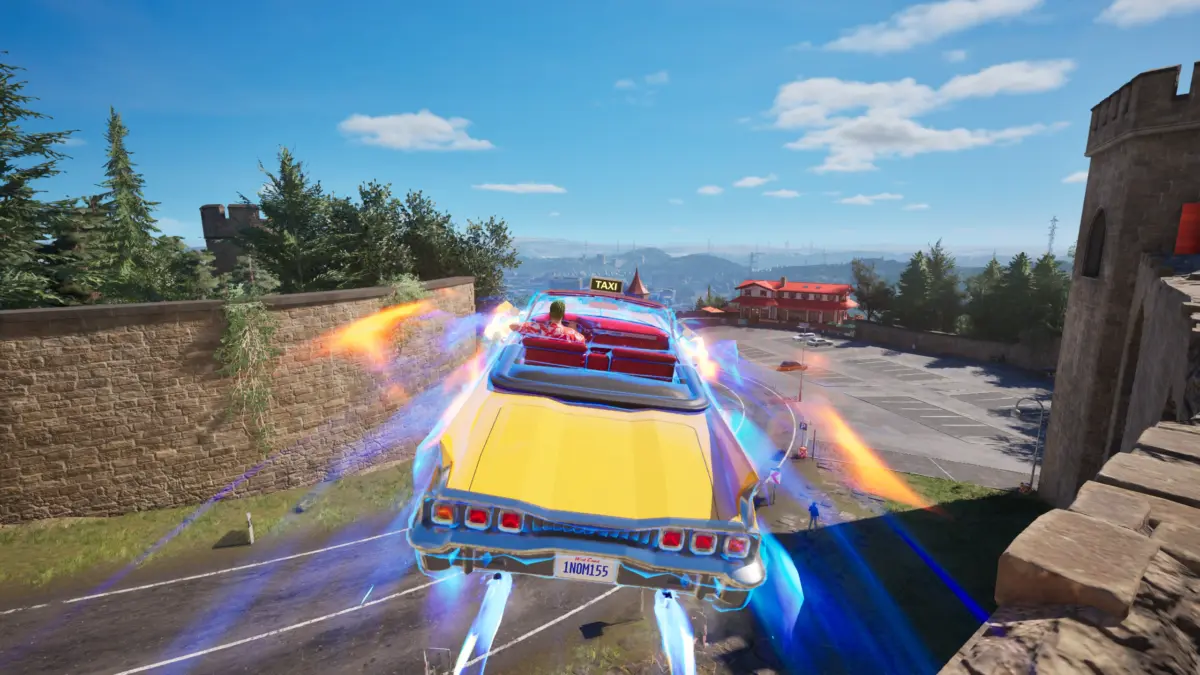
Unlike the linear arcade structures of the past, World Tour introduces expansive, multi-tiered sandbox environments. The preview build featured a sprawling map themed around Germany—just one of several international locations planned for the final release. This map is designed as a large, interconnected loop broken down into distinct, highly detailed functional zones:

- A bustling international airport
- A dense, vertical downtown city center
- A quaint, winding European village
- A majestic castle perched high on a hill
Within these regional pockets, players encounter specialized fares that transform simple point-A-to-point-B drives into elaborate, multi-stage mini-quests. Approximately ten unique narrative-driven fares were scattered across the map in the preview build, featuring absurd scenarios:
- The Easter Bunny: An unsettlingly enthusiastic man clad in a full Easter Bunny costume enlisting the player to help "collect his eggs" across the city.
- The Wingsuit Daredevil: A reckless thrill-seeker in the back seat demanding to be launched directly off a high cliffside ledge from the cab’s roof.
These encounters point to a broader, highly eccentric roster of characters populating the global maps, promising rewards for players who lean into the controlled chaos.
Official Responses and Developer Insight
Sega has framed Crazy Taxi: World Tour not merely as a nostalgia trip, but as a modernization of arcade sensibilities for an audience accustomed to deep, sprawling open-world experiences.
While formal panel interviews at the Los Angeles showcase kept specific narrative plotlines under wraps, developer communications emphasize that World Tour aims to bridge the gap between classic arcade pick-up-and-play mechanics and modern open-world freedom. Representatives noted that the decision to incorporate localized, region-specific mini-quests was born from a desire to reward player exploration without sacrificing the breakneck pace that defined the original coin-op experience.
Furthermore, Sega’s internal studios—particularly Ryu Ga Gotoku (RGG) Studio, renowned for the wildly imaginative Yakuza and Like a Dragon series—have continually championed this brand of unapologetic, scripted eccentricity. World Tour leans directly into that corporate philosophy, offering a stark antidote to the industry-wide trend of relentlessly grim, hyper-realistic narratives.
Implications: Why Crazy Taxi Matters in Today’s Gaming Landscape
The announcement and subsequent preview of Crazy Taxi: World Tour carry profound implications for the current video game market, touching on player psychology, industry trends, and the cyclical nature of nostalgia.
1. The Antidote to Exhausting Seriousness
Modern AAA gaming is heavily saturated with high-stakes, emotionally draining experiences. After spending dozens of hours navigating exhaustingly serious samurai epics about reclaiming lost honor, or diving into sprawling role-playing games tasked with single-handedly saving a dying planet, a distinct fatigue sets in.

Players increasingly yearn for accessible, unpretentious titles that embrace lighthearted, joyous absurdity. While emergent multiplayer party games like Peak or The Big Walk offer social hilarity, there is a unique, irreplaceable magic in scripted absurdity—experiencing the twisted, brilliant ideas unearthed from a game developer’s imagination. World Tour fills this exact psychological void, offering a neon-drenched escape where the only goal is to drive recklessly and laugh at the sheer ridiculousness of the journey.
2. The Evolution of the Arcade Genre
For years, traditional arcade racing games struggled to find a sustainable home in an era dominated by live-service games, battle royales, and hyper-realistic simulators like Forza Horizon or Gran Turismo. By transforming Crazy Taxi into a global tour featuring sandbox maps and story-driven vignettes, Sega is demonstrating how classic arcade formulas can evolve. It proves that retro properties don’t need to be shackled to 90s design philosophies; they can expand horizontally, offering emergent quests and rich environmental storytelling while retaining their core identity.
3. Fulfilling the Dreamcast Legacy for a New Generation
The Sega Dreamcast holds a mythical status in gaming history, remembered fondly as a console that died before its time. Bringing Crazy Taxi back into the modern cultural conversation ensures that younger gamers—those who missed the 1999 hardware revolution—can experience firsthand the manic, boundary-pushing creativity that defined Sega’s golden twilight.
As I discovered during my preview, where else can you pick up a sleazeball Lothario trying to escape a failed romantic encounter, dodge incoming police cruiser missiles, and successfully execute a drop-off directly onto the rolling wheels of a departing airplane?
Crazy Taxi: World Tour is shaping up to be a triumphant return to form. Keep the fares coming—because in the world of Sega arcade revivals, the crazier, the better.
