

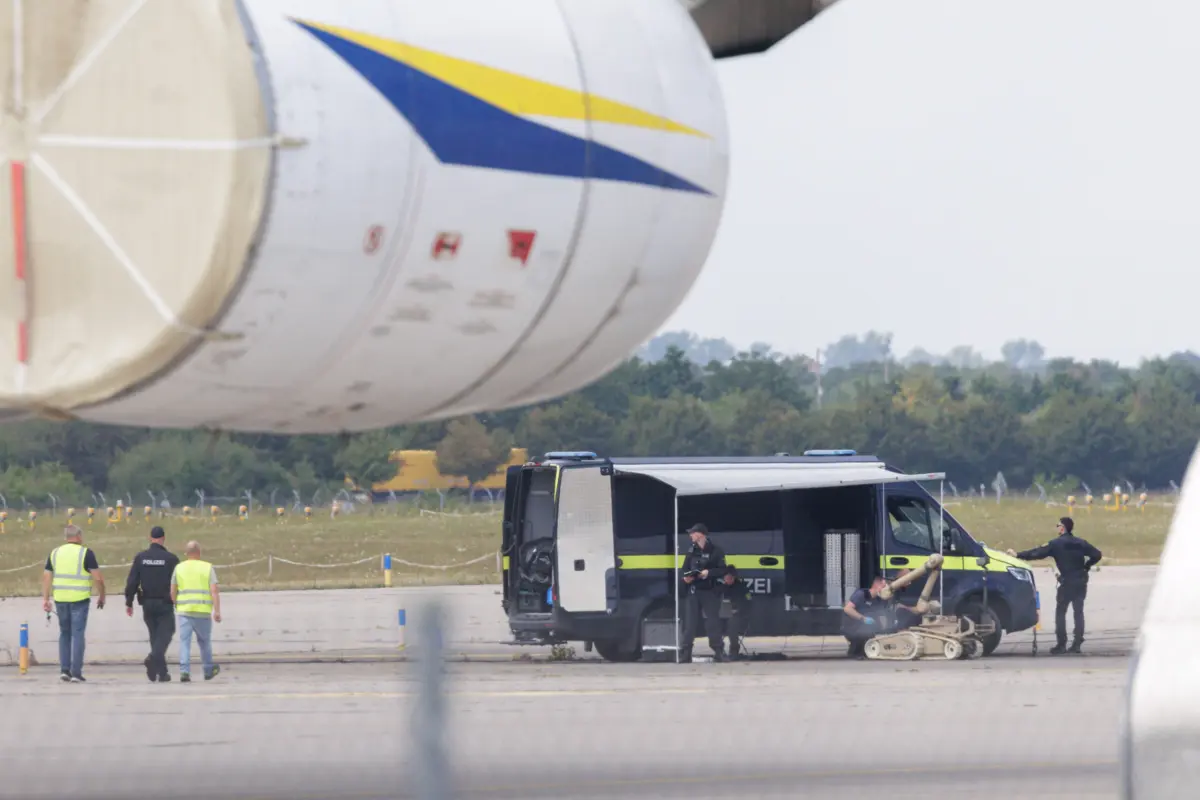
BERLIN — In a dramatic escalation of geopolitical tensions that marks a profound deterioration in relations between Western Europe and the Kremlin, the German government announced that a comprehensive security investigation has definitively linked Russia to a failed explosive drone attack at Leipzig-Halle Airport last month.
The brazen assault, targeting a critical logistics hub used for vital military and humanitarian deliveries to Ukraine, has sent shockwaves through the heart of Europe’s largest economy. In response, Berlin has unveiled a series of sharp punitive measures, including the immediate closure of Russia’s consulate in Bonn, the termination of contracts tied to a prominent Russian cultural center in Berlin, and significantly tightened border controls for Russian nationals.
Senior German officials warned that the incident is not an isolated occurrence, but rather a dangerous escalation in a wider campaign of hybrid warfare orchestrated by Moscow. Interior Minister Alexander Dobrindt stated unequivocally that the hostile activity on German soil demonstrates an alarming readiness by the Kremlin to inflict "greater damage" on European infrastructure and civilian populations.
The fallout from the Leipzig incident has triggered a coordinated European response, drawing strong declarations of solidarity from NATO and the European Union, even as Moscow dismisses the allegations as baseless fabrications and threatens retaliatory measures.
Main Facts of the Crisis
The unfolding crisis centers on an explosive drone attack launched against Leipzig-Halle Airport, a major international logistics and cargo facility in eastern Germany that serves as a primary transit point for shipments bound for Ukraine.
According to German security and government officials, the sabotage operation involved three specialized drones:
- The Impact: One explosive-laden drone struck the wing of a Ukrainian cargo plane parked on the tarmac.
- The Recovered Devices: Two additional drones were subsequently discovered in agricultural fields surrounding the airport complex.
- The Forensic Evidence: Interior Minister Dobrindt noted that the technical configuration of the drones, the specific components utilized, the chemical composition of the explosives, and the sophisticated operational planning all pointed directly to Russian state involvement.
In the wake of these findings, the German federal government implemented a series of immediate diplomatic and security countermeasures:
- Consular Closure: The Russian consulate in Bonn—the historic former seat of government of West Germany—is being shuttered this month.
- Cultural Facility Restrictions: The state contract with a key Russian cultural center operating in Berlin has been summarily canceled.
- Border Security: Berlin is tightening border controls for all Russian nationals entering the country.
- Sanctions Expansion: Foreign Minister Johann Wadephul confirmed that EU authorities are actively compiling an expanded sanctions list targeting key Russian individuals deemed responsible for hybrid aggression.
Simultaneously, senior government officials—speaking on condition of anonymity due to protocol—revealed that Germany is determined to expand its military assistance to Ukraine, specifically prioritizing assets designed to counter Russian attacks, including advanced interceptor missiles and long-range strike drones.
Chronology of Events
The road to the current diplomatic rupture spans several months of escalating security concerns, suspicious incidents, and meticulous forensic investigations across Germany and the wider European continent.
- Last Year (2025): German intelligence and law enforcement agencies launch an ongoing investigation into potential links between foreign security agents and a mysterious cache of high-grade weapons discovered hidden on the outskirts of Berlin.
- August 5, 2026: A security breach at Leipzig-Halle Airport results in a chaotic scene as a cargo plane operated by DHL hits an object amid the discovery of a drone. Several incoming and outgoing aircraft are forced to divert, prompting a massive police and forensic response on the tarmac.
- Mid-August 2026: Chancellor Friedrich Merz addresses the nation following initial intelligence briefings, declaring that the attempted drone attack on a vital Ukrainian logistics lifeline represents an unprecedented escalation in hybrid warfare and warning that the perpetrators "will pay a price."
- Late August 2026: Investigators finalize forensic reports tying the drone’s hardware, explosives, and tactics to Russian operatives. Simultaneously, talks intensify between Berlin and European Union counterparts to formulate a unified diplomatic and economic response.
- August 26, 2026: Foreign Minister Johann Wadephul publicly announces the findings of the investigation, the closure of the Bonn consulate, and the termination of the Berlin cultural center contract during a press briefing in Berlin.
- September 2026 (Ongoing): Just days after the announcement, a separate act of sabotage strikes eastern Germany’s electrical infrastructure. Unknown perpetrators damage multiple power lines, causing a brief transmission network disruption and a temporary power-plant outage, compounding national security anxieties.
Supporting Data and Context
The Leipzig drone attack does not occur in a vacuum. It forms part of an alarming, continent-wide pattern of alleged Kremlin-backed provocations designed to destabilize Western democracies, undermine public confidence, and disrupt support for Ukraine.
Over the past four years—following Russia’s full-scale invasion of Ukraine in February 2022—European security services have recorded a steady uptick in hybrid warfare tactics. These include:
- Sabotage Operations: Mysterious explosions, logistics fires, and infrastructural tampering across various NATO member states.
- Critical Undersea Infrastructure: Suspicious disruptions and damage to undersea data communication cables and offshore energy pipelines in the Baltic and North Seas.
- Espionage and Reconnaissance: An increase in unauthorized drone flights over sensitive military installations, training grounds, and industrial manufacturing centers throughout Central and Northern Europe.
The convergence of the Leipzig airport incident, the Berlin weapons cache discovery, and the recent power-infrastructure sabotage in eastern Germany has propelled Germany—traditionally cautious in its direct attribution of cyber and hybrid attacks—onto high alert. Security analysts note that the targeting of a logistics hub explicitly linked to Ukrainian supply chains represents a tactical shift from espionage and psychological disruption to direct physical sabotage on European soil.
Official Responses and Diplomatic Fallout
The international reaction to Germany’s findings has been swift, drawing sharp lines between Western allies and Moscow.
Berlin’s Stance
Foreign Minister Johann Wadephul minced no words during his address to reporters in Berlin, emphasizing that Moscow’s actions have closed the door to diplomatic engagement.
"Russia shows no willingness to reach an understanding," Wadephul said. "On the contrary: with the attempted attack in Leipzig, the Russian leadership has deliberately chosen to inflict further significant damage on our already severely strained bilateral relationship."
Chancellor Friedrich Merz reinforced this sentiment, maintaining that Germany will not be cowed by acts of sabotage and will ensure that those orchestrating such attacks face severe repercussions.
Moscow’s Retaliation and Denial
As anticipated, the Kremlin reacted with immediate indignation. Maria Zakharova, spokeswoman for the Russian Foreign Ministry, told the state-run Tass news service that Berlin’s decisions were built on fabricated pretexts and promised a "fitting response."
"Under a completely far-fetched and contrived pretext, Berlin has once again escalated bilateral relations," Zakharova stated. "As usual, no convincing or serious evidence has been presented. There simply isn’t any."
Western Allies Rally
The transatlantic community rallied instantly around Berlin, validating the German government’s intelligence assessments.
NATO Secretary General Mark Rutte issued a public statement expressing unwavering solidarity with Germany, noting that the intelligence and forensic evidence presented by Berlin was unambiguous.
European Commission President Ursula von der Leyen took to social media platform X to condemn the attack and reaffirm European unity:
"Russia is seeking to sow distrust and fear among our societies," von der Leyen wrote. "But it will fail. And we still stand by Ukraine for as long as it takes."
Implications for European Security
The formal attribution of the Leipzig drone attack to the Russian state marks a watershed moment for European security architecture. For years, Western intelligence agencies have grappled with the gray-zone nature of hybrid warfare—operations carefully calibrated to remain just below the threshold of Article 5 collective defense triggers or open military conflict.
By publicly naming Moscow, expelling consular assets, and tightening Schengen-area border controls for Russian citizens, Germany has signaled that the era of strategic patience regarding hybrid aggression is drawing to a close.
Several long-term implications emerge from this crisis:
- Hardened Domestic Security: Critical infrastructure operators across Germany and neighboring EU states are undergoing emergency security audits. Airports, rail networks, power grids, and military logistics hubs are rapidly upgrading counter-drone technologies (C-UAS) and physical perimeter surveillance.
- Accelerated Aid to Kyiv: Rather than intimidating Berlin into reducing its footprint in the war, the attack appears to have achieved the exact opposite. German officials confirm that military aid pipelines—particularly regarding advanced air defense interceptors and offensive drone systems—will be accelerated to strike back at the strategic capabilities hurting Russia most.
- Stricter EU-Wide Posture: The coordination between Berlin, NATO, and the European Commission foreshadows a wider crackdown on Russian intelligence assets operating under diplomatic cover across the continent. Future EU sanctions packages are expected to cast a much wider net, targeting not only military leaders and oligarchs, but also the clandestine networks executing hybrid operations within European borders.
As investigators continue to comb through the wreckage of the recent infrastructural sabotage in eastern Germany, the message from Berlin is unmistakable: Europe’s largest economy recognizes the new reality of a gray-zone war on its doorstep, and it is locking its doors, fortifying its alliances, and preparing to push back.
