

As the consumer appliance landscape continually shifts toward lighter, more agile, and multifunctional cleaning solutions, legacy brands face the immense challenge of modernizing without diluting their core reputation for durability. Miele, long considered an industry titan in premium floor care and home appliances, discovered this firsthand with the previous-generation Miele HX2 cordless vacuum. While built with robust German engineering, lab testers and consumers alike noted that the HX2 struggled with deep-pile carpet sand extraction, felt finicky compared to lightweight rivals from Dyson and Shark, and carried a steep $1,100 price tag that made it a difficult sell for average households.
Enter the next generation. Ahead of the IFA 2026 conference in Berlin, Miele invited tech journalists to the Miele Experience Center in Manhattan to preview its newest flagship cordless offerings: the Triflex HX3 and the Triflex HX3 Plus Aqua. Initially approached with professional skepticism—wondering if the new lineup would offer little more than an incremental bump—reviewer Ajay Kumar came away pleasantly surprised. Featuring a rebalanced weight distribution, drastically improved pickup performance, and Miele’s first-ever dedicated mopping attachment, the HX3 series represents a comprehensive attempt to rectify past shortcomings and redefine what a premium cordless stick vacuum can achieve.
Main Facts: What You Need to Know About the Miele Triflex HX3 Series
The Miele Triflex HX3 lineup introduces several structural, performance, and feature-driven upgrades designed to address the ergonomic and cleaning flaws of its predecessor:
- Rebalanced Ergonomics: Miele has shifted the weight distribution downward to alleviate wrist and arm strain during extended cleaning sessions.
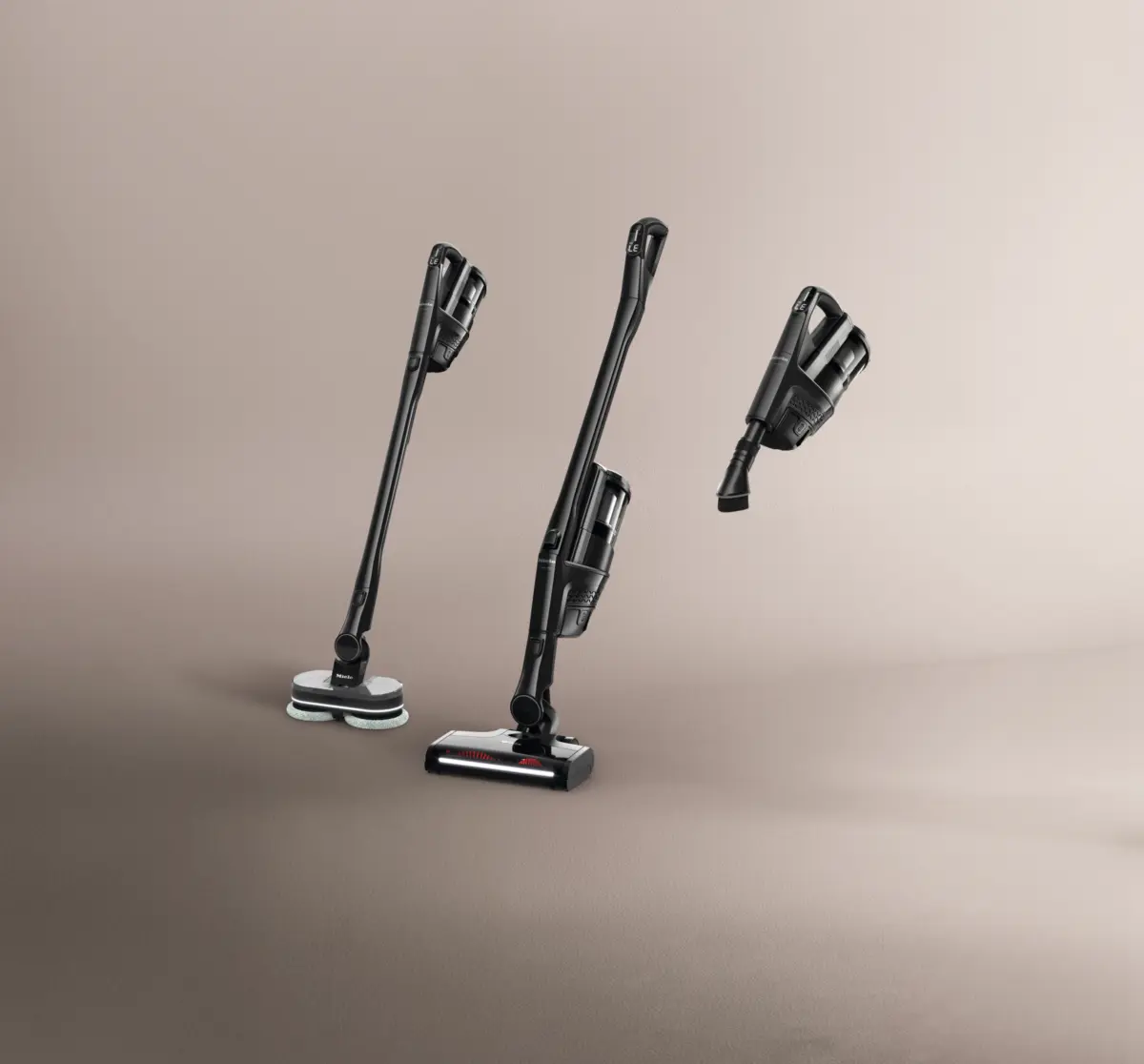
- Modular Configuration: Retaining the signature Triflex design, users can still reconfigure the motor and dustbin placement (top-heavy for high ceilings and corners, or bottom-heavy for standard floor cleaning) as well as convert the unit into a standalone upright vacuum, traditional stick vac, or handheld device.
- Performance Upgrades: The HX3 models feature substantially improved debris collection on both carpets and hard floors, easily managing pet hair and surface-level particles in preliminary hands-on demonstrations.
- The HX3 Plus Aqua: This new variant introduces Miele’s first integrated mopping system—the Aqua Twister Floorhead—equipped with dual machine-washable spinning mop pads, a 300-milliliter water tank, and a 360-degree illumination light.
- Pricing and Availability: The baseline Triflex HX3 starts at an accessible $849, while the top-tier HX3 Plus Aqua tops out at $1,249, with various intermediate models filling out the gap depending on included accessories. Furthermore, all core motor units and specs are identical across the lineup, meaning users can purchase base models and buy modular attachments separately over time.
Chronology: From the HX2 Letdown to the Manhattan Preview
To understand the significance of the Triflex HX3, it helps to examine the timeline of Miele’s recent cordless evolution and the steps leading up to its Berlin debut.

The Pre-2026 Era: The HX2 Legacy
When Miele launched the Triflex HX2, it aimed to capture the booming cordless stick vacuum market dominated by brands like Dyson. However, independent lab testing revealed significant performance gaps. While the vacuum boasted solid aesthetic design and high-end materials, it stumbled during rigorous sand-pickup trials on low- and mid-pile carpets. Combined with an idiosyncratic user interface and a daunting $1,100 price tag, the HX2 struggled to justify its cost to value-conscious consumers.
Early 2026: The Manhattan Preview
In the weeks leading up to IFA 2026 in Berlin, Miele hosted an exclusive media preview at the Miele Experience Center in Manhattan. Engineers and product representatives showcased the new Triflex HX3 and HX3 Plus Aqua. During these sessions, media members were invited to test the vacuums firsthand using simulated debris—such as imitation sand and pet hair—strewn across various carpet and hardwood surfaces.
Future Outlook: CNET Lab Testing (Fall 2026)
Following the Manhattan preview and the official IFA 2026 unveil, review units—including the high-end HX3 Plus Aqua—have been dispatched to independent testing laboratories, such as the CNET Smart Home labs. Comprehensive, lab-exclusive performance benchmarks and scoring are slated for publication in the coming weeks, providing definitive data on how the HX3 stacks up against the broader cleaning market.
Supporting Data & Technical Specifications
While complete, multi-environment laboratory metrics from independent testers are still underway, Miele has released the core specifications and feature sets for the HX3 ecosystem.

Battery Life and Coverage
- Standard Runtime: Up to 70 minutes on a single charge under optimal operating conditions.
- Cleaning Capacity: Miele estimates that a single full charge is capable of refreshing up to 1,700 square feet of living space.
- Extended Options: Select high-end configurations include an auxiliary swappable battery pack for doubled cleaning endurance.
- Boost Mode: A temporary, high-power suction setting designed for stubborn debris. On the standard floorhead, it delivers maximum suction for 10 seconds before throttling back to conserve battery. When the Aqua Twister mopping head is attached, Boost mode extends its duration to 30 seconds, automatically increasing water dispensation to tackle acute stains.
Ergonomics and User Experience Enhancements
- Upright Self-Standing Mode: Unlike many competitors that require wall docks, the HX3 can securely park itself upright unassisted—a major quality-of-life upgrade for pauses during cleaning.
- Simplified Maintenance: Redesigned dustbin mechanics allow for cleaner, more intuitive emptying without debris backspill.
- Smart Detection: Automatic floor-type recognition dynamically adjusts suction power when transitioning seamlessly from hardwood to carpets.
- Finer Filtration: Enhanced particle capture mechanisms target microscopic allergens, improving overall indoor air quality.
Pricing Tiers and Accessory Spread
Rather than forcing consumers into a single, highly expensive all-inclusive bundle, Miele has structured the HX3 release across multiple price points:
- Base Triflex HX3: Starting at $849, offering the core motor, improved weight distribution, and standard floorhead.
- Mid-Tier Configurations: Various packages ranging between $849 and $1,249 that include specialized upholstery tools, crevice attachments, or extra batteries.
- Triflex HX3 Plus Aqua: Priced at $1,249, featuring the complete accessory suite alongside the flagship Aqua Twister Floorhead mopping attachment.
Crucially, Miele confirmed that the foundational technical capabilities and motor performance remain identical across all models. Consumers who purchase a lower-tier unit can organically expand their device’s capabilities later by purchasing specific attachments à la carte.
Official Responses and Hands-On Impressions
The transition from the drawing board to real-world testing yielded enthusiastic responses from both Miele representatives and industry reviewers who put the hardware through its paces.
The Engineering Focus: Weight and Balance
Miele product specialists emphasized that user feedback regarding arm fatigue heavily influenced the redesign of the HX3 series. By rebalancing the physical architecture to anchor more weight near the floor nozzle during standard cleaning configurations, the vacuum feels significantly lighter in the hand.

However, the signature three-in-one modularity remains intact. When cleaning high-ceiling corners, ceiling fans, or crown moldings, users can quickly shift the motor and dustbin assembly back up toward the handle to restore a top-heavy, maneuverable profile.
Hands-On Performance Observations
During the Manhattan hands-on session, reviewers tested the vacuum against simulated messes:
- Pet Hair Extraction: On carpeting, the HX3 successfully lifted the vast majority of scattered pet hair within a single back-and-forth stroke, marking a noticeable improvement over the HX2.
- Hardwood Debris: Imitation sand and particulate matter on hardwood floors presented virtually no challenge, disappearing instantly under the standard floorhead.
- The Aqua Twister Floorhead: The standout addition of the Plus Aqua model was rigorously tested on dried spills and surface stains. The dual machine-washable spinning pads, illuminated by a 360-degree LED light ring, effectively buffed out grime. Reviewers noted that the adjustable water-flow mechanism successfully balanced dampness, preventing puddling while offering enough moisture to dissolve sticky kitchen residues.
Implications for the Home Appliance Market
The arrival of the Miele Triflex HX3 and HX3 Plus Aqua carries significant implications for the premium vacuum cleaner market, particularly regarding brand loyalty, multifunctional cleaning, and pricing strategies.
1. Rebuilding Consumer Trust in High-End Cordless
The cordless vacuum sector is intensely competitive, with brands like Dyson, Shark, and Tineco dominating mindshare. By directly addressing the performance bottlenecks of the HX2—specifically carpet suction and ergonomics—Miele is signaling that it listens to critical lab feedback. If independent tests confirm that the HX3 matches its preliminary hands-on performance, Miele could successfully recapture market share from buyers who previously bypassed the brand due to performance-to-cost concerns.

2. The Rise of the Multi-Surface "Wet-Dry" Hybrid
The integration of the Aqua Twister Floorhead reflects a broader industry trend: consumers increasingly demand hybrid devices that can vacuum and mop simultaneously. By combining a high-powered stick vacuum with a legitimate, motorized spinning mop head, Miele reduces the need for consumers to purchase and store separate dedicated floor scrubbers.
3. A More Consumer-Friendly Pricing Approach
By offering a modular lineup that starts at a more approachable $849 while retaining core motor performance across all tiers, Miele is lowering the barrier to entry. Allowing users to buy a base model and scale up with optional accessories over time is a smart economic strategy, especially during periods of cautious consumer spending on major home appliances.
As lab results from CNET and other major tech publications roll out in the coming weeks, the true test will be whether the production units can sustain the glowing impressions gathered in Manhattan and Berlin. For now, Miele appears to have engineered a thoughtful, powerful redemption arc for its flagship cordless lineup.
