

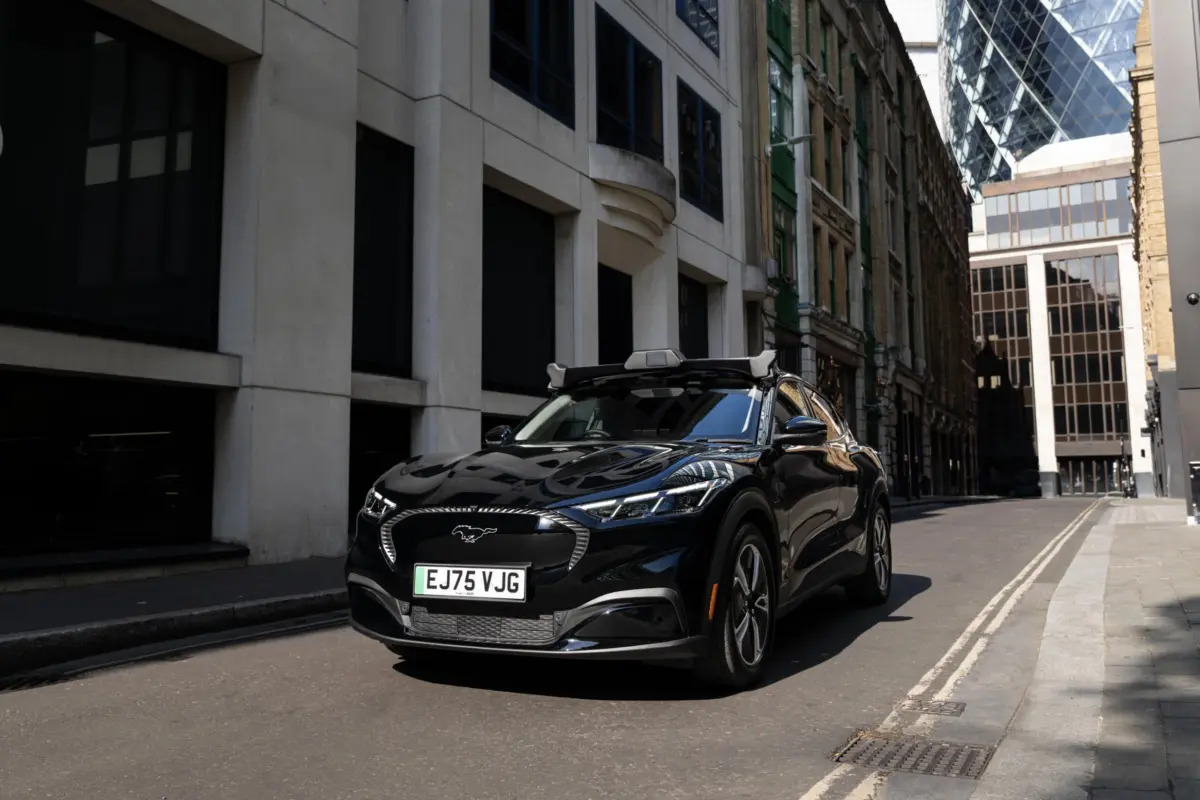
LONDON — In a high-stakes race for dominance in the European autonomous vehicle market, ride-hailing giant Uber has successfully launched London’s very first commercial robotaxi service. By partnering with UK-based autonomous driving startup Wayve, Uber has stolen a march on its primary rival, Alphabet-backed Waymo, setting a new benchmark for urban autonomous transit in the British capital.
The rollout marks a watershed moment for the commercialization of self-driving technology outside of its traditional strongholds in the United States and China. For Londoners, the future of mobility has arrived—albeit with a familiar human safety net temporarily stationed behind the steering wheel.
Main Facts
The newly inaugurated robotaxi service integrates Wayve’s cutting-edge autonomous technology directly into the Uber ecosystem. London-based customers who wish to experience the future of transport can now opt-in via their app settings. When requesting an UberX, Uber Comfort, or Uber Electric ride, users may be randomly paired with a Wayve-powered autonomous vehicle.
The initial fleet features Ford Mustang Mach-Es, with plans to incorporate Nissan Leafs in subsequent phases. To ensure a seamless operational rollout, Uber has partnered with UK fleet management and operator Otto Car to handle vehicle maintenance and servicing, while Wayve retains total control over the autonomous driving software stack.
Crucially, the vehicles are operating without traditional geofences—the virtual geographical boundaries that severely limit where most legacy robotaxis are permitted to travel. Wayve’s next-generation "AV2.0" system relies on artificial intelligence rather than rigid, hand-engineered maps, allowing the vehicles to navigate complex and dynamic environments freely.
While the cars are fully capable of navigating the labyrinthine streets of London independently, they will temporarily feature safety drivers in the front seat. Licensed by Transport for London (TfL), these operators are present to monitor performance and reassure the public, though Uber has emphasized that they do not actively control the vehicle and will be systematically phased out as the technology matures.
Chronology
The path to London’s first commercial robotaxi service has been years in the making, defined by strategic alignments, heavy capital investments, and intense corporate rivalry:

- 2017: Wayve is founded in the UK by a pair of machine learning PhD students from the University of Cambridge, pioneering a radical end-to-end deep learning approach to autonomous driving.
- The Planning Years: Uber and Wayve quietly spend several years plotting a strategic UK launch, developing the software framework and regulatory pathways necessary for a London deployment.
- Early 2026: Wayve secures a massive $1.2 billion funding round backed by a heavyweight coalition including Uber, Nvidia, Stellantis, Nissan, and Mercedes-Benz.
- Late 2026 (Present): Uber beats rival Waymo to market, launching the commercial robotaxi service in London and establishing the UK as a primary battleground for international autonomous ride-hailing.
Despite this major coup for Uber and Wayve, the competitive landscape in London remains fiercely contested. Waymo has publicly committed to launching its own London robotaxi service before the end of the year, while rival platform Lyft has partnered with Chinese autonomous vehicle giant Baidu to introduce a competing service starting in the London borough of Brent.
Supporting Data and Technical Architecture
The technical foundation of the Uber-Wayve partnership represents a distinct ideological divide in the global autonomous vehicle industry. While companies like Waymo and Cruise have traditionally relied on AV1.0 architectures—characterized by expensive hardware suites, hyper-detailed High-Definition (HD) maps, and rigid rule-based programming—Wayve has positioned itself as the standard-bearer for scalable, camera-and-radar-driven AI.
The AV2.0 Paradigm
Wayve’s system relies on what the company terms "AV2.0": a single, learned artificial intelligence driver trained to interpret the world, anticipate risks, and adapt to unfamiliar environments in real time.
- Sensor Suite: The fleet utilizes cameras and radar for perception. Notably, Wayve’s vehicles do not use lidar (light detection and ranging)—the expensive laser sensors heavily relied upon by Waymo and other legacy operators. This places Wayve’s philosophy closer to Tesla’s camera-only autonomous approach.
- Hardware Agnostic: Wayve’s software stack is designed to be hardware agnostic, capable of operating across diverse chips and sensor suites chosen by automakers.
- No HD Maps Required: Because the AI learns dynamically like a human driver, it can adapt to unmapped roads, unexpected construction, and severe weather conditions without requiring pre-surveyed HD mapping data.
Financial and Corporate Backing
The technological ambition of Wayve is matched by its war chest. The startup’s $1.2 billion funding injection earlier this year underscores the immense financial backing supporting its scale-up. Furthermore, Uber has signaled a broader global commitment to autonomy, stating its intention to spend upwards of $10 billion over time to build out its hybrid robotaxi network through partnerships with multiple developers, including Zoox, Avride, Nuro, Motional, Waabi, and Wayve.
Official Responses and Industry Perspectives
The partnership between Uber and Wayve highlights a broader strategic schism in the future of urban mobility: the debate between a hybrid network versus a dedicated, vertically integrated fleet.
Uber has consistently advocated for a hybrid ecosystem—a marketplace where human drivers and robotaxis coexist seamlessly to balance supply, demand, and labor continuity. This vision increasingly puts Uber at odds with Waymo, whose business model centers heavily on exclusive, driver-free, rider-only ecosystems. Although Waymo and Uber maintain operational partnerships in US markets like Austin and Atlanta, industry insiders note that their diverging visions have strained relations, fueling persistent rumors of an impending corporate separation.
Commenting on the milestone, representatives for Wayve emphasized the scalability advantages of their AI-first approach. "The traditional AV1.0 approach relies on hand-engineered stacks, HD maps, and a rule-based approach—this limits scalability and the ability to rapidly generalize to new environments or complex scenarios," the company stated. "Wayve’s AV2.0 takes a different path: a single, learned AI driver trained to understand the world, anticipate risk, and adapt to new environments."

For its part, TfL has maintained a rigorous safety-first stance, ensuring that all safety drivers supervising the initial London rollout are fully licensed and vetted. The transit authority’s cooperative yet cautious oversight has allowed London to emerge as a primary international testing ground for next-generation transportation tech.
Implications
The successful deployment of Wayve-powered robotaxis on London streets carries profound implications for the global ride-hailing industry, urban infrastructure, and the future of labor.
1. Proving Ground for Non-US/Chinese Markets
To date, the vast majority of commercial robotaxi deployments have been geographically concentrated in the United States and China, with minor pockets in the Middle East. London serves as the ultimate stress test for whether Western European urban centers—characterized by dense, historical street layouts, complex pedestrian behaviors, and rigorous regulatory scrutiny—have a consumer appetite for driverless ride-hailing.
2. The Lidar Debate Realized
By successfully operating without lidar in one of the world’s most congested and complex driving environments, Wayve is helping to validate the camera-and-radar-centric AI model. If the service proves safe and reliable at scale, it could drastically lower the manufacturing cost of autonomous vehicles, making mass production and broad commercial deployment economically viable much faster than anticipated.
3. Redefining the Uber Platform
By positioning itself as an open-network aggregator rather than an exclusive hardware manufacturer, Uber is insulating itself from the immense capital expenditure of building and maintaining proprietary fleets alone. By integrating diverse partners like Wayve, Zoox, and Motional into a single app interface, Uber is attempting to become the definitive clearinghouse for all autonomous mobility—ensuring that whether a Londoner hails a human-driven electric vehicle or an AI-controlled Mustang Mach-E, Uber captures the transaction.
As the safety drivers are gradually phased out and Waymo prepares its own imminent London debut, the streets of the British capital have officially become the most important laboratory for the future of global transportation.
