

By: HousingWire TBD Reporting Desk
Date: October 2023 / Expanded Feature
Main Facts
In the contemporary landscape of American homebuilding, traditional scale is synonymous with satellite GPS mapping, drone-controlled aerial surveys, and sprawling, master-planned suburban tracts. It manifests as thousands of platted lots controlled by a single balance sheet, national bulk-purchasing agreements, and decentralized operating divisions driving down fixed costs through massive, repeatable volume.
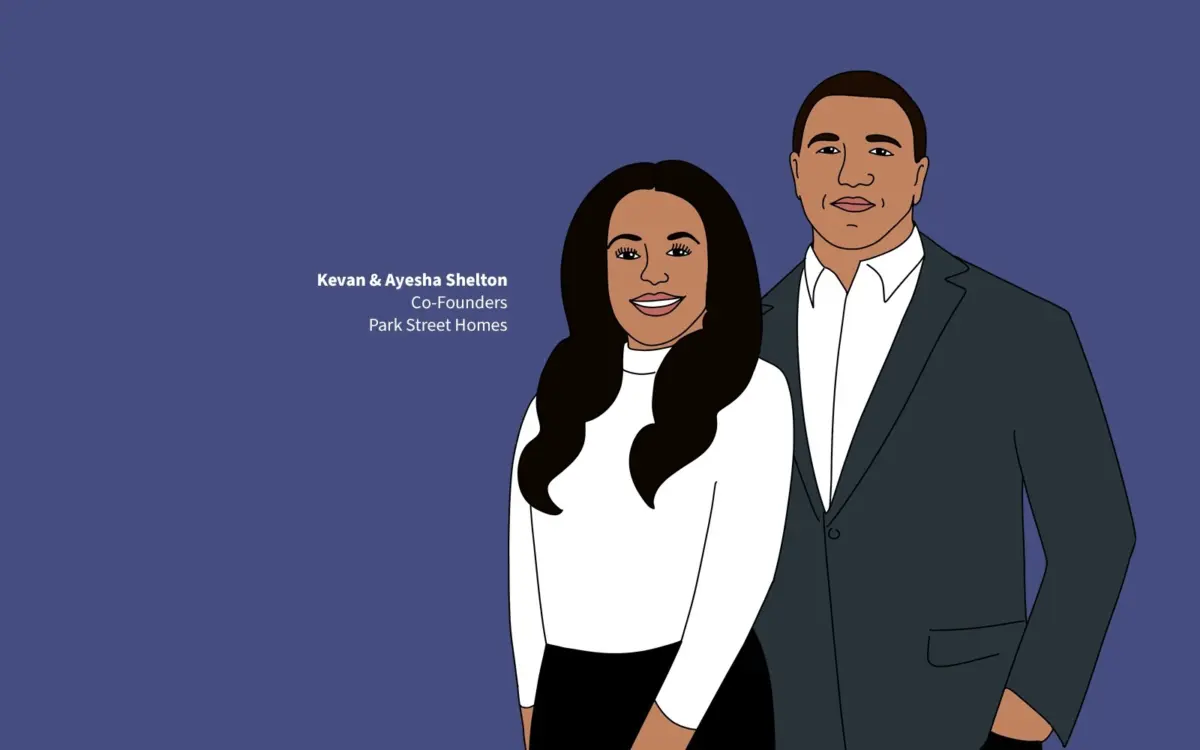
Kevan and Ayesha Shelton, the co-founders of Park Street Homes, are operating under a radically different definition.
Through their Houston-based enterprise, the Sheltons have spent the past decade proving that the mechanical efficiency of production-homebuilding can be successfully deployed where conventional volume builders routinely fail: established urban cores. These are environments defined by fragmented parcel ownership, aging municipal infrastructure, deep-rooted historical architecture, and watchful neighborhood stakeholders who demand accountability for every new foundation poured next door.
Despite a punishing macroeconomic environment characterized by fragile consumer demand, persistent affordability gaps, and high capital costs, Park Street Homes is preparing for an aggressive expansion phase. The company has targeted roughly 15 new urban markets nationwide for entry and is actively raising capital to accelerate this growth trajectory.
However, unlike national production builders whose growth is measured in multi-hundred-acre acquisitions, Park Street’s unit of expansion remains intentionally granular: block by block, neighborhood by neighborhood, city by city.
Chronology: The Evolution of an Urban Infill Pioneer
To understand how Park Street Homes reached this inflection point, it is necessary to examine the evolution of its operating model over the past decade:
- 2013–2018 (The Proof of Concept): Operating primarily in Houston, the Sheltons initially focused on mastering the complexities of urban infill. They recognized that while land acquisition was difficult and piecemeal, the underlying demand for attainable housing in urban centers was virtually limitless if products could be priced correctly.
- 2019–2021 (Refining "Reflective Design"): Park Street codified its hybrid operating philosophy. The company decoupled its structural building plans—relying on repeatable, efficient construction methodologies behind the walls—from its exterior elevations, which were meticulously designed to mirror the historical and cultural context of each specific neighborhood.
- 2022 (Market Volatility and Validation): As interest rates spiked and broader market demand softened, Park Street found that its core mission of urban affordability aligned directly with macroeconomic shifts. While competitors struggled with sudden demand shocks, Park Street’s long-horizon land-takedown strategy insulated its pipeline.
- 2023 (The Expansion Blueprint): Park Street was featured prominently in HousingWire’s Built For This series. The company initiated discussions with major investment banks and potential strategic homebuilding partners to secure capital for multi-market expansion, targeting approximately 15 new metropolitan statistical areas (MSAs).
- October 2023 and Beyond: Kevan Shelton prepares to take the stage at the HousingWire Homebuilder Summit in Dallas to discuss the intersection of production efficiency and local trust, cementing Park Street’s position as a blueprint for non-traditional homebuilding scale.
Supporting Data & Comparative Industry Analysis
Park Street Homes occupies a unique vanguard position within the Built For This series, sharing philosophical DNA with peers like National Home Corp. and StyleCraft Builders, yet attacking market headwinds from a fundamentally different angle.
| Builder | Core Operating Strategy | Competitive Advantage | Primary Market Focus |
|---|---|---|---|
| National Home Corp. | Land-light production discipline | Disciplined playbook tied to attainable price points | Broad regional suburban markets |
| StyleCraft Builders | Back-to-basics operational execution | Mastery of schedules, purchase orders, and variance reduction | Growing regional suburban corridors |
| Park Street Homes | Hybrid production/urban infill model | "Reflective design" and community trust as infrastructure | Established, overlooked urban neighborhoods |
While National Home Corp. leans into a land-light production model to maintain gross margins and StyleCraft CEO Doug French focuses intensely on operational fundamentals—such as cycle times and purchase order accuracy—Park Street’s competitive moat begins where conventional builders see insurmountable friction.
Large-scale public builders often bypass small, scattered parcels in urban cores because their volume requirements and overhead structures demand large, contiguous tracts. Park Street views these overlooked fragments as a scalable pipeline. By establishing pricing and design metrics 12 to 24 months before a home is delivered, the company achieves a level of financial visibility that shields it from immediate market volatility.
Official Responses and Executive Insights
The tension between repeating an operating system and respecting local context is central to Park Street’s strategic vision. Company leadership has articulated this challenge through several key reflections:
"As we’ve grown and done more, I think we found the thread of a sweater," Kevan Shelton said during a recent one-on-one interview. "We realize that our model is such a needed thing in almost every urban core around the country."
Addressing the delicate balance between standardization and localization, Shelton emphasized that the internal mechanics of a home do not need to change for the exterior to respect its environment:
"We can take our same plans, kind of change the face to the neighborhood culture of where we are, but the core tenets of the plan work. The core tenets of the philosophy around the plan work."
On the subject of market timing and affordability, Shelton noted that the broader economic downturn ironically validated their long-standing mission:
"What we found ourselves, especially in the affordable housing space, it seems like the market met us where we were. We were focused on affordability, and then everybody now is focused on affordability."
However, he acknowledged the reality of consumer sentiment: "In a market like this, demand is what really is more fragile. I think in 2022 you could throw a dart and sell a house, and now you have to do a lot more convincing."
Finally, regarding the upcoming multi-market expansion, Shelton outlined a collaborative "two-handed" approach to capital and execution:
"We’ve identified […] about 15 additional markets other than the markets that we’re in that we have on our list to expand to. It is on that neighborhood-by-neighborhood, kind of city-by-city scale."
Implications: A New Architecture for Industry Scale
The implications of Park Street Homes’ trajectory extend far beyond Houston, offering critical lessons for an American housing sector grappling with chronic under-supply, high land costs, and zoning hurdles.
1. Trust as Operating Infrastructure
In traditional suburban development, a builder’s "infrastructure" consists of concrete, utilities, and grading. In Park Street’s urban infill model, trust is the infrastructure. Municipal relationships, zoning entitlements, nonprofit partnerships, and community acceptance directly dictate velocity. If a builder alienates the existing neighborhood, entitlements stall, legal challenges mount, and the production machine grinds to a halt. By treating community integration as an essential operational input rather than an afterthought, Park Street converts potential resistance into a defensive moat.
2. Redefining the Threshold of Scale
For decades, the housing industry has operated under the assumption that consolidation and sheer size are the only paths to survival. National builders leverage massive purchasing power and overhead efficiency, but their size creates a high threshold of minimum viable project size. Opportunities falling below that threshold are discarded as inefficient noise. Park Street proves that a profitable, highly scalable business can be built entirely out of the opportunities that major national builders reject.
3. Navigating the Leadership Dilemma
The immediate challenge facing Kevan and Ayesha Shelton is a classic scaling paradox: determining what to standardize and what to leave fluid.
- What must be standardized: Construction sequencing, purchasing contracts, architectural framing efficiency, capital allocation, and back-office accounting.
- What must never be standardized: Historical context, neighborhood architectural cues, local stakeholder engagement, and the nuanced understanding of block-by-block demographics.
4. Macroeconomic Resilience Through Visibility
As the housing industry navigates an era of high mortgage rates, sticky inflation, and cautious buyers, builders who rely on immediate-market sentiment are suffering. Park Street’s long-horizon approach—securing land, establishing pricing, and aligning with community needs years in advance—demonstrates that true resilience comes from structural clarity rather than market timing.
As Kevan Shelton prepares to present these insights at the upcoming HousingWire Homebuilder Summit in Dallas, the broader industry faces a compelling challenge. When macroeconomic headwinds offer little external relief, survival and growth do not come from waiting for the economy to change. They come from defining what your business can do that no one else can—and executing it with relentless, disciplined precision.
