

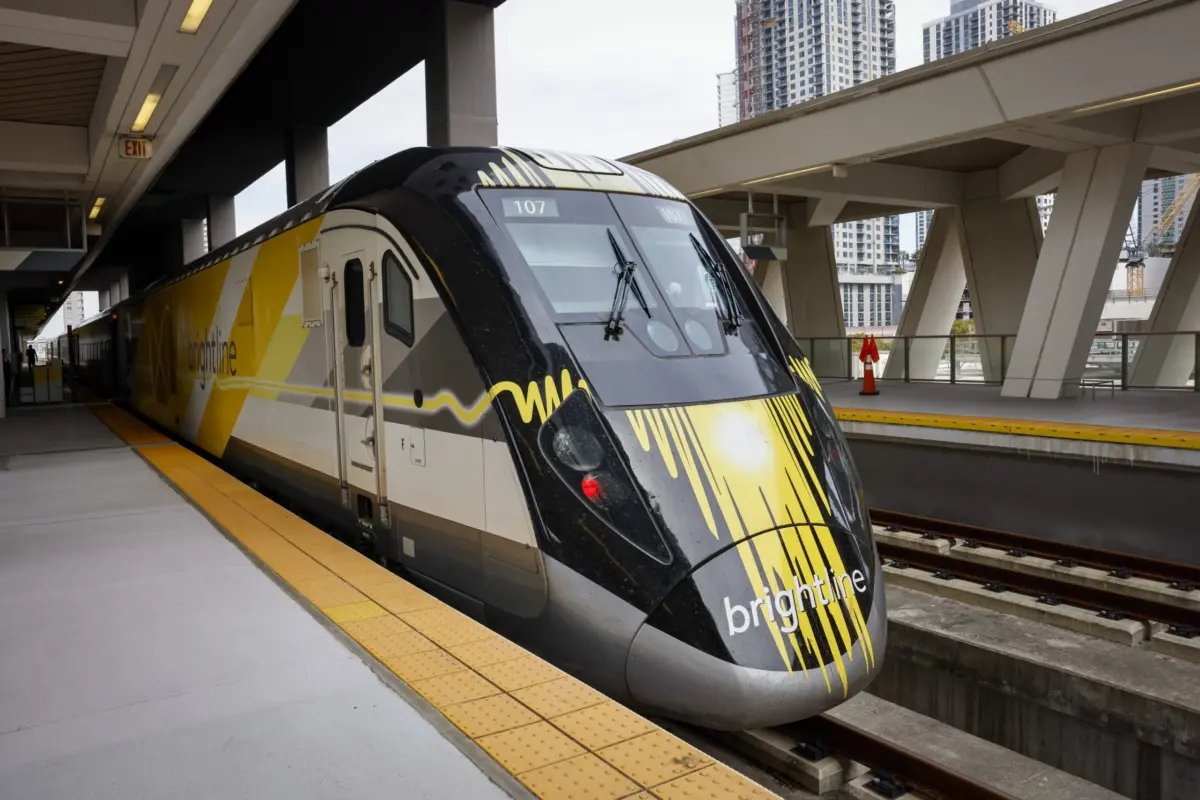
NEW YORK/NEW JERSEY — Brightline Holdings LLC, the high-profile private developer and parent entity of Florida’s much-heralded intercity passenger railroad, has officially filed for Chapter 11 bankruptcy protection. The filing, executed on Thursday in a New Jersey federal court, marks a dramatic financial reckoning for a project that sought to redefine American infrastructure by bridging Miami and Orlando with high-speed rail.
Years of lower-than-expected revenue, compounded by a staggering and complex $5.5 billion debt stack, left the company unable to service its multi-billion-dollar liabilities. Despite the dramatic restructuring proceedings at the holding company level, the operational arm of the transit system remains untouched by the court filing. Trains continue to run between South Florida and Central Florida on their regular schedules, offering a semblance of business-as-usual for commuters and tourists alike as financial stakeholders attempt to steer the enterprise toward long-term solvency.
The bankruptcy filing is a major blow to Fortress Investment Group, the private equity powerhouse that backed the venture, and particularly to billionaire Fortress co-founder Wes Edens. Edens originally conceived of the private railroad in 2012 with a grand vision of introducing modern, European-style high-speed rail to a nation largely devoid of it. However, high construction costs, aggressive municipal-bond leveraging, and sluggish post-pandemic adoption rates turned the ambitious undertaking into a slow-motion journey toward insolvency.
Main Facts of the Restructuring
The Chapter 11 petitions filed by Brightline Holdings LLC and select parent entities list estimated assets and liabilities both falling within the $1 billion to $10 billion range. Crucially, the filing strategically excludes the primary operating company, BrightLine Trains Florida LLC. This legal firewall allows day-to-day operations, maintenance, station management, and passenger services to continue uninterrupted while financial stakeholders negotiate a comprehensive debt overhaul behind closed doors.
To keep the enterprise solvent through the restructuring process, Brightline has secured $258 million in debtor-in-possession (DIP)—or post-petition—financing. This vital liquidity injection is being provided by a consortium led by bond insurer Assured Guaranty Ltd. and other institutional investors.
Furthermore, Assured Guaranty and participating stakeholders have agreed to inject an additional $490 million in new long-term debt upon the company’s eventual emergence from Chapter 11 protection.
- Total Debt Burden: Approximately $5.5 billion.
- Immediate DIP Financing: $258 million (provided by Assured Guaranty and other investors).
- Exit Financing Commitment: $490 million in new long-term capital upon exit.
- Protected Entities: BrightLine Trains Florida LLC (the operating company) is excluded from the filing, ensuring continuous train service.
- Bond Structuring: Under the proposed restructuring outline, $2.2 billion in Series 2024 bonds issued by Brightline Trains Florida, alongside another $2.2 billion in bonds issued by associated entities, will remain outstanding with no principal reductions.
Chronology of an Ambitious Rail Project
To understand how a private rail pioneer found itself in federal bankruptcy court, one must trace the timeline of Brightline’s expansion, financial engineering, and ultimate collision with economic reality.
2012–2018: Inception and the South Florida Genesis
- 2012: Billionaire Wes Edens and Fortress Investment Group conceptualize a private high-speed rail network in Florida, intending to privately finance and build a transformative transit corridor.
- 2018: Brightline officially launches its initial passenger service connecting West Palm Beach, Fort Lauderdale, and Miami, operating on existing tracks upgraded for higher speeds. The service garners early praise for its modern stations, sleek trainsets, and upscale amenities, though it operates at a net loss during its infancy.
2019–2023: The Orlando Bet and Municipal Bond Markets
- 2019: In a rare and bold move for the municipal-bond market—where private passenger rail bankruptcies are historically sparse—Brightline taps institutional investors for $1.5 billion in tax-exempt bonds to help finance the massive, multi-billion-dollar infrastructure extension from South Florida to Orlando International Airport.
- 2023 (Late): After years of construction delays, supply chain hurdles, and pandemic-era headwinds, the Miami-to-Orlando high-speed extension officially opens to the public. Hailed as a milestone for American transit, the rollout is immediately followed by a sobering economic reality check: passenger volumes fail to match the aggressive feasibility projections used to pitch the bond offerings. Within months of launch, Brightline begins quietly slashing its future ridership forecasts.
2024–2026: The Financial Precipice and Collapse
- April 2024: Struggling with cash flow and ballooning capital expenditure obligations, Brightline returns to Wall Street to market a $1.2 billion junk-debt sale. This high-yield offering opens the floodgates to opportunistic hedge funds and distressed-debt investors who begin accumulating exposure.
- Late 2024–2025: As interest payments are repeatedly missed and financial strain intensifies, these hedge fund bondholders begin huddling separately from traditional insurers, drafting their own aggressive restructuring proposals aimed at wresting control of the enterprise from Fortress.
- Late 2025–Early 2026: In a desperate bid to stave off insolvency, Brightline initiates a late-stage corporate sale process, shakes up its C-suite by hiring former Eurostar CEO Nicolas Petrovic, and evaluates competing debtor-in-possession loan packages from dueling creditor factions.
- Thursday (Filing Date): With consensus on a holistic out-of-court debt swap proving impossible to reach, Brightline Holdings LLC files for Chapter 11 bankruptcy protection in New Jersey, utilizing Assured Guaranty’s financing package to stabilize the balance sheet.
Supporting Data and Financial Anatomy
The municipal-bond market has long viewed private high-speed rail with a mixture of awe and skepticism. Brightline’s massive capital expenditures required unprecedented financial leverage, culminating in a reported $5.5 billion debt stack.
When the company marketed its $1.5 billion muni bond package in 2019 and its subsequent $1.2 billion junk debt offering in 2024, it relied heavily on projections that assumed rapid corporate travel adoption, high tourist volumes, and premium ticket pricing models. However, inflation, shifting post-pandemic corporate travel habits, and the sheer capital intensity of maintaining dedicated high-speed infrastructure strained those assumptions.
Despite the sweeping nature of the Chapter 11 filing, structural protections have been engineered to safeguard key tranches of debt. According to official company disclosures, the $2.2 billion Series 2024 bonds issued by Brightline Trains Florida will remain fully in place throughout the restructuring process. An additional $2.2 billion in bonds issued by associated corporate entities will likewise remain outstanding, with stakeholders agreeing to preserve principal amounts rather than imposing haircuts on those specific instruments.
The $258 million DIP loan ensures that day-to-day operations—spanning diesel-electric locomotives, track maintenance, signaling systems, station operations, and staffing—are shielded from the liquidity crunch impacting the parent entities.
Official Responses and Stakeholder Perspectives
Reactions from corporate leadership and primary financial backers emphasize continuity, resilience, and a shared belief in the underlying operational fundamentals of the rail corridor.
Patrick Goddard, Chief Executive Officer of Brightline Florida, struck an optimistic tone regarding the path forward, pointing to the commitment of institutional capital as proof of the system’s long-term commercial viability.
"Today’s agreement brings $490 million in new long-term capital to Brightline from the stakeholders who know this business, and it comes at a time of real momentum," Goddard said in a corporate statement. "This transaction will be a catalyst for further growth in ridership and revenue."
Assured Guaranty, which insures a substantial majority of the existing senior tax-exempt bonds issued by BrightLine Trains Florida LLC, framed its financial life raft as a necessary intervention to protect both investors and a vital piece of American transit infrastructure.
"This new capital will be used to support Brightline Florida’s ongoing operations and help position it for long-term stability and success, in addition to repaying the post-petition financing," Assured Guaranty stated, underscoring its confidence in the fundamental utility of the Miami-to-Orlando rail link.
Meanwhile, representatives for Fortress Investment Group and founder Wes Edens have remained publicly measured, recognizing that while the holding company’s balance sheet requires radical surgery, the core physical asset—the tracks, rolling stock, and right-of-way—remains intact.
Broader Implications: A Reality Check for Private Infrastructure
Brightline’s journey from a celebrated visionary project to federal bankruptcy court carries profound implications for the future of privately funded passenger rail in the United States.
For decades, conventional wisdom held that passenger rail in the U.S. could not survive without heavy, continuous government subsidies and public sector backing. Brightline’s founders sought to shatter that paradigm, betting that real estate development rights around stations, combined with premium hospitality-focused travel experiences, could generate enough cash flow to service private debt.
While the operating trains prove that consumer demand for high-speed rail exists in Florida—attracting hundreds of thousands of monthly passengers—the economics of servicing multi-billion-dollar infrastructure debt through passenger revenues alone have proven brutally unforgiving.
As Brightline moves through the Chapter 11 process in New Jersey, its fate will be closely monitored by institutional investors, municipal bond traders, and urban planners alike. The restructuring will test whether private equity and bond insurers can successfully right-ship an infrastructure titan without disrupting public service, and whether the grand experiment of private high-speed rail in America can emerge from financial wreckage leaner, wiser, and ultimately sustainable.
