

By Anthony Capkun
Published: October 1, 2026
Main Facts
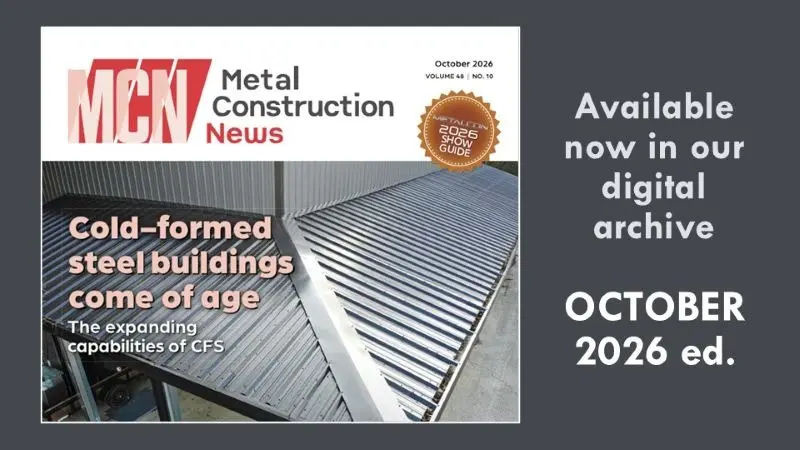
The industrial and metal construction sector faces a pivotal moment of transformation, driven by rapid advancements in material science, evolving regulatory standards, and complex logistical demands. Addressing these macro trends head-on, Metal Construction News (MCN) has officially released its comprehensive October 2026 edition.
Available both in print and through the publication’s digital channels, the latest issue delivers in-depth reporting tailored for architects, engineers, contractors, and metal building manufacturers. The October line-up zeroes in on several critical verticals shaping the built environment:
- The Maturation of Cold-Formed Steel (CFS): A deep dive into how technological leaps in design software and engineering practices are shattering traditional boundaries for CFS structures.
- The Official METALCON 2026 Show Guide: An exhaustive preview of the industry’s premier annual event, including floor plans, exhibitor lists, educational pathways, and high-level masterclasses.
- Building Envelope Diagnostics: A reframe of ice damming not merely as a seasonal nuisance, but as a critical structural and thermal failure point in expansive metal distribution facilities.
- Workforce Management Realities: Strategies for overcoming the severe labor tracking complications inherent to multi-site construction operations.
- Next-Generation Safety Equipment: An evaluation of the widening chasm between bare-minimum OSHA compliance and cutting-edge personal protective equipment (PPE).
- Coastal Resilience: A focused exploration of AMCA 550-certified louvers and their indispensable role in hurricane-prone architectural designs.
The release of this month’s digital and print issues marks another milestone for Metal Construction News as it continues to document the intersection of high-performance materials and modern project management.
Chronology: The Lead-Up to the October 2026 Release
The publishing of the October 2026 edition is the culmination of months of field research, industry surveys, and coordination leading up to the autumn trade show season.
- Late Spring 2026: Editorial teams at MCN began aggregating data regarding the expanding capabilities of cold-formed steel. Recognizing a surge in mid-rise and commercial applications, reporters initiated interviews with structural engineers and software developers specializing in computer-aided manufacturing (CAM) integrations.
- Mid-Summer 2026: Preparations for the METALCON 2026 show guide commenced in earnest. Organizers finalized floor plans, workshop schedules, and keynote presentations, allowing MCN’s editorial staff to compile a comprehensive, user-friendly roadmap for attendees.
- August 2026: As summer turned toward fall, building envelope consultants raised alarms regarding thermal bridging and moisture management in large industrial spaces. MCN expanded its planned coverage on ice damming, shifting the narrative from a simple maintenance issue to an underlying thermal failure.
- September 2026: Contractors and project managers weighed in on the administrative bottlenecks of multi-site operations, prompting a dedicated feature on advanced geofencing and digital labor tracking tools. Concurrently, safety consultants finalized assessments on modern PPE standards.
- October 1, 2026: The October 2026 edition officially goes live, hitting the desks of industry professionals and opening access via the Metal Construction News Digital Edition Archive.
Supporting Data and Deep-Dive Analysis
The articles featured in the October 2026 issue reflect broader, data-backed shifts occurring across the North American construction landscape.
1. Cold-Formed Steel (CFS) Comes of Age
For decades, cold-formed steel was primarily constrained to interior partitioning, non-load-bearing walls, and low-rise residential framing. However, the October issue highlights how advanced structural modeling software, tighter manufacturing tolerances, and composite panel systems have unlocked new structural horizons.
Data from structural engineering firms indicate that modern CFS framing can now support multi-story commercial offices, healthcare facilities, and light industrial complexes with significantly reduced dead loads compared to traditional hot-rolled steel or concrete alternatives. Prefabrication and panelization have also cut framing cycle times by up to 30%, addressing ongoing schedule pressures in the commercial sector.
2. Thermal Failures and Ice Damming in Mega-Warehouses
The explosive growth of e-commerce has led to the proliferation of massive metal distribution centers—often spanning hundreds of thousands of square feet. According to MCN’s envelope analysis this month, facility managers frequently misdiagnose winter ice damming as a localized roofing leak.
In reality, ice accumulation along the eaves of large metal distribution hubs is a symptom of severe thermal envelope failure. Inconsistent insulation continuity, air leakage from high-volume interior spaces, and poor ventilation within the roof assembly cause interior heat to escape, melting rooftop snow that subsequently refreezes at the colder eaves. Left unaddressed, these thermal bridges lead to premature fastener corrosion, degraded sealants, and catastrophic interior water damage.
3. The Multi-Site Labor Tracking Dilemma
As construction firms scale operations across regional and national footprints, labor tracking has emerged as a major financial leak. MCN’s operations feature highlights that traditional manual timesheets and fragmented communication channels lead to widespread misallocated project hours.
Industry benchmarks cited in the report reveal that unrecorded travel time between multiple active jobsites and inaccurate task-switching entries can distort true job costs by 5% to 12%. In an era of compressed profit margins and competitive bidding, these discrepancies can easily turn a profitable project into a loss, undermining the accuracy of future estimates.
4. Safety Gear: Compliance vs. Innovation
The conversation around jobsite safety has evolved beyond checking regulatory boxes. The October issue tackles the growing divergence between equipment that merely meets minimum Occupational Safety and Health Administration (OSHA) standards and equipment engineered around human-centric ergonomics, smart-sensor integration, and enhanced impact mitigation. Contractors adopting advanced fall protection, wearable fatigue-monitoring sensors, and lightweight breathable harnesses report tangible drops in injury rates and improved daily worker comfort.
5. Coastal Resilience and AMCA 550 Louvers
With extreme weather events increasing in frequency and intensity along the Atlantic and Gulf coasts, architectural standards are tightening. MCN’s architectural focus centers on AMCA 550-certified louvers. Unlike standard louvers, AMCA 550-rated products are specifically tested to withstand high-velocity wind-driven rain and prevent water penetration into mechanical intakes during severe hurricanes. For architects designing critical infrastructure and commercial properties in hurricane zones, integrating these certified systems is no longer optional—it is a code-mandated necessity.
Official Responses and Industry Reactions
The release of the October 2026 edition has drawn positive early commentary from trade associations, event organizers, and engineering leaders who contributed to or are featured in the issue.
"The metal construction industry is moving at an unprecedented pace, driven by the need for speed, sustainability, and structural resilience," said an industry spokesperson close to the METALCON 2026 planning committee. "Resources like the October MCN issue—particularly the comprehensive show guide and deep dives into technical topics like thermal envelope diagnostics—provide our attendees and exhibitors with the vital knowledge they need to stay competitive."
Contractors specializing in envelope maintenance have similarly praised the magazine’s focus on ice damming as a systemic thermal failure.
"For years, building owners treated ice dams with a bag of rock salt or a temporary heat tape fix," noted a senior building envelope consultant. "By reframing this as a core thermal design and insulation continuity failure, Metal Construction News is helping the industry address the root cause rather than treating the symptoms. This is crucial for protecting the long-term asset value of large distribution centers."
Implications for the Metal Construction Sector
The insights compiled in the October 2026 edition of Metal Construction News carry profound implications for stakeholders across the supply chain:
- For Architects and Designers: The technical breakdowns of AMCA 550 louvers and evolving CFS capabilities mean designers can push aesthetic and structural boundaries without sacrificing safety or code compliance in harsh climates.
- For General Contractors and Project Managers: The operational focus on multi-site labor tracking underscores the urgent need to adopt digital, cloud-based project management tools. Firms that fail to tighten their labor accounting risk losing bids to more technologically agile competitors.
- For Facility Owners and Maintenance Teams: Shifting perspectives on roof thermal dynamics emphasizes that proactive envelope maintenance and energy auditing are far more cost-effective than reactive leak remediation.
- For Event Attendees: The METALCON 2026 Show Guide serves as an essential roadmap for navigating the educational sessions, workshops, and exhibition floors, ensuring participants maximize their return on investment during the industry’s premier annual gathering.
Industry professionals can explore these stories in full by picking up the print edition or accessing the Metal Construction News Digital Edition Archive online.
