

Published: October 10, 2026
Original Author: Camilla Ghisleni (ArchDaily)
Topic: The Lure of Escapism in Architecture and Alternative Worlds
Main Facts
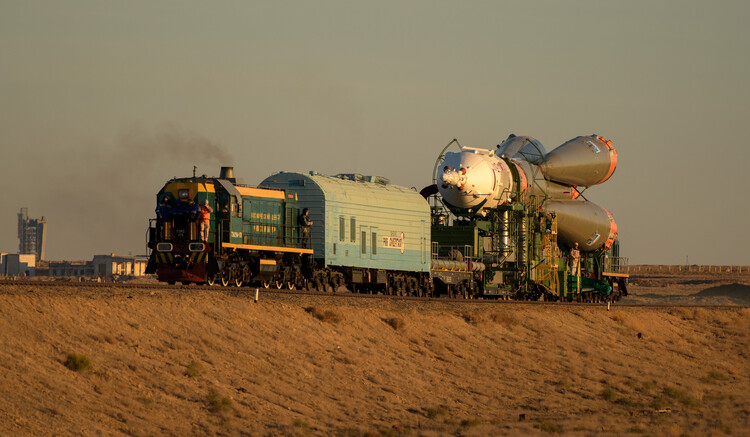
When history books record April 12, 1961, as the watershed moment humanity first broke free from Earth’s gravity, they frequently credit the Soviet Union for winning the initial leg of the space race. However, the precise launchpad for Yuri Gagarin’s historic orbital flight lies deep within the arid, wind-swept steppes of Kazakhstan at the Baikonur Cosmodrome. This remote location was more than just a logistical choice; it served as the physical epicenter of a colossal ideological enterprise.
During the mid-20th century, Kazakhstan occupied a strategic, highly expansive frontier at the southern edge of the Union of Soviet Socialist Republics (USSR), bridging Europe and Asia. Because of its vast territorial size and low population density, the republic became a blank canvas for the Soviet regime’s most ambitious scientific, industrial, and military experiments. Planned cities rose from the desert dust to support these technological marvels, transforming the physical landscape into a living testament to socialist supremacy.
Architecture, engineering, and monumental public art were deliberately leveraged to construct and market a specific narrative to the global stage: that the Soviet future had already arrived, and that it belonged exclusively to the USSR. From the cosmic motifs embedded in Central Asian mosaics to the seismic-resistant towers of Almaty, the built environment functioned as a physical manifestation of state propaganda. This article explores how Soviet modernism in Kazakhstan shaped an enduring spatial imaginary—one that continues to influence the country’s contemporary megaprojects today.
Chronology of an Era: From Steppe Frontier to Space Age
To understand how Kazakhstan became a crucible for futuristic Soviet architecture, it is necessary to examine the timeline of its transformation:
- 1955: The establishment of the Baikonur Cosmodrome (originally named Tyuratam) in the Kyzylorda region of Kazakhstan. What began as a secret military testing range rapidly evolved into the cradle of global space exploration.
- April 12, 1961: Cosmonaut Yuri Gagarin blasts off from Baikonur aboard Vostok 1, catapulting the Soviet Union into a position of unmatched technological prestige and cementing Kazakhstan’s role in the space race.
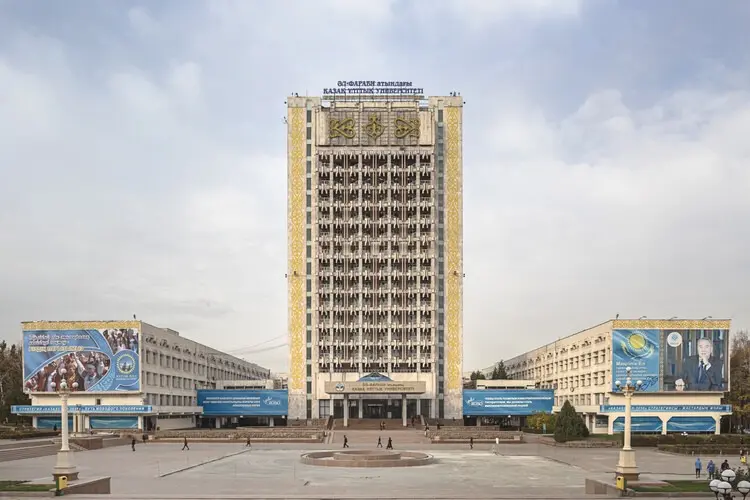
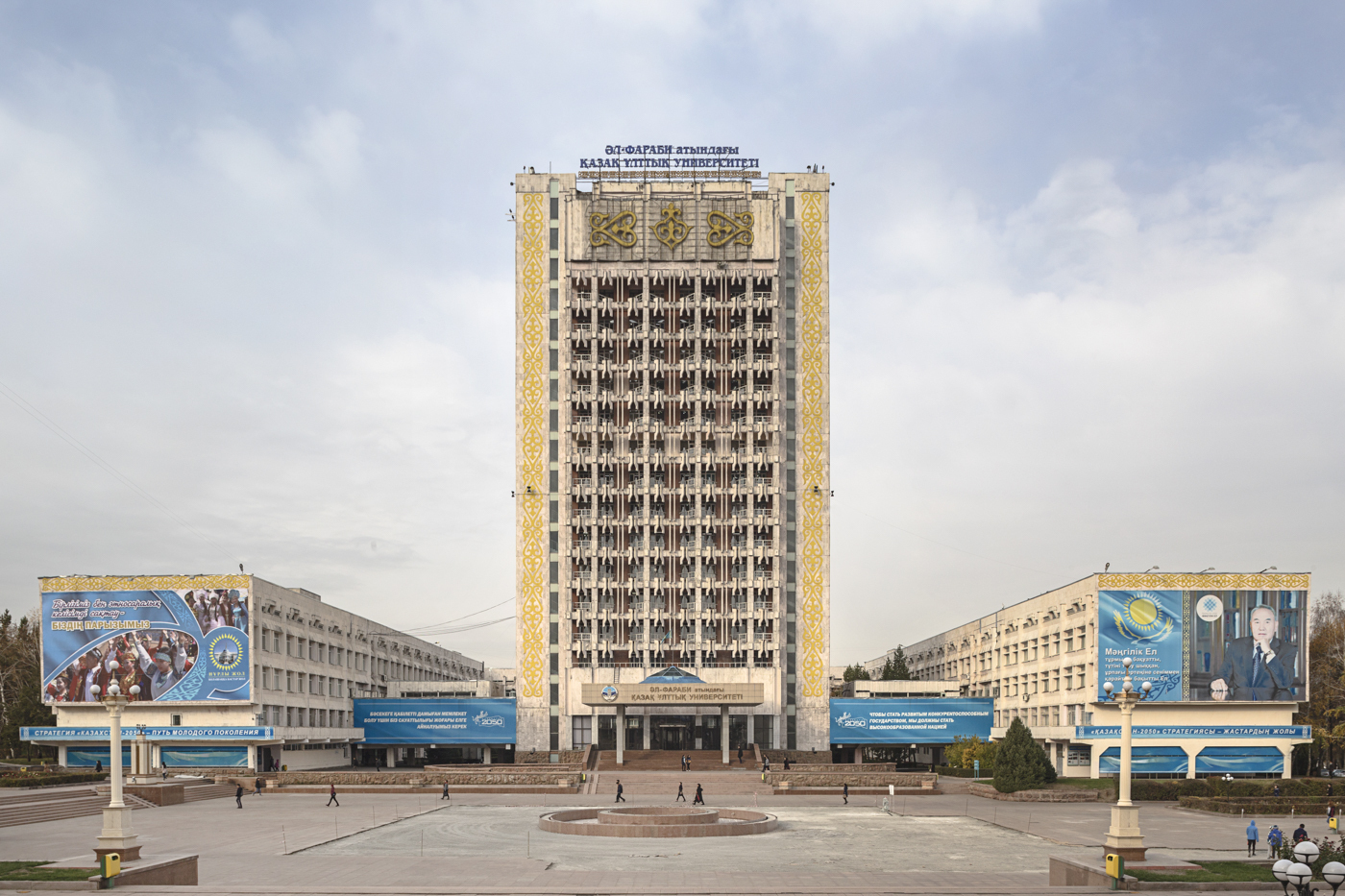
- 1970s–1980s: A golden age of Soviet modernist architecture in Kazakhstan. Urban centers like Almaty see the construction of bold, experimental public structures, including the Kazakh State Circus, the Al-Farabi Kazakh National University, and Republic Square, balancing avant-garde spatial geometries with traditional regional ornaments.
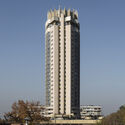
- 1977: Completion of the iconic Hotel Kazakhstan in Almaty. Designed to withstand severe regional seismic activity, its monolithic reinforced-concrete core showcases the apex of Soviet structural engineering.
- 1981: The Palace of Culture AHBK (later the State Academic Russian Theatre for Children and Young People) is completed, showcasing monumental volumes and radical civic spaces.
- 1991: The dissolution of the Soviet Union. Kazakhstan gains independence, inheriting a vast legacy of monumental Soviet-era infrastructure, space facilities, and modernist masterworks.
- 1997: The capital of Kazakhstan is officially relocated from Almaty to Akmola (renamed Astana in 1998). This kicks off a new era of state-sponsored architectural experimentation, echoing the monumental scale and futuristic ambitions of the Soviet past.
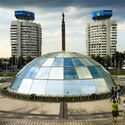
- 2017: Astana hosts Expo 2017, introducing structures like the Nur Alem sphere—a giant glass globe reminiscent of celestial bodies—continuing the nation’s tradition of projecting future-forward national identity through architecture.
Supporting Data & Architectural Analysis
The architectural landscape of Soviet Kazakhstan was defined by a unique synthesis of futuristic form, structural daring, and regional identity.
The Aesthetics of Futurism and the Cosmos
Soviet architects working in Central Asia were tasked with projecting a society that was perpetually ahead of its time. While the West associated futurism with capitalist consumerism, Soviet futurism was rooted in collective industrial might and cosmic conquest. Although buildings like the Kazakh State Circus or Republic Square in Almaty were not explicitly designed to look like flying saucers or rockets, their sweeping domes, circular volumes, and daring cantilevers resonated powerfully with the space-age imaginary.
This visual language transcended architecture alone. Across the Central Asian republics, public art mirrored this cosmic optimism. A prominent mosaic in Dushanbe, Tajikistan, features the medieval Persian polymath Avicenna standing shoulder-to-shoulder with modern Soviet cosmonauts, all gazing into a star-studded universe. Such imagery deliberately stitched ancient regional heritage into a progressive, scientifically triumphant socialist trajectory.
Engineering Against the Earth: Seismic Innovation
The futurism of Kazakhstan’s architecture was not merely skin-deep; it was backed by genuine structural innovation. Almaty sits in a highly active seismic zone, forcing local architects and engineers to abandon rigid typologies in favor of flexible, resilient systems.
The Hotel Kazakhstan (1977) stands as a premier example of this ingenuity. Rising boldly against the backdrop of the Tian Shan mountains, the tower relies on a monolithic reinforced-concrete core and specialized damping foundations capable of absorbing severe ground tremors. Erecting a slender, high-rise structure of this scale in an earthquake-prone zone served as a functional propaganda piece, proving that Soviet engineering could conquer both the heavens and the earth.
Official Perspectives and Expert Commentary
Architectural historians and preservationists view the Soviet heritage of Kazakhstan not merely as political relics, but as significant cultural achievements that deserve critical re-evaluation.
Experts note that the integration of local cultural motifs—such as patterns inspired by traditional nomadic yurts—with brutalist and modernist concrete volumes created a regional vernacular often overlooked in traditional Western architectural histories. Rather than imposing a monolithic Moscow style across the board, many Soviet-era architects working in Kazakhstan engaged in a delicate dialogue with local climate, topography, and cultural memory.

Furthermore, contemporary urban planners draw a direct line between the monumental urbanism of the Soviet era and modern Kazakh nation-building. The rapid transformation of Astana into a futuristic laboratory of international starchitecture—exemplified by Foster + Partners’ translucent tent (Khan Shatyr) and the spherical Nur Alem pavilion—proves that the psychological lure of the "alternative world" and the desire to project national modernity through radical scale remain deeply embedded in the region’s governance and design ethos.
Implications: The Legacy of Alternative Futures
The architectural legacy of Soviet Kazakhstan carries profound implications for how nations utilize the built environment to shape identity, project power, and manufacture optimism.
- The Persistence of Monumentalism: The transition from a socialist planned economy to a market-driven independent state did not erase the desire for monumental architecture. Instead, it repurposed it. The mega-scale projects in Astana demonstrate that governments often rely on radical architectural statements to signal economic vitality, sovereignty, and forward-looking ambition to the international community.
- Preservation Versus Erasure: As Kazakhstan continues to modernize, buildings from the Soviet era face uncertain futures. While some are celebrated as masterpieces of Soviet Modernism, others are threatened by demolition or insensitive renovations. Balancing the complex political history of these structures with their undeniable artistic and engineering value remains a central challenge for contemporary preservationists.
- Architecture as Propaganda: Ultimately, Kazakhstan’s built environment serves as a lasting reminder that architecture is never neutral. Whether used by the Soviet regime to propagate the triumph of collective space exploration or by a modern republic to reinvent its capital on the steppe, buildings act as physical vessels for societal dreams, anxieties, and political narratives.
By looking back at the ambitious visions of the 20th century, contemporary observers gain vital insights into how humanity continuously attempts to build, inhabit, and market alternative futures.
