

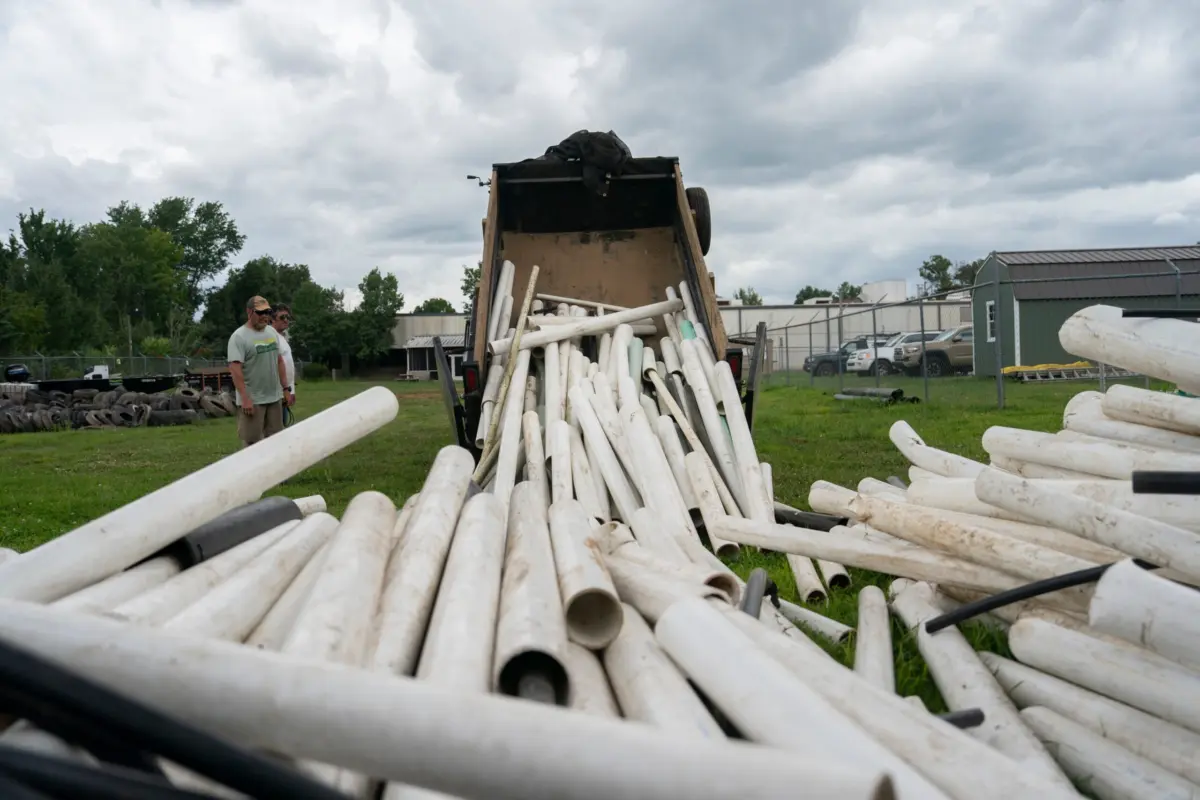
ASHEVILLE, N.C. — Two years after the cataclysmic fury of Hurricane Helene tore through western North Carolina, transforming tranquil waterways into violent torrents of destruction, the region is still grappling with a surreal and persistent legacy: millions of feet of industrial plastic.
Piled high on eroding river banks, wedged deeply into uprooted root systems, buried in shifting sediment, and jammed menacingly beneath tangled logs, massive quantities of PVC pipe continue to dominate the landscape. In some stretches of the iconic French Broad River—renowned worldwide for its roaring whitewater rapids and scenic beauty—plastic piping accounts for an astonishing 80% of all recovered debris.
The pipes originated from an industrial manufacturing plant north of Asheville owned by IPEX, a Canada-based piping solutions company. When Helene struck in late September 2024, dumping a historic and catastrophic 30 inches of rain in parts of the region, the raging French Broad overflowed its banks, overwhelming the facility and sweeping away massive outdoor storage yards of inventory.
Today, as communities across the Atlantic basin nervously watch the intensification of the hurricane season, the plastic waste choking North Carolina’s waterways serves as a stark, tangible reminder that the ecological and infrastructural scars of major climate disasters can take years—if not decades—to heal.
Chronology: From Cataclysmic Deluge to a Multi-Year Cleanup Operation
To understand the scale of the ongoing environmental crisis on the French Broad River, one must trace the timeline of the disaster and the grueling recovery effort that followed:
- Late September 2024: Hurricane Helene makes landfall and stalls over the southern Appalachian Mountains. Western North Carolina receives unprecedented rainfall exceeding 30 inches in localized zones. Landslides obliterate infrastructure, entire homes are swept off their foundations, and waterways are choked with debris. At the IPEX manufacturing site in Woodfin, an earthen berm fails to hold back a 1,000-year flood event, sweeping millions of pounds of PVC pipe into the French Broad River.
- Late 2024 – Early 2025: Following a temporary shutdown and structural assessments resulting in losses exceeding $100 million, IPEX begins assessing damages while localized volunteer groups and nascent river organizations mobilize to pull hazardous plastic out of the water.
- Mid-2025: MountainTrue, a prominent regional environmental nonprofit, secures a critical $10 million state grant to spearhead large-scale debris removal across several western North Carolina rivers heavily impacted by Helene.
- Late 2025 – 2026: MountainTrue deploys specialized crews, many composed of out-of-work river guides and elite outdoor athletes, to tackle the treacherous logjams and embedded piping. IPEX eventually agrees to contribute an additional $500,000 toward ongoing French Broad cleanup efforts, extending operations.
- Present Day (Two Years Later): The state grant, originally slated to expire in December, is extended through February as cleanup crews realize the sheer magnitude of the task. Despite hundreds of thousands of pipes removed, an untold number still litter 70 miles of river corridor, stretching all the way to a massive reservoir near the Tennessee border.
Supporting Data: The Staggering Scale of the Plastic Crisis
The numbers behind the French Broad River cleanup illustrate an unprecedented logistical and financial burden:
- 50,000+: The estimated number of grueling work-hours MountainTrue crews have dedicated exclusively to pipe removal on the French Broad River.
- $1.5 Million: The direct financial investment made by MountainTrue for pipe extraction alone.
- $10 Million: The baseline state grant awarded in 2025 to fund regional river cleanup efforts, recently extended through February 2026.
- $500,000: The financial settlement provided by IPEX to MountainTrue to subsidize continued remediation work.
- $100+ Million: The capital losses suffered by IPEX during the flood, matched by subsequent facility investments to harden the plant against future extreme weather.
- 70 Miles: The downstream distance—all the way to a major lake on the Tennessee border—where scattered PVC fragments and whole pipes continue to be discovered.
- 80%: The estimated percentage of total river debris composed of PVC pipes in the hardest-hit sectors.
Official Responses and Corporate Accountability
As the cleanup stretches into its third year, questions surrounding corporate preparedness, disaster forecasting, and environmental responsibility have taken center stage.
IPEX executives maintain that the company took reasonable precautions ahead of the storm. Johnny Drummond, vice president of manufacturing for IPEX, noted that the facility had constructed an earthen berm and actively moved inventory out of the projected 100-year flood zone—defined as a flood with a 1% annual probability of occurrence. Employees were safely evacuated a day before the peak of the disaster.
However, the flooding unleashed by Helene was roughly ten times worse than a standard 100-year threshold, effectively amounting to a catastrophic 1,000-year flood event.
"We secured the site as best we could," Drummond said.
While IPEX has declined to disclose the exact pre-storm inventory of pipes stored at its Woodfin plant or share the full findings of its internal environmental recovery assessments—citing "commercially sensitive" information—company leadership acknowledges the severity of the ongoing issue.
"We understand the ongoing challenge," said IPEX CEO Colleen Pritchett. "We recognize that… recovery efforts are complex, they’re resource-intensive, and it’s constantly shaped by the river conditions."
Pritchett highlighted that the company has invested over $100 million to repair, rebuild, and structurally reinforce the Woodfin manufacturing plant. Furthermore, IPEX is currently studying advanced containment methodologies to prevent future inventory loss—a mitigation measure that environmental advocates spent months demanding.
On the front lines, environmental leaders express a mix of exhaustion and determination. Jon Stamper, operations director at MountainTrue, points out that despite the millions of dollars and thousands of labor hours spent, large stretches of the river remain entirely untouched.
"Just the amount of time and energy that we put into removing all this pipe is exhausting," Stamper said.
Implications: Environmental Degradation, Long-Term Health Risks, and Logistical Nightmares
The presence of millions of feet of rigid and flexible PVC piping in a dynamic river ecosystem carries profound implications for both nature and human recreation.
Ecological and Microplastic Hazards
Beyond altering the natural flow of the river and creating physical obstacles that threaten the safety of recreational kayakers, rafters, and tubers, the aging plastic poses a ticking ecological time bomb. Subjected to relentless ultraviolet radiation from the sun, the exposed PVC is beginning to degrade, becoming brittle and prone to shattering upon impact.
Stamper warns that without aggressive removal, the sun-baked plastic will continuously fragment into increasingly smaller pieces, eventually shedding massive quantities of microplastics into the aquatic food web.
"We want to avoid that stuff sitting there forever and just slowly deteriorating and breaking into smaller and smaller pieces," Stamper explained. "Some of the pipe that’s been sitting out since Hurricane Helene… is getting to the point where you could crack it when you grab it."
Furthermore, the submerged pipes have become integrated into the riverbed itself, frequently acting as artificial anchors that trap organic silt, logs, and other debris into monolithic, concrete-like mounds up to two stories high. Fish and other aquatic wildlife have even taken up residence inside the hollow tubes, complicating extraction efforts.
The Human Toll: Trauma Bonding and Technical Extraction
Removing the debris is not a job for conventional cleanup crews. Anna Alsobrook, MountainTrue’s French Broad Riverkeeper, emphasizes that the work requires a rare combination of technical whitewater navigation skills and high-altitude climbing expertise.
Many of the cleanup workers are former local river guides, fishing outfitters, and avid rock climbers who lost their livelihoods when Helene devastated the local outdoor tourism economy. Jemima Filiss-Cook, who coordinates cleanup operations in heavily impacted Madison County, describes the towering, unstable log-and-pipe jams as "jungle gyms" that workers must cautiously scale and balance upon. For many crew members, the grueling physical labor has served as an avenue for shared healing and "trauma bonding" in the wake of regional devastation.
Operating chainsaws while balancing on slippery, unstable piles of timber suspended over roaring whitewater rapids—all while loading heavy segments of PVC pipe onto small watercraft—makes the project uniquely perilous.
"I truly don’t think anybody else could do this work except for our debris team members," Alsobrook said.
Looking Ahead
As state and private funding streams slowly dwindle, MountainTrue is actively applying for additional grants to sustain the cleanup initiative. Yet, project leaders harbor realistic, sobering expectations about the permanence of the disaster.
While the immediate priority remains extracting hazards that pose active entrapment risks to river recreationists, vast quantities of pipe remain trapped in remote floodplains, steep ravines, and deep river sediment. Every time water levels fluctuate following seasonal rains, buried pipes resurface, proving that the river has not finished revealing the scars of Helene.
"We’re going to do our best as long as the funding allows," Stamper concluded somberly. "But there’s going to be pipe out there that we can’t get ever."
