

By The Associated Press
Enriched & Expanded Report
Main Facts
Two years after Hurricane Helene tore through the heart of western North Carolina with cataclysmic fury, flattening forests, demolishing homes, and permanently altering the region’s topography, the physical scars of the storm remain starkly visible. Nowhere is this more apparent than along the iconic French Broad River. Famed for its roaring whitewater rapids and deep ecological roots, the waterway is still choking on a legacy of industrial debris: millions of pounds of polyvinyl chloride (PVC) pipes.
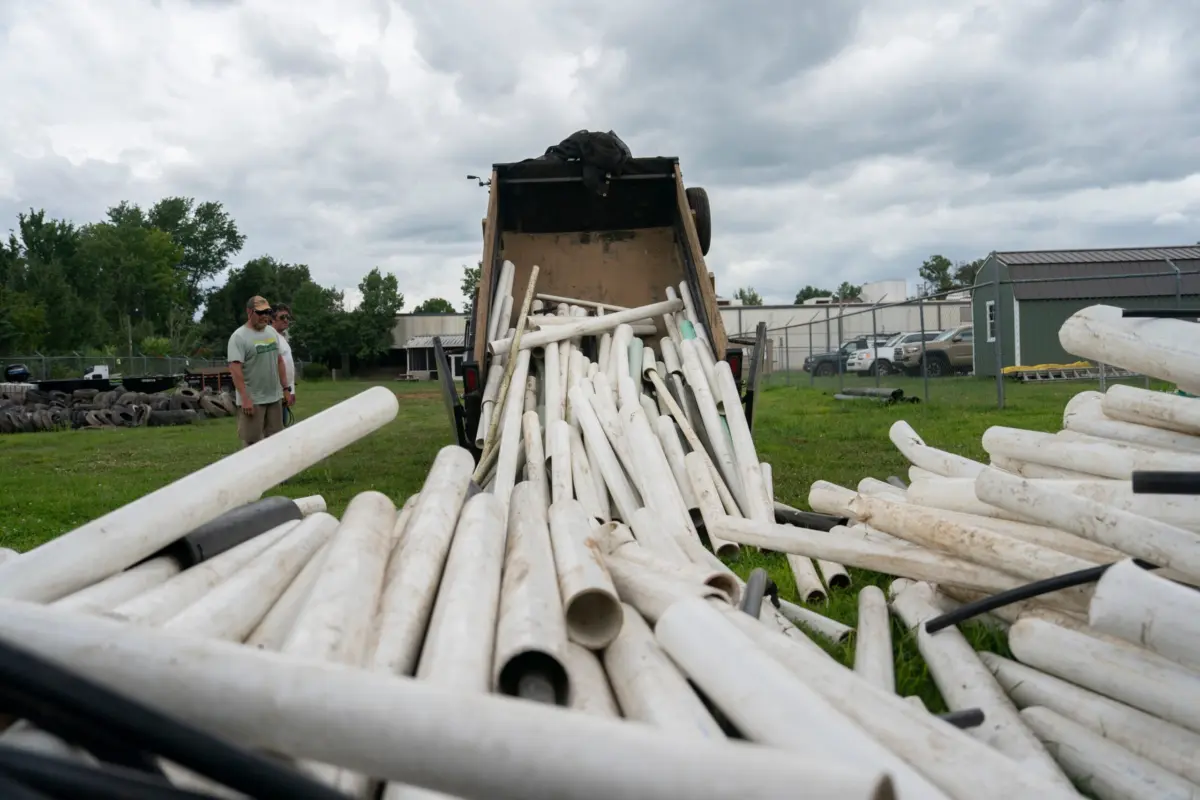
Washed away from a massive manufacturing facility north of Asheville during the 2024 disaster, the endless stretches of white and blue plastic pipes are piled high on riverbanks, wedged deep into uprooted root systems, buried in sediment, and jammed beneath towering logjams. In some zones, the debris forms two-story-high mounds that dictate the flow of the current and choke local ecosystems.
MountainTrue, a regional environmental nonprofit spearheading the grueling cleanup effort, estimates that its crews have pulled hundreds of thousands of individual pipes from the river. Yet, an untold number continue to litter a sprawling 70-mile (113-kilometer) corridor stretching all the way to a massive lake at the Tennessee border.
As seasonal storms continue to threaten the region, the enduring crisis of the French Broad River stands as a potent cautionary tale. It illustrates how industrial vulnerabilities compounded by extreme weather can leave an environmental and economic disaster zone that takes years—and tens of millions of dollars—to remediate.
Chronology of a Disaster and Recovery
September 2024: The Deluge
Hurricane Helene arrived in late September 2024 as an atmospheric monster, stalling over the Southern Appalachians and dumping an unprecedented 30 inches (76 centimeters) of rain in isolated pockets of western North Carolina. The resulting catastrophe triggered catastrophic landslides, swept houses off their stone foundations, decimated infrastructure, and sent rivers rampaging through valleys with unprecedented velocity.
At the IPEX manufacturing plant in Woodfin, North Carolina, operations had been halted a day prior. Executives monitored the incoming storm and relied on protective measures built around a 100-year flood standard—a level of high water deemed to have a 1% chance of occurring in any given year. An earthen berm separated the plant’s towering outdoor storage stacks of PVC pipe from the rushing currents of the French Broad River.
However, Helene brought a 1,000-year flood event. Water levels surged far beyond anything recorded or anticipated, surging past the berm, overwhelming the facility, and sweeping roughly 60% of the plant’s outdoor pipe inventory directly into the swollen river.
Late 2024 – 2025: Emergency Response and Factory Overhaul
In the immediate aftermath, the factory closed its doors for months, registering losses exceeding $100 million. IPEX later invested over $100 million to repair, rebuild, and significantly harden the facility against future meteorological anomalies.
Concurrently, local communities and displaced river guides initiated grassroots cleanups. Recognizing the monumental scope of the crisis, the State of North Carolina awarded MountainTrue a $10 million grant in 2025 to spearhead comprehensive debris removal across several impacted river systems.
2026: Ongoing Remediation and Extended Deadlines
As the cleanup efforts enter their second full year, the logistical hurdles have only compounded. Originally slated to expire in December, MountainTrue’s state grant has been extended through February.
To bridge funding gaps and assist with accountability, IPEX agreed to contribute an additional $500,000 directly to MountainTrue for French Broad River remediation, enabling operations to stretch well into the coming year. Nevertheless, crews warn that complete restoration remains a distant horizon.
Supporting Data and Operational Metrics
The sheer scale of the PVC contamination on the French Broad River defies casual comprehension. According to MountainTrue data, PVC pipe constitutes upwards of 80% of the total debris composition in the hardest-hit stretches of the river.
- Labor Investment: MountainTrue has expended more than 50,000 rigorous work-hours solely on pipe removal along the French Broad River.
- Financial Footprint: The organization has channeled over $1.5 million strictly into the logistics of extracting, hauling, and disposing of the plastic infrastructure.
- Geographic Scope: The debris field spans a staggering 70-mile corridor, terminating at a massive reservoir near the Tennessee border.
- Corporate Outlay: IPEX has sustained over $100 million in facility repairs and committed $500,000 in direct cleanup grants to MountainTrue, alongside an undisclosed sum for company-funded hydrological and environmental recovery studies.
- State Funding: A pivotal $10 million state grant, originally designated to close in late 2025, has been extended to early 2026 to accommodate the painfully slow pace of river recovery.
Official Responses and Perspectives
The Manufacturer: IPEX
Faced with intense public scrutiny and profound economic losses, IPEX leadership has acknowledged the lingering gravity of the situation while defending the facility’s initial preparedness.
"We secured the site as best we could, and we sent people home a day before the flooding was expected," said Johnny Drummond, IPEX’s vice president of manufacturing, noting that the company simply could not have predicted a 1,000-year flood event.
IPEX CEO Colleen Pritchett emphasized the company’s commitment to righting the wrong. "We understand the ongoing challenge," Pritchett stated. "We recognize that… recovery efforts are complex, they’re resource-intensive, and it’s constantly shaped by the river conditions."
Despite these acknowledgments, IPEX has declined to publicly disclose the exact pre-storm inventory of pipes stored at the Woodfin site or release the granular findings of its internal environmental impact assessments, citing corporate confidentiality and commercial sensitivity.
The Environmental Stewards: MountainTrue
For the nonprofit on the front lines, the battle is intensely physical and mentally taxing. Jon Stamper, operations director at MountainTrue, captures the exhaustion felt by his personnel.
"Just the amount of time and energy that we put into removing all this pipe is exhausting," Stamper said. "We still have stretches of river that haven’t been touched."
Stamper oversees a dedicated cadre of 10 cleanup crews—roughly 100 workers in total. Many of these individuals are former whitewater rafting and fishing guides who lost their traditional livelihoods when Helene decimated the local recreation economy.
Anna Alsobrook, MountainTrue’s French Broad Riverkeeper, underscores the unique skill set required for the job. "I truly don’t think anybody else could do this work except for our debris team members," she noted, highlighting that crew members must possess the rare ability to safely navigate raging whitewater rapids while simultaneously operating chainsaws and hauling heavy industrial materials inside waterlogged boats.
Environmental and Human Implications
Ecological Degradation and Microplastic Hazards
The ecological ramifications of millions of feet of PVC pipe trapped within a fragile river ecosystem are profound. The pipes alter natural water flow, scour sensitive benthic habitats, and create artificial traps that disrupt aquatic migration.
Furthermore, time and the elements are working against the cleanup crews. Exposed to relentless ultraviolet radiation from the sun, the PVC material is beginning to degrade, becoming brittle and prone to shattering under pressure.
"We want to avoid that stuff sitting there forever and just slowly deteriorating and breaking into smaller and smaller pieces," Stamper warned. As the plastic breaks down, it threatens to introduce persistent microplastics into the food web, posing long-term bioaccumulative risks to aquatic life and downstream human water supplies.
Technical and Physical Perils for Cleanup Crews
Removing the PVC debris is a hazardous undertaking. The pipes—ranging from rigid straight conduits to massive, unraveled coils of flexible tubing—are frequently trapped deep beneath 20-foot-high (6-meter) tangles of uprooted timber and silt.
Jemima Filiss-Cook, who directs cleanup operations in Madison County where the concentration of pipe is heaviest, describes navigating these unstable structures. Crew members, she says, treat the logjams "sort of it as a jungle gym," balancing precariously on shifting timber to cut and extract the plastic.
Paradoxically, the grueling labor has fostered a deep sense of camaraderie among the workers. Many joined the effort organically in the immediate aftermath of the storm as a form of collective healing—what participants describe as "trauma bonding" over shared devastation. The crews heavily feature experienced rock climbers and outdoor enthusiasts whose technical proficiencies render them uniquely suited to the inherent dangers of the job.
Looking Ahead
While immediate safety hazards—such as underwater entrapment risks for kayakers and tubers—have been largely mitigated in primary recreational zones, thousands of pipes remain embedded in riverbanks and floodplains, waiting for the next seasonal rise in water levels to dislodge them.
MountainTrue is actively seeking additional grant funding to sustain its operations long after current state and corporate allocations dry up. Yet, crew leaders admit a sobering reality: despite their best efforts, some fraction of the industrial plastic has become so permanently integrated into the riverbed that it may never be recovered.
"We’re going to do our best as long as the funding allows," Stamper concluded. "But there’s going to be pipe out there that we can’t get ever."
