

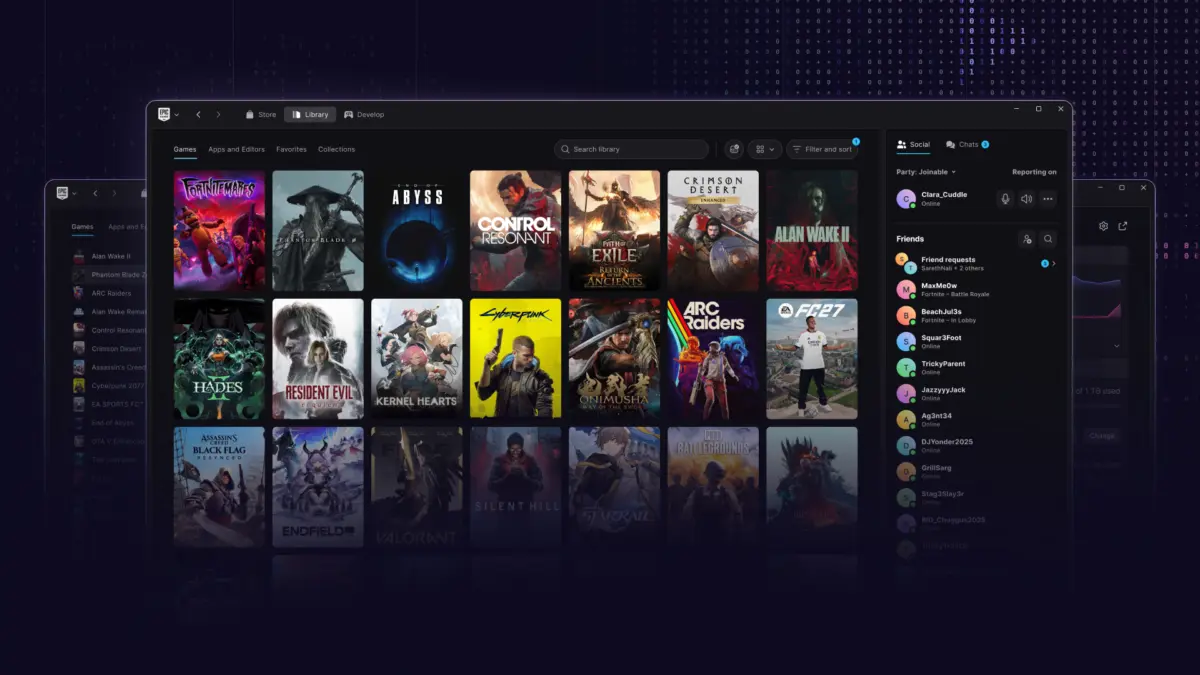
SAN FRANCISCO — In a move that signals a monumental turning point in modern software engineering and game development, Epic Games has officially released a public preview of its radically redesigned PC games launcher. The company promises that the updated application is dramatically faster, highly responsive, and introduces long-awaited native support for Linux—complete with plans to finally bring Fortnite to the platform.
However, the headline feature accompanying this release is not just a UI overhaul or a new operating system compatibility list. Epic Games is proudly leaning into the bleeding edge of artificial intelligence, openly admitting that the new desktop application was "vibe coded"—built predominantly using AI agents to write, test, and review the codebase.
The announcement arrives amid a broader, aggressive corporate pivot toward AI-assisted development spearheaded by CEO Tim Sweeney, shining a harsh, revealing spotlight on how the video game industry is transforming in the face of generative tools.
Main Facts: What Is the New Epic Games Launcher?
The preview build of the next-generation Epic Games Launcher is available today across Windows, Mac, and Linux. While the legacy launcher will remain accessible for the time being while bugs are ironed out and feature parity is achieved, the preview gives users a clear look at where Epic’s desktop ecosystem is heading.
Key takeaways from the launcher rollout include:
- Dramatic Performance Boosts: Epic describes the new version as "way faster" and noticeably more responsive than its predecessor, a notorious pain point for users who frequently complained about the sluggishness of the previous Chromium-based architecture.
- Linux Support and Fortnite: For the first time, Linux users will have native access to the Epic Games Launcher. Even more consequential, Epic has announced its intention to bring its crown jewel, Fortnite, to Linux through the newly minted application.
- The "Vibe Coded" Moniker: In an unprecedented admission for a major technology corporation, Epic’s official blog post stated: "Programming is hard. So, instead of doing that, we vibe coded a new Epic Games Launcher that’s way faster and more responsive than the current one, and has a new look."
- Managed AI Development: Although AI agents generated the vast majority of the code, human supervisors managed the process meticulously, ensuring that safety, functionality, and stability benchmarks were met before pushing the preview to the public.
Chronology: The Road to "No More Hand-Written Code"
To understand the weight of Epic’s launcher redesign, it is necessary to examine the rapid timeline of announcements that have rattled the games industry over the past several days:
- March 2023–2024: Following a turbulent economic climate for the tech and gaming sectors, Epic Games enacted sweeping layoffs, cutting more than 1,000 jobs. CEO Tim Sweeney insisted at the time that the reductions were financial corrections rather than a preemptive strike to replace humans with AI.
- Earlier This Year: The launcher development team began quietly working on the overhaul, looking for ways to accelerate production cycles and eliminate technical debt. They integrated AI agents into the workflow to replicate core functionalities from the legacy system.
- Monday (The Pivot): CEO Tim Sweeney took to social media to announce a "huge pivot underway" at Epic Games. He detailed plans to shuffle developers around to retool the entire organization for "maximum AI acceleration," stating that the ultimate goal is to empower teams to build more and better content.
- Earlier This Week (Bloomberg Report): A leaked report surfaced indicating that an Epic director working on an unannounced Disney collaboration told staffers there would be "no more hand-written code," signaling an abrupt and totalizing institutional shift.
- Today: Epic officially drops the preview of the new AI-built launcher on Windows, Mac, and Linux, turning abstract corporate policy into a tangible software product running on millions of gamer desktops.
Supporting Data and Technical Realities
Behind the marketing spin of "vibe coding" lies a calculated technical restructuring. According to Martin Keely, Epic’s Vice President and General Manager of the Epic Games Store and Epic Online Services, the launcher project has been in development for "most of this year."
While the launcher team didn’t completely abandon human oversight—relying on developers to direct the agents, review outputs, and manage the overall architecture—the speed advantages were undeniable. Keely noted that AI proved "super helpful" in accelerating the testing phase and faithfully replicating complex core functionalities from the older software stack.
Crucially, the success of this project is what management needed to greenlight broader company-wide integration. While the launcher team’s reliance on automated generation predated Sweeney’s sweeping Monday mandate, Keely acknowledges that they are "on the same train."
Official Responses and Industry Perspectives
The normalization of phrases like "vibe coding" by a multi-billion-dollar enterprise has sent ripples through software engineering and gaming communities alike.
In a briefing with The Verge, Keely defended the methodology while clarifying the boundaries of automation at Epic:

"We used AI as a tool for this… It’s part of our migration as a company to use AI in new and different ways. We definitely had agents write and review all of the code. We used it to replicate the core functionality. But the development team managed that process and supervised the entirety of what we did."
Keely views the swift delivery of a high-performance, cross-platform launcher as definitive proof that Epic’s aggressive bet on artificial intelligence is paying off:
"The launcher is something that is demonstrative of the speed and efficiency both from the development process and the actual output that we think gives us confidence that the direction that we’re headed in is a positive one for our company and for gaming development overall."
Meanwhile, CEO Tim Sweeney has repeatedly defended the company’s trajectory, addressing anxieties regarding job security and creative integrity. In his initial memo regarding structural shifts, Sweeney emphasized that automation is designed to expand horizons rather than simply shrink headcounts:
"To the extent it improves productivity, we want to have as many awesome developers developing great content and tech as we can."
Implications: What Does "Vibe Coding" Mean for the Future of Gaming?
Epic Games’ public embrace of AI-first software engineering is a watershed moment that forces developers, consumers, and publishers to reevaluate the future of interactive entertainment.
1. The Redefinition of Software Engineering
The term "vibe coding"—once a tongue-in-cheek descriptor used by hobbyists prompting large language models to spin up simple web apps—has now entered the corporate vernacular of a major industry titan. If companies can effectively delegate the grunt work of software architecture, UI replication, and basic pipeline management to AI agents, the role of the traditional programmer will shift rapidly from syntax writer to system architect and prompt supervisor.
2. Linux and Fortnite Re-emergence
For years, Linux gaming has been an uphill battle, championed largely by Valve’s Proton compatibility layer and the Steam Deck. Epic’s decision to use AI acceleration to finally build a native Linux launcher—and with it, lay the groundwork for bringing Fortnite to the operating system—could drastically alter the desktop ecosystem. If automated tooling makes cross-platform development trivial, publishers may no longer treat alternative operating systems as costly afterthoughts.
3. Developer Anxiety and Creative Integrity
Despite executive assurances that AI is meant to empower rather than replace creators, the atmosphere within the games industry remains deeply tense. Following massive post-pandemic layoffs across the sector, announcements like "no more hand-written code" naturally stoke fears about career obsolescence. Gamers and critics will also be watching closely to see whether AI-accelerated codebases introduce subtle, persistent bugs, security vulnerabilities, or a homogenization of software design.
Moving Forward
Epic Games has placed a massive wager on the proposition that artificial intelligence can outpace and outperform traditional human coding pipelines without sacrificing quality. As the new Epic Games Launcher preview rolls out to the public, users will ultimately decide whether the "vibe" translates into a genuinely superior product, or if the loss of the human touch leaves software feeling sterile and uninspired. One thing is certain: the rules of game development have changed forever.
