

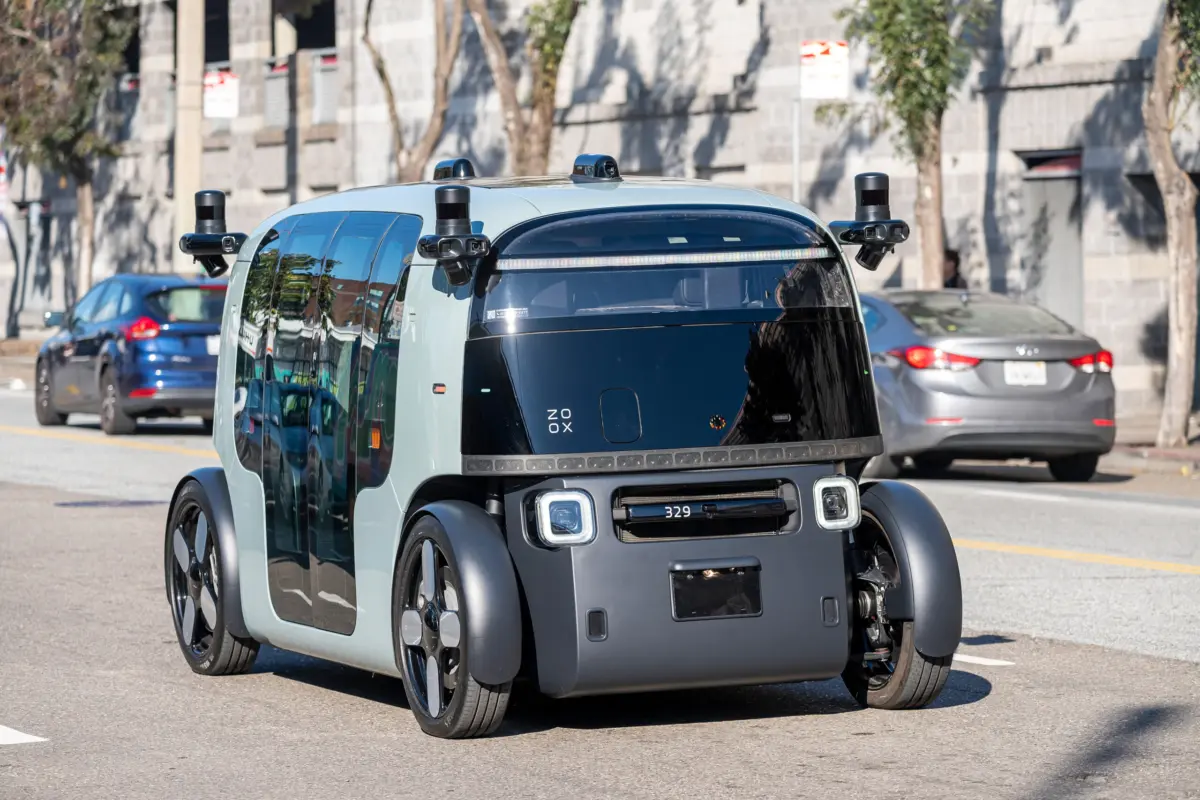
LAS VEGAS — In a milestone that bridges the gap between science fiction and everyday urban transit, Amazon.com Inc.’s autonomous vehicle subsidiary, Zoox, is officially stepping into the commercial arena. Beginning next week, the company will begin charging fares for its custom-built robotaxis in Las Vegas.
The launch represents a monumental first for the United States: the commercial deployment of a passenger-carrying autonomous vehicle that completely lacks human-centric driving controls. Unlike competitors who rely on retrofitted traditional automobiles outfitted with steering wheels and pedals, Zoox’s distinctively boxy, bi-directional vehicle was designed from the ground up for a world without drivers.
The roll-out, scheduled to begin on August 10, marks the aggressive commercialization of a technology that has spent years navigating regulatory hurdles, rigorous testing regimes, and public skepticism. As Amazon seeks to carve out a dominant market share in the rapidly expanding autonomous ride-hailing sector, the eyes of the tech, automotive, and insurance industries will be fixed on the neon-lit streets of the Las Vegas Strip.
Main Facts
The core of the upcoming launch is straightforward yet historically significant: Zoox is transitioning from a testing and promotional phase to a revenue-generating commercial enterprise.
Starting next week, passengers in Las Vegas utilizing the Zoox service will be greeted with a familiar digital ride-hailing experience—with one major exception: nobody is sitting in the front seat. According to statements released by the company, fares will be calculated using a dynamic pricing model based on a base rate, supplemented by distance and the duration of each trip. While Zoox has declined to release granular pricing specifics ahead of the launch, the company has confirmed that riders will be shown the full, transparent fare prior to confirming their booking.
The commercialization comes on the heels of a crucial regulatory victory. Last month, federal authorities granted Zoox a temporary exemption that permits the company to deploy up to 5,000 of its custom robotaxis on U.S. roads over the next two years. Crucially, this exemption included the legal authorization to charge passengers per ride, clearing the runway for next week’s launch.
While Zoox is pioneering the "no steering wheel" category, it enters a bustling marketplace. Alphabet Inc.’s Waymo currently stands as the undisputed titan of U.S. robotaxis, operating the largest commercial driverless ride-hailing network in the country. However, Waymo’s fleet relies on heavily modified traditional vehicles equipped with manual controls, underscoring the stark philosophical and engineering differences separating the industry leaders. Other players, most notably Tesla Inc., are also jockeying for position in a race to capture the future of urban mobility.
Chronology of Development: From Concept to Commercialization
The path to Las Vegas’s newest fare-charging fleet has been long, deliberate, and marked by intense engineering challenges.
The Early Years and Acquisition (2014–2020)
Founded in 2014 by Tim Kentley-Klay and Jesse Levinson, Zoox set out with a radical premise: autonomous vehicles should not look or function like cars modified with computers; they should be purpose-built pods optimized for shared, autonomous passenger transport. The company developed custom hardware, proprietary software, and a unique symmetrical vehicle design that could travel forward or backward with equal ease.
Recognizing the immense capital required to bring such a hardware-heavy vision to life, Amazon acquired Zoox in 2020 for an estimated $1.2 billion. Backed by Amazon’s deep pockets and cloud computing prowess (via AWS), Zoox accelerated its research and development phase.
Testing and Public Previews (2021–2024)
Over the subsequent years, Zoox moved from closed-course testing to public streets. The company established testing footprints in challenging, diverse urban environments to stress-test its sensor suites and artificial intelligence. By late 2024, Zoox vehicles had become familiar sights in cities like San Francisco, where a Bloomberg photo captured a distinctive bug-eyed prototype navigating the city’s complex hills and cable-car tracks on December 4, 2024.
The Regulatory Breakthrough (July 2026)
The modern era of Zoox solidified in July 2026. The National Highway Traffic Safety Administration (NHTSA) granted Zoox a historic temporary exemption. This administrative green light permitted the company to deploy up to 5,000 driverless vehicles without human controls over a two-year window and explicitly granted the right to charge passenger fares.
The Commercial Launch (August 2026)
Now, mere weeks after securing federal approval, Zoox is flipping the switch. The Las Vegas launch on August 10 represents the commercial fruition of more than a decade of research, development, and regulatory navigation.
Supporting Data and Safety Metrics
Before opening its virtual doors to paying customers, Zoox accumulated a massive ledger of real-world operational data designed to reassure both regulators and prospective riders.
To date, the company’s distinctive boxy robotaxis have logged over 3 million miles on public roadways. This mileage has been accrued across some of the most complex and demanding driving environments in the United States, including Las Vegas, San Francisco, Austin, and Miami.
Furthermore, prior to transitioning to a commercial, fare-based model, Zoox successfully completed 1 million passenger rides during its pre-commercial testing and promotional phases. This large sample size of human cargo provided the company’s machine learning models with invaluable data regarding passenger ingress, egress, comfort, and edge-case traffic scenarios.
The launch also arrives amid a broader industry conversation regarding the safety of autonomous vehicles relative to human drivers. Recent industry studies—such as research published by the Insurance Institute for Highway Safety (IIHS) indicating that autonomous fleets like Waymo demonstrate significantly lower injury-crash rates than human counterparts—have created a more receptive climate for autonomous deployment. Regulators and safety advocates are increasingly viewing mature autonomous systems not as hazardous novelties, but as potential solutions to the catastrophic toll of human error on American roadways.
Official Responses and Industry Perspectives
The announcement of the Las Vegas rollout has elicited reactions from across the autonomous vehicle landscape, reflecting the high stakes of the emerging market.
Zoox leadership has framed the launch not merely as a corporate milestone, but as the realization of a completely new paradigm in personal transportation. In statements accompanying the announcement, company executives emphasized that the omission of traditional driving controls was designed entirely around the passenger experience. Without a driver’s seat, steering wheel, or pedals, the interior of a Zoox vehicle resembles a cozy, opposing-bench lounge, prioritizing social interaction and relaxation over piloting logistics.
Competitors are watching closely. While Alphabet’s Waymo currently holds the crown for scale and market penetration, Zoox’s regulatory clearance to field thousands of dedicated, purpose-built pods gives Amazon a unique strategic advantage in the long-term unit economics of robotaxi fleets. Traditional automakers and tech giants alike view the Las Vegas experiment as a critical litmus test for whether consumers are ready to embrace vehicles that reject the traditional automotive form factor entirely.
Meanwhile, municipal and federal regulators have maintained a cautious yet cooperative posture. The NHTSA’s decision to grant the temporary exemption underscores a regulatory willingness to foster innovation, provided companies meet stringent safety baselines. Regulators will undoubtedly scrutinize the Las Vegas deployment’s safety data, traffic impact, and customer feedback as they weigh the potential expansion of the exemption beyond the initial 5,000-vehicle cap.
Implications for Urban Mobility, Insurance, and the Future
As Zoox robotaxis begin accepting fare payments next week, the ripples will extend far beyond the borders of Clark County, Nevada.
Urban Transportation and Infrastructure
The normalization of driverless pods could profoundly alter urban planning. If successful, services like Zoox could reduce the demand for private vehicle ownership in dense urban centers, lower parking requirements for new real estate developments, and reshape public transit integration. Because the vehicles are electric and purpose-built for shared fleets, cities may also see localized reductions in carbon emissions and traffic congestion—provided the technology scales efficiently.
The Insurance Landscape
The commercialization of fully driverless fleets accelerates a structural transformation in the insurance industry. As liability shifts decisively away from individual human drivers and toward corporate fleet operators and tech manufacturers, commercial multi-peril and product liability insurance policies are taking center stage. Insurers are increasingly relying on rigorous safety data—such as the IIHS findings regarding autonomous safety performance—to price risk for autonomous operators, potentially heralding an era where algorithmic safety reduces overall commercial transit insurance costs.
Consumer Acceptance
Perhaps the most immediate implication is psychological. For decades, the public has been conditioned to view driving as an active, human responsibility. By eliminating the steering wheel and charging money for the privilege of being transported by an invisible algorithm, Zoox is asking everyday consumers to cross a psychological Rubicon. If riders in Las Vegas embrace the experience safely and seamlessly, it will pave the way for a rapid, nationwide acceleration of autonomous transit.
As the sun sets over the Las Vegas Strip on August 10, the arrival of Zoox’s first fare-paying, driverless passengers will mark more than just a corporate victory for Amazon. It will signal the day the future officially started driving itself.
