

In the complex ecosystem of modern commercial building automation, hidden programming flaws often lie dormant until specific environmental or operational triggers expose them. Among the most perplexing and frequently misunderstood anomalies plaguing heating, ventilation, and air conditioning (HVAC) professionals is the "recirculating mode death spiral."
This insidious control issue occurs in air handling units (AHUs) that utilize airflow tracking to govern their return fans while operating—either intentionally or unintentionally—in a fully recirculating configuration. When left unaddressed, this oversight leads to unstable fan operation, erratic building pressure, cryptic variable frequency drive (VFD) fault codes, and sudden system shutdowns driven by safety alarms.

Commissioning engineer Miles Ryan, a specialist with Questions & Solutions Engineering and a mechanical systems instructor at the Air Force Institute of Technology, has brought this nuanced engineering challenge to light. According to Ryan, this phenomenon is the first in a series of recurring design and programming pitfalls that routinely baffle facility operations staff and controls contractors alike.
Main Facts: Deconstructing the Airflow Tracking Dilemma
To understand how a system can self-destruct from within, it is necessary to examine the core mechanics of airflow tracking and fully recirculating AHU configurations.
- The Vulnerable Setup: The issue exclusively targets AHUs equipped with both supply and return fans where the return fan relies on an airflow tracking strategy.
- The Mechanism of Airflow Tracking: In a standard airflow tracking configuration, the return fan’s speed is modulated to maintain a precise return airflow setpoint. This setpoint is typically dynamically reset to a specific offset below the real-time, measured supply airflow.
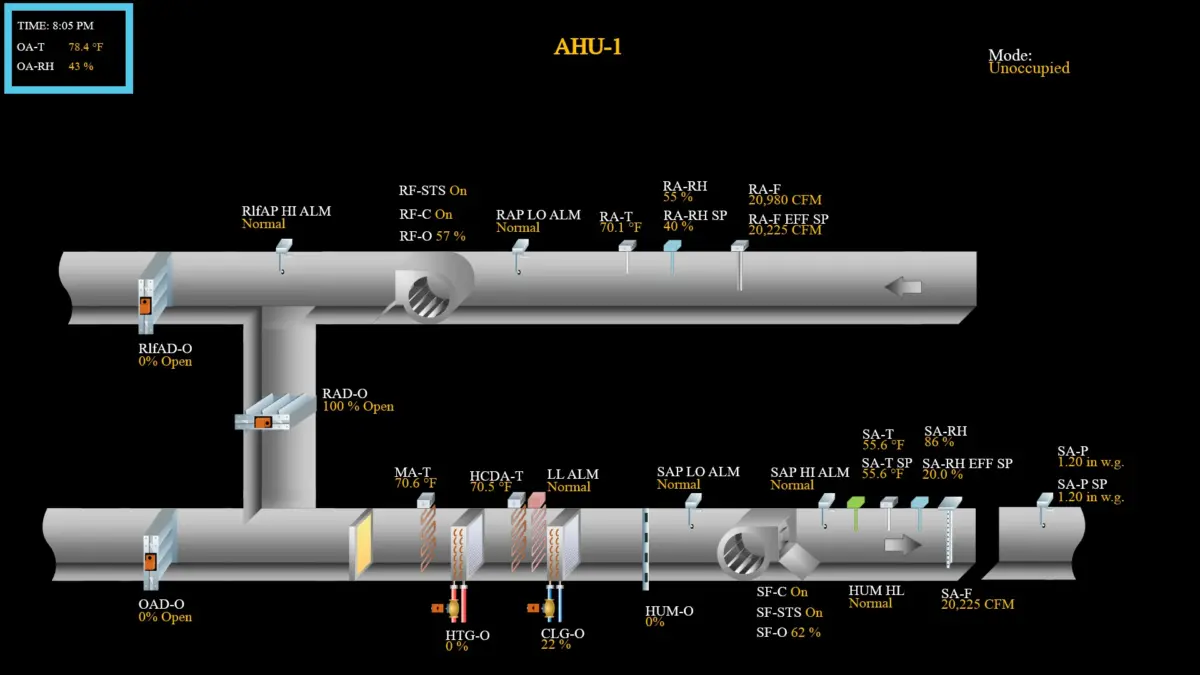
- The Fully Recirculating Trap: AHU sequences frequently dictate modes where outdoor air and relief air dampers close completely, while return dampers open fully. Common triggers include specific unoccupied modes, warm-up or cool-down cycles, and periods when minimum ventilation requirements drop to zero.
- The Conflict: When a system operates in full recirculation with a zero CFM offset, both the supply and return fans are effectively attempting to control the exact same volume of air trapped in a closed loop, relying on two independent, uncalibrated airflow measuring stations. Because sensor readings never match identically, the fans begin a relentless cycle of working against one another, ultimately driving the system into a destructive operational extreme.
Chronology: The Anatomy of a Recirculating "Death Spiral"
To visualize how minor sensor discrepancies snowball into catastrophic mechanical failure, Ryan maps out the step-by-step progression of the death spiral as it plays out on a Building Automation System (BAS) graphic and across fan performance curves.
Phase 1: Initial Divergence
The process begins innocently. In a fully recirculating mode with closed outside/relief dampers, the system attempts to maintain an offset (such as a 0 CFM differential) between supply and return airflow. Due to minor, unavoidable calibration discrepancies between the supply airflow measuring station and the return airflow measuring station, the BAS registers a minor mismatch—for instance, a return airflow reading slightly higher than its setpoint.

Phase 2: The Shift in Workload
Interpreting the sensor data as an over-pressurization or excess return air condition, the control loop commands the return fan to slow down in an attempt to hit its target. As the return fan decelerates, it creates an unintended resistance in the return ductwork. The supply fan suddenly inherits a heavier workload as it tries to pull air through a sluggish return path, causing the supply fan to fall short of its static pressure setpoint.
Phase 3: Escalating Corrections
Sensing the drop in static pressure, the supply fan ramps up its speed to compensate. Meanwhile, the return fan continues to register an airflow reading above its dynamically falling setpoint, prompting the return fan to slow down even further. A feedback loop is now locked in motion:

- The return fan continuously throttles down because its perceived airflow remains artificially elevated.
- The supply fan continuously ramps up to overcome the mounting negative pressure and duct resistance.
Phase 4: The Terminal End-State
The feedback loop reaches its extreme physical limits. The return fan bottoms out at minimum speed, yet its sensors still falsely report an airflow higher than the target. Simultaneously, the supply fan maxes out at 100% speed, bearing the full brunt of the system’s air movement.
At this juncture, both fans are operating far outside their optimal design parameters on their respective fan curves. The supply fan struggles against massive frictional and suction losses, while the return fan operates in a bizarre state where the supply fan pulls more air through it than the return fan is mechanically capable of generating. VFDs, confused by the nonsensical pressure differentials across the fan housing, frequently fault out with anomalous error codes, or an internal safety switch—such as a supply fan suction limit—trips to shut the unit down entirely.

Supporting Data and Operational Case Studies
Facility managers rarely diagnose the root cause of a recirculating death spiral independently. Because the system generally locks into this destructive loop only during unobserved transitions—such as overnight unoccupied modes—operators usually discover the issue reactively when arriving to find tripped VFDs or building pressure complaints.
Case Study: Re-Commissioning a Clinic AHU
Ryan encountered this exact scenario while re-commissioning an air handling unit at a medical clinic. Facility staff had long wrestled with inconsistent building pressure control. Initially, Ryan suspected a flawed pre-existing control strategy: the previous controls contractor had tied the return fan speed to a fixed percentage offset of the supply fan speed (e.g., return fan commanded to run at 10% less speed than the supply fan).

While this sounds logical, it relies on a faulty engineering assumption: that airflow directly mirrors fan speed. While return airflow tracks closely with return fan speed in a fixed-geometry duct system, supply airflow does not track linearly with supply fan speed because downstream Variable Air Volume (VAV) box dampers constantly modulate, altering system resistance. This mismatch routinely wreaks havoc on building pressurization.
To correct this, Ryan recommended restoring the original engineering design intent: true airflow tracking.

The clinic brought back the original controls technician to execute the change. The technician expressed immediate hesitation, recalling that the building had been forced to abandon airflow tracking shortly after construction years prior—though he could no longer remember why.
Ignoring the warning, they implemented the airflow tracking strategy. The clinic’s AHU featured an unoccupied mode that reset minimum ventilation requirements to zero, utilizing a 0 CFM offset for return fan control.

On the very first night, as outdoor temperatures rose and the economizer deactivated, the system entered a fully recirculating configuration. Exactly as predicted by the death spiral model, the return fan wound down to minimum speed while the supply fan maxed out, ultimately tripping the supply fan’s low static pressure safety switch. The alarm instantly jogged the controls technician’s memory: this was the precise, unresolved bug that had forced them to abandon airflow tracking in the first place.
The Engineering Solution
Faced with the recurring flaw, Ryan and the controls technician devised a hybrid mitigation strategy:

- Occupied Mode: The system retains robust airflow tracking control, ensuring optimal and consistent building pressurization while VAV boxes actively modulate.
- Unoccupied / Full Recirculation Mode: When the economizer is disabled and the AHU enters a fully recirculating configuration, the control sequence automatically bypasses airflow tracking, shifting instead to a reliable, fixed-speed offset for the return fan.
This simple programmatic fix prevents the feedback loop from initiating during zero-ventilation or unoccupied periods, eliminating the death spiral while preserving precision control during occupied hours.
Official Responses and Industry Implications
The implications of the AHU recirculating mode death spiral extend far beyond a single clinic in Miles Ryan’s portfolio. Across the HVAC and commissioning sectors, controls engineers frequently overlook how baseline transition sequences interact with sophisticated airflow tracking loops.

Industry experts emphasize that automated sequences of operation must be rigorously tested not just under steady-state design conditions, but across every edge-case transition—including damper closures, mode switches, and unoccupied resets. When commissioning agents and mechanical engineers fail to simulate these transient states during functional testing, buildings are left vulnerable to chronic equipment wear, premature VFD failures, and unexplained energy penalties.
Furthermore, facility management teams are advised to audit their building automation systems for instances where return fans track supply airflows under zero-outside-air conditions. As Ryan notes in his ongoing investigative series, this phenomenon is not an isolated anomaly; it manifests in numerous subtle operational scenarios that designers inadvertently engineer into modern facilities.

Looking Ahead
The discovery and documentation of the recirculating mode death spiral serve as a vital reminder of the complexities inherent in modern HVAC controls. As building codes push for tighter envelopes, more stringent ventilation controls, and advanced energy-saving modes, the potential for unintended component conflicts multiplies.
Commissioning engineers, controls programmers, and facility operators must remain vigilant, bridging the gap between theoretical design intent and real-world BAS execution. With at least five additional case studies on recirculating mode failures slated for release in upcoming installments, Ryan’s ongoing series promises to equip the HVAC industry with the diagnostic tools needed to tame these hidden control ghosts once and for all.
