

FORT LAUDERDALE, Fla. — For decades, the coastal city of Fort Lauderdale has played second fiddle to its flashier South Florida neighbors. While Miami captured global headlines with its glittering nightlife and tech-boom wealth, and Palm Beach catered to ultra-high-net-worth dynastic fortunes, Fort Lauderdale was often affectionately—and sometimes dismissively—cast as a sleepy, working-class boating town.
That narrative is undergoing a radical, high-stakes rewrite.
Today, Fort Lauderdale is experiencing an unprecedented real estate and economic renaissance. Fueled by an influx of luxury condominium projects, a booming corporate sector, and billions of dollars in institutional backing from Wall Street and elite New York real estate firms, the city is shedding its reputation as merely an affordable alternative. Instead, it is rapidly emerging as a premier destination in its own right—one that is attracting a wave of affluent transplants, reshaping its urban core, and igniting a fierce debate over its economic future.
1. Main Facts: The New Frontier of South Florida Real Estate
The core of Fort Lauderdale’s current transformation lies in its downtown and emerging urban neighborhoods like Flagler Village. Once characterized by low-rise industrial spaces and warehouses, the area is morphing into a vertical metropolis defined by sleek glass towers, luxury lifestyle amenities, and pedestrian-friendly infrastructure.
A primary catalyst for this shift is buyer fatigue in Miami. As Miami has grappled with soaring housing costs, crippling traffic congestion, and a hyper-accelerated pace of life, Fort Lauderdale offers a compelling middle ground.
"For some people, Miami became too hectic, too busy, too noisy," observes Miki Naftali, a veteran developer whose firm is currently spearheading the construction of more than 250 luxury condominium units alongside a major rental building in Flagler Village. "So Fort Lauderdale is a fantastic city for those that just want one notch down."
Naftali’s bullish outlook is shared by a growing cohort of northeastern developers who see striking parallels between Fort Lauderdale today and outer-borough New York districts decades ago. Dependable Equities co-founders Isaac Schlesinger and Simon Dushinsky—renowned for their transformative luxury residential projects in Brooklyn neighborhoods like Williamsburg, Greenpoint, and Bushwick—are bringing their playbook down to South Florida.
The duo is currently developing three major projects in Fort Lauderdale, most notably Ombelle, a massive two-tower residential undertaking featuring 754 units slated for completion around 2028. In a clear signal of the target demographic’s lifestyle expectations, Ombelle will host the city’s very first Equinox fitness club.
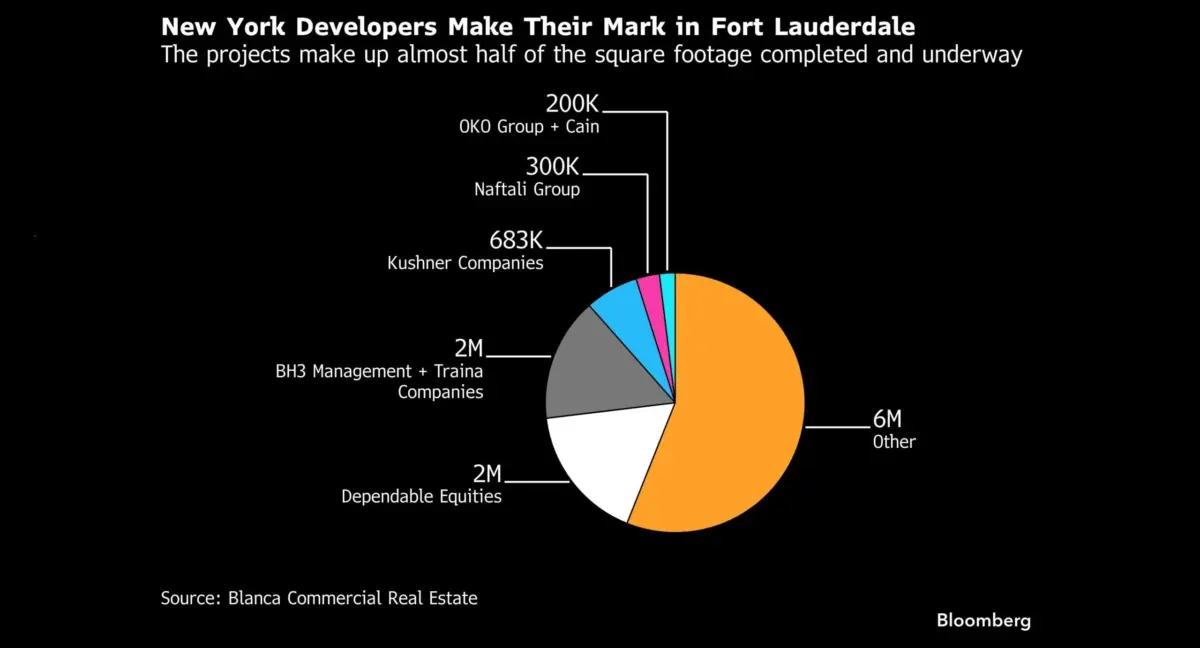
Simultaneously, New York-based Apollo Global Management’s Athene Annuity and Life Company is providing critical financial backing for the 46-story Andare Residences, which is poised to become Fort Lauderdale’s tallest tower. According to data from Blanca Commercial Real Estate, New York-based firms are currently behind roughly 4.5 million square feet of downtown development—accounting for an astounding 45% of the city’s total active pipeline.
2. Chronology: The Evolution of Fort Lauderdale’s Boom
To understand how Fort Lauderdale reached this tipping point, it is helpful to trace the timeline of its modern development:
- The 1990s–2010s (The "Up and Coming" Era): For nearly three decades, local boosters and real estate agents routinely branded Fort Lauderdale as an "up-and-coming" market. While it attracted retirees and middle-class families drawn to its canals and beaches, large-scale institutional investment largely bypassed the city in favor of Miami and Orlando.
- 2018–2020 (Infrastructure and Transit Foundations): The launch of the Brightline high-speed rail service fundamentally altered South Florida’s regional connectivity. By linking downtown Fort Lauderdale directly to downtown Miami in roughly 40 minutes, the city suddenly became accessible to regional commuters and corporate travelers without the headache of highway traffic.
- 2020–2022 (The Pandemic Migration Wave): Following the onset of COVID-19, a historic wave of migration out of high-tax, dense northeastern and West Coast cities hit South Florida. While Miami captured the lions’ share, Fort Lauderdale quietly absorbed a rapidly growing population of young professionals. City data indicates that the population of downtown adults under the age of 45 has surged by 25% since 2020.
- 2023–2025 (The Corporate Influx and Wall Street Capital): Major corporations and supply-chain giants began planting flags in Broward County. Concurrently, New York developers shifted from speculative planning to aggressive capital deployment, leveraging institutional New York financing to break ground on record-setting high-rises.
- 2026 and Beyond (Maturation and Vertical Transformation): As megaprojects like T3 FAT Village and Ombelle progress toward completion, Fort Lauderdale is transitioning from a secondary market into a primary institutional investment target.
3. Supporting Data: The Numbers Behind the Transformation
The data confirms that Fort Lauderdale’s pitch is resonating deeply with investors, corporations, and interstate migrants alike.
Demographics and Migration
While the New York City metropolitan area remains by far the single largest feeder market for Fort Lauderdale newcomers, the city is increasingly drawing talent from the West Coast. According to the downtown development group, 22% of out-of-state movers now hail from Los Angeles or San Diego, drawn by a combination of favorable tax structures and lifestyle flexibility.
Housing Market Dynamics
For years, buying a home in Fort Lauderdale offered a steep discount compared to Miami. However, that cost advantage is rapidly compressing. According to Redfin data:
- The median home sale price in Fort Lauderdale is currently about $70,000 less than in Miami.
- Just one year ago, that price gap sat at approximately $120,000, indicating that Fort Lauderdale real estate is appreciating at a notably faster clip as demand surges.
"In five to 10 years, you will see a lot of price appreciation, because we are just at the beginning of the story," Miki Naftali predicts.
Commercial Real Estate and Corporate Expansion
Fort Lauderdale’s residential boom is successfully mirroring a parallel explosion in its corporate and commercial sectors.
- Broward County Commercial Sales: Broward County has witnessed the strongest growth in commercial sales volume across the region this year, surging to $3.4 billion, according to CBRE data.
- Major Leases: Greenwich, Connecticut-based supply chain giant GXO Logistics recently secured roughly 35,000 square feet of office space at Hines’ flagship $500 million T3 FAT Village development in downtown Fort Lauderdale. According to Tere Blanca, founder and CEO of Blanca Commercial Real Estate, this transaction ranks among the top three largest commercial leases signed in all of South Florida since 2023, trailing only major deals by ServiceNow in Palm Beach and FIFA in Miami.
- Local Anchors: The city is already home to major corporate footprints, including automotive giant AutoNation, pet products leader Chewy, and aerospace firm VSE.
Transit and Accessibility
Infrastructure improvements have served as the lifeblood of this economic activity. The Brightline high-speed rail offers downtown-to-downtown transit for as little as $9 with multi-ride packs—frequently undercutting the cost of peak rush-hour highway tolls. Additionally, local aviation options have rebounded strongly; local airports have successfully increased service capacity to fill the void left when budget carrier Spirit Airlines restructured its operations.
4. Official Responses and Industry Perspectives
Despite the undeniable influx of capital, opinions within the real estate community remain sharply divided over whether Fort Lauderdale’s rapid luxury pivot is sustainable.
The Optimists: Banking on Institutional Maturity
Proponents of the boom argue that the sheer scale of institutional backing separates this cycle from historical false starts. Unlike other fast-growing Florida markets—such as Orlando—where developers have relied heavily on regional banks and risk-prone insurance lenders, Fort Lauderdale’s major projects are fueled by deep-pocketed private equity and elite New York asset managers.
"I look at the Fort Lauderdale numbers and I’m like, ‘Wow, this is a whole new world being created,’" says Ana Bozovic of Analytics Miami. "That’s following the New York money."
Isaac Schlesinger of Dependable Equities expresses utter confidence in the trajectory of the city. "I’m looking forward to continuing being involved in the maturing of the city to the point where the question of skepticism will be answered on its own," he notes.
Public-private partnerships are also accelerating the transformation. The city government recently partnered on a $130 million overhaul of the Las Olas Marina, expanding dockage capacity for larger super-yachts, adding upscale waterfront dining, retail space, and an expansive pedestrian promenade. Additional city plans call for wider sidewalks, enhanced landscaping, and improved bicycle connectivity linking the downtown core directly to the beach.
The Skeptics: Warnings of Overbuilding and Cultural Disconnect
Conversely, veteran local brokers and market watchers warn that the sudden inundation of luxury high-rises risks alienating the very demographic that built the city.
"When you’re pitching Fort Lauderdale around the country it makes sense, but then reality hits when you’re on the ground," cautions Peter Zalewski, a prominent South Florida real estate broker. "It’s a suburb with high rises. The demographic has always been working class."
Zalewski points to cautionary regional tales, such as Panama City, where external capital flooded real estate markets without the underlying local wage growth required to sustain long-term demand.
"Developers have overspent," Zalewski warns. "We don’t have salaries like Silicon Valley."
Critics note that a disconnect persists between incoming luxury developments—where rental and purchase prices cater to affluent coastal transplants—and the median local wage earner, raising pressing questions regarding long-term affordability and socioeconomic displacement.
5. Implications: What Lies Ahead for Broward County
As Fort Lauderdale charges forward into the latter half of the decade, the implications of its vertical transformation will reverberate across the entire South Florida economic landscape.
- Economic Diversification: By successfully attracting major corporate tenants like GXO Logistics alongside established giants like Chewy and AutoNation, Fort Lauderdale is proving it is more than just a bedroom community or a retirement haven. It is cementing its status as an independent white-collar employment hub.
- The Redefinition of South Florida Metros: The traditional bipolar dynamic of South Florida real estate—Miami versus Palm Beach—is effectively fading into a tripolar powerhouse model. Fort Lauderdale is successfully carving out an independent identity as a "Goldilocks" city: offering urban sophistication and high-end luxury without the chaotic congestion of Miami or the exclusive, quiet seclusion of Palm Beach.
- Infrastructure and Governance Pressures: With thousands of luxury residential units and millions of square feet of commercial space scheduled to come online by 2028, municipal leaders face mounting pressure. Balancing pedestrian-friendly master planning, transit expansion, and public amenities with the urgent need for workforce and attainable housing will dictate whether the city can grow equitably.
For now, the cranes towering over Flagler Village and the Las Olas corridor tell a definitive story. Wall Street capital has arrived, New York developers have planted their flag, and Fort Lauderdale’s long-awaited moment in the sun has finally materialized. Whether the city can successfully bridge its working-class roots with its high-rise future remains the ultimate test of its historic boom.
