

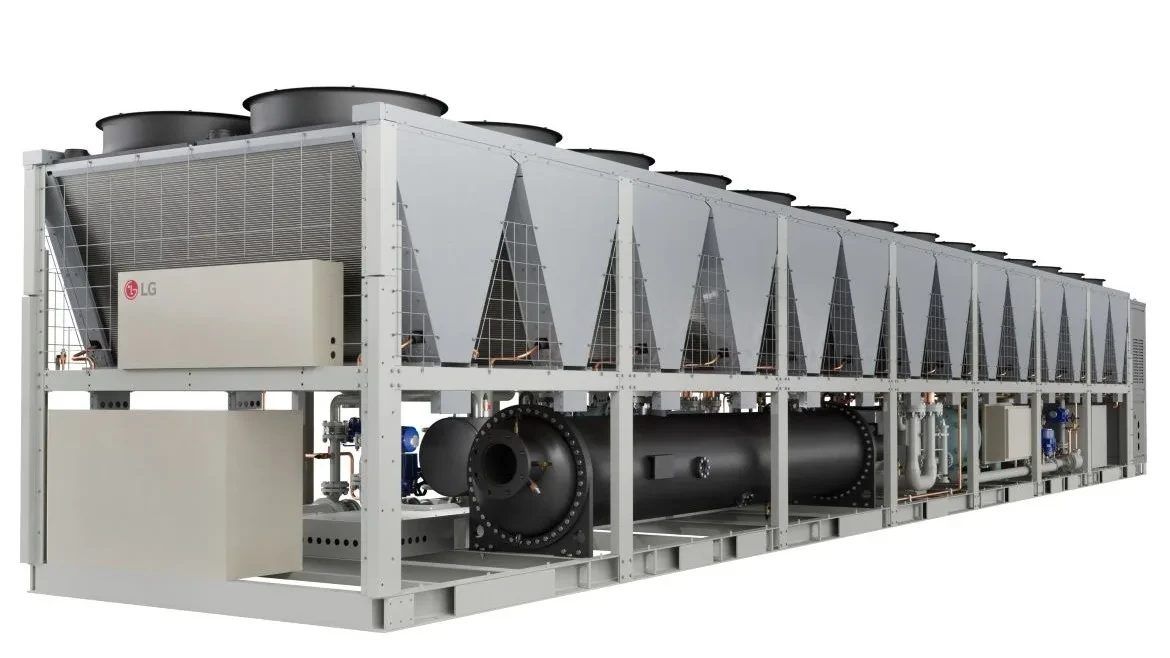
SEOUL — In response to the unprecedented thermal challenges posed by the artificial intelligence (AI) boom, LG Electronics has officially announced the launch of its high-efficiency, highly reliable Air-Cooled Centrifugal Chiller (ACC). Designed specifically to meet the intensive cooling demands of modern AI data centers (AIDCs), the new system aims to redefine energy performance, operational continuity, and system reliability.
Available in capacities ranging between 480 and 600 tons of refrigeration per unit, the newly engineered chiller can be dynamically configured to match data centers of varying footprints and cooling thresholds. The announcement significantly expands LG’s robust commercial and industrial data center cooling portfolio, cementing the electronics giant’s commitment to providing critical infrastructure solutions for the tech sector.
Main Facts: Engineering the Future of Data Center Thermal Management
The modern AI data center represents a massive paradigm shift in IT infrastructure. Driven by generative AI, machine learning training models, and high-density computing clusters, these facilities generate unprecedented levels of heat. Traditional cooling systems often struggle to keep pace without incurring massive energy penalties. LG’s new Air-Cooled Centrifugal Chiller tackles this challenge head-on through a combination of oil-free architecture, advanced refrigerant free-cooling technology, and machine learning-driven automation.
Core Architectural Highlights:
- Capacity Range: 480 to 600 tons of refrigeration per unit, adaptable to scalable AIDC environments.
- Oil-Free Magnetic Bearings: Eliminates the need for lubricating oil by using magnetic force to suspend the rotating compressor shaft, drastically cutting mechanical friction losses.
- Direct Refrigerant Free-Cooling: Circulates refrigerant directly using outdoor air without an intermediate heat exchanger or glycol, minimizing heat and pressure losses while simplifying overall maintenance.
- Smart Safety and Recovery Protocols: Features an integrated gap sensor, uninterruptible power supply (UPS) integration for safe emergency shutdowns, and a fast-recovery feature that restores full cooling capacity within three minutes of power restoration.
- Data Center Cooling Management (DCCM) Software: Provides centralized, integrated monitoring, sensor-based early anomaly detection, and predictive maintenance.
Chronology: The Evolution of LG’s HVAC and Cooling Dominance
To understand the significance of LG’s latest release, it is helpful to trace the company’s trajectory in the heating, ventilation, air conditioning, and refrigeration (HVAC&R) space.
Strategic Milestones:
- Decades of Core Component Development: Unlike many competitors who outsource crucial components, LG has long invested in its proprietary "Core Tech," designing and manufacturing its own compressors, motors, inverters, and magnetic bearings.
- Consistent Industry Recognition: LG’s air-cooled chillers have achieved a remarkable industry milestone, receiving the prestigious Air-Conditioning, Heating, and Refrigeration Institute (AHRI) Performance Award for nine consecutive years.
- The AI Infrastructure Pivot: As the generative AI boom accelerated through the early 2020s, data center operators increasingly flagged cooling as their primary operational bottleneck. In response, LG accelerated its R&D pipelines to engineer specialized thermal management systems tailored to high-density server racks.
- The 2026 Launch: The unveiling of the Air-Cooled Centrifugal Chiller marks the culmination of these efforts, positioning LG as a premier end-to-end infrastructure provider for hyperscale and enterprise AI facilities.
Supporting Data and Technical Deep Dive
The technical architecture of the new LG ACC distinguishes it from conventional chillers on the market. Every subsystem has been optimized to maximize efficiency and minimize downtime in mission-critical environments.
1. Oil-Free Magnetic-Bearing Centrifugal Compressor
At the heart of the ACC is a cutting-edge centrifugal compressor that completely discards traditional lubrication systems. By leveraging magnetic levitation to suspend the rotating compressor shaft, the design eradicates mechanical friction. This reduction in friction not only boosts overall compression performance but also drastically lowers long-term wear and tear, reducing maintenance frequency and operational overhead.
2. Advanced Refrigerant Free-Cooling Efficiency
Maintaining thermal equilibrium in data centers requires constant energy expenditure. LG’s system introduces a streamlined refrigerant free-cooling approach that leverages ambient outdoor air to reduce the compressor’s workload.
Traditional free-cooling systems typically rely on intermediate heat exchangers and glycol loops, which can introduce thermal resistance and pressure drops. LG’s direct-circulation method bypasses these hurdles. According to internal company simulations, this direct refrigerant free-cooling technology consumes approximately 30% less energy annually than conventional water-side free-cooling setups. Furthermore, the inclusion of LG’s series counter-flow (SCF) technology ensures that thermal performance remains balanced across varying ambient conditions.
3. Fail-Safe Operations and Rapid Recovery
In an AIDC environment, even a brief interruption in cooling can lead to catastrophic thermal runaway, server throttling, or hardware damage. LG has engineered multiple redundancies into the ACC to mitigate these risks:
- Precision Gap Sensors: Integrated directly into the magnetic bearing system, these sensors continuously track the rotation axis to allow for hyper-accurate operational control.
- Adaptive Machine Learning: The chiller utilizes machine learning algorithms to study historical and real-time operating patterns, proactively predicting and preventing damaging compressor surges.
- UPS Emergency Integration: In the event of a sudden grid failure, an uninterruptible power supply kicks in to provide emergency power, ensuring the compressor shaft decelerates safely and preventing bearing degradation.
- Three-Minute Fast Recovery: Once power is restored, the chiller can re-establish optimal cooling capacity in just three minutes, minimizing thermal spikes inside the data hall.
4. Software Integration via DCCM
Hardware is only part of the equation. LG addresses the software side of data center management through its proprietary Data Center Cooling Management (DCCM) platform. DCCM acts as the nerve center for complex cooling infrastructures, providing:
- Integrated, real-time monitoring across multiple chiller units.
- Data-driven, sensor-based diagnostics for early anomaly detection.
- Predictive maintenance tools to avert unexpected hardware failures.
- Dynamic workload optimization, adjusting cooling output in real-time based on fluctuating IT computing demands.
5. Global Compliance and Certifications
To ensure seamless deployment across international markets, LG’s chillers and testing laboratories strictly adhere to major global standards. The systems meet the rigorous requirements of:
- AHRI: Certified performance standards.
- ASME: American Society of Mechanical Engineers standards for pressure vessels.
- ETL: Electrical Testing Laboratories safety standards for North America.
- CE Mark: Conformité Européenne directives covering safety, health, and environmental protection across Europe.
Official Responses and Industry Perspective
The commercial heating and cooling sector has taken close note of LG’s strategic expansion into the AI data center market. Industry leaders emphasize that thermal management is no longer a secondary consideration for tech giants—it is a core determinant of profitability and sustainability.
“As AI data centers become increasingly dense and heat-intensive, energy-efficient, reliable cooling is more critical than ever,” said James Lee, president of LG Electronics’ Eco Solution Co., in the official press release. “With our Core Tech and data center cooling expertise, we will continue to expand our portfolio of solutions to meet these evolving requirements.”
Market analysts point out that as data center operators face stricter environmental regulations and rising energy costs, innovations like LG’s oil-free magnetic bearings and 30% more efficient free-cooling technology will play a pivotal role in helping tech companies meet their net-zero carbon pledges without sacrificing computational power.
Implications for the Future of Data Center Infrastructure
The launch of LG’s Air-Cooled Centrifugal Chiller carries profound implications for the broader technology and HVAC landscapes:
- Easing the Grid Strain: AI data centers are notoriously power-hungry, frequently straining local power grids. By cutting annual free-cooling energy consumption by roughly 30%, LG’s chiller directly addresses the sustainability crisis facing modern tech hubs.
- Redefining Reliability Standards: The integration of machine learning surge prevention, UPS-backed emergency shutdowns, and rapid 3-minute thermal recovery sets a new benchmark for uptime in mission-critical facilities.
- Strengthening Supply Chain Resilience: By relying on its proprietary "Core Tech" (inverters, motors, bearings, and compressors), LG ensures tighter quality control and reduces reliance on external component suppliers, a major asset in a market prone to supply chain disruptions.
As hyperscalers and enterprise colocation providers continue to scale up their AI infrastructure, thermal management solutions that blend high energy efficiency, intelligent software automation, and robust fail-safes will dictate market leadership. With this latest ACC release, LG Electronics has positioned itself at the forefront of the green data center revolution.
