

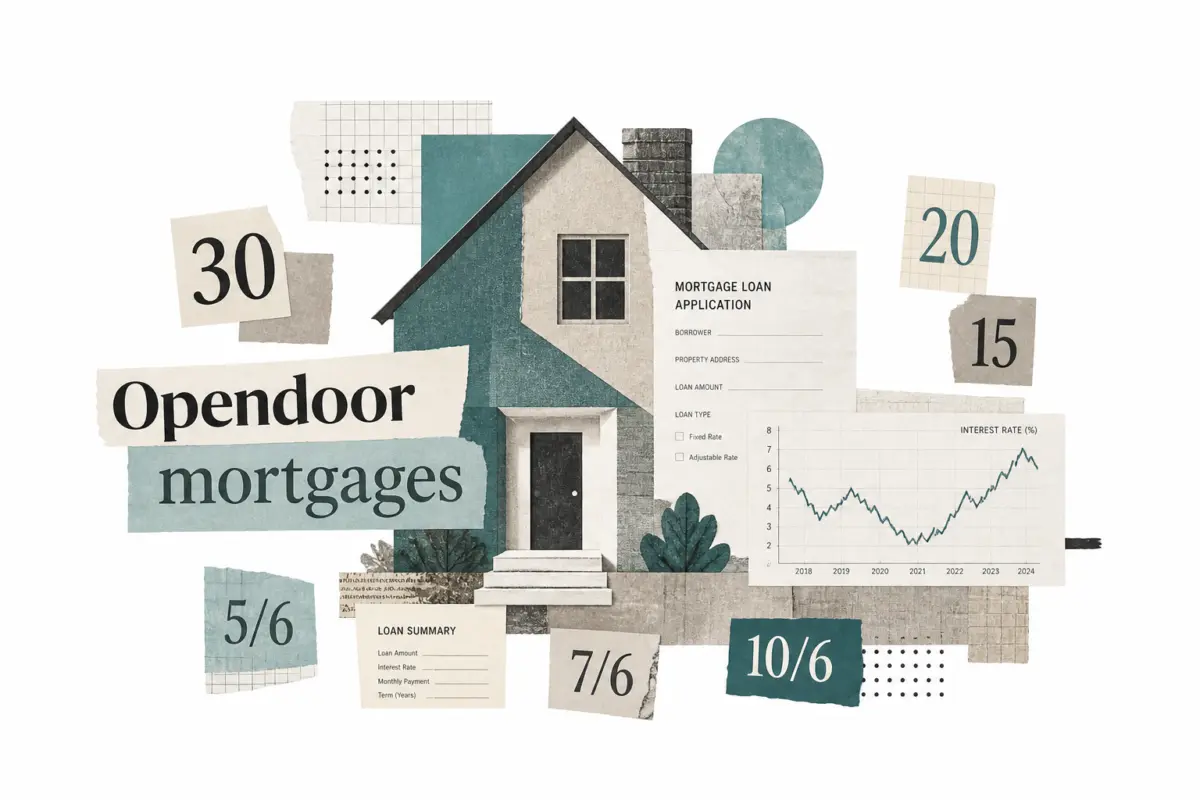
SAN FRANCISCO — In a strategic move poised to reshape how consumers interact with digital real estate platforms, Opendoor Technologies announced Friday that its proprietary lending arm, Opendoor Home Loans, has officially exited beta testing. The service is now widely available, offering a comprehensive suite of fixed- and adjustable-rate mortgages to prospective home buyers across all markets where the company is legally licensed.
The nationwide commercial rollout marks a critical milestone for the San Francisco-based iBuying pioneer. By bringing mortgage origination fully back into its operational ecosystem, Opendoor is positioning itself as a vertically integrated "one-stop shop" for residential real estate transactions. Crucially, the newly minted loan products are not restricted to properties owned by Opendoor; they are available for any open-market home purchase within the company’s operational footprint.
This expansion arrives at a volatile time for the broader U.S. housing market. Stubbornly high borrowing costs continue to sideline potential buyers, making the intersection of home search and financing more critical than ever. Industry observers are watching closely to see if Opendoor’s streamlined, tech-forward lending model can successfully capture market share in an environment defined by affordability constraints and intense competition among lenders.
Main Facts of the Launch
The official exit from beta unlocks a full menu of traditional and modern loan products designed to cater to diverse financial profiles. According to company disclosures, Opendoor Home Loans now provides:
- Fixed-Rate Mortgages: 30-year, 20-year, and 15-year conventional fixed-rate loans.
- Adjustable-Rate Mortgages (ARMs): 5/6, 7/6, and 10/6 adjustable-rate products, giving buyers alternative pathways to lower initial monthly payments.
- Open-Market Accessibility: Financing is applicable to any residential purchase in licensed jurisdictions, broadening the total addressable market far beyond Opendoor’s own inventory.
- Digital-First Infrastructure: The platform enables users to secure prequalification in minutes—without triggering a hard credit pull—complete a fully digital application with automated income and asset verification, and upload closing documents through a centralized portal designed to eliminate traditional handoffs and administrative friction.
The broader economic backdrop serves as the ultimate proving ground for these products. According to the HousingWire Mortgage Rates Center, the average benchmark rate for a 30-year conventional fixed-rate loan recently hovered near 7.01%, down a modest 5 basis points week-over-week. While slight downward movements offer occasional windows of relief, overall borrowing costs remain near historic multi-year highs, heightening consumer sensitivity to lender fees, closing costs, and operational transparency.
A Historical Retrospective: The Chronology of Opendoor Home Loans
To understand the weight of Friday’s announcement, one must look at the tumultuous history of Opendoor’s ventures into mortgage origination. The journey has been marked by ambitious expansion, pandemic-era disruptions, macroeconomic corrections, and a calculated corporate pivot.
2019: The Initial Inception
Opendoor originally launched its in-house mortgage division back in 2019. The move was part of an aggressive, broader diversification strategy designed to capture every facet of the real estate transaction lifecycle. By bundling home searching, instant cash offers, traditional brokerage services, and mortgage financing under one digital roof, the company hoped to maximize lifetime customer value and streamline a notoriously fragmented consumer experience.
2022: The Pandemic Hangover and Shutdown
The initial momentum came to a grinding halt as macroeconomic conditions deteriorated. Spurred by surging inflation, the Federal Reserve embarked on one of the most aggressive monetary tightening cycles in modern history. Mortgage rates doubled in a matter of months, triggering a steep housing market slowdown. Faced with compressed transaction volumes, mounting operational costs, and declining demand across its core iBuying business, Opendoor shuttered its home loan division in 2022 to preserve capital and refocus on core profitability.
February 2026: The Quiet Return to Beta
After years of stabilizing its core operations and navigating the shifting post-pandemic real estate landscape, Opendoor signaled a strategic reversal. In February 2026, the company quietly reintroduced a mortgage product to a limited, controlled group of users. This soft launch served as a proving ground for the platform’s upgraded technological architecture, testing automated underwriting systems, digital document verification pipelines, and customer response metrics.
March 2026: Sparking Industry Debate
The beta phase quickly generated controversy and intense industry chatter. In March, Opendoor leadership took to social media to highlight a headline-grabbing milestone: the company had successfully locked a mortgage for a consumer at an eye-opening 4.99%.
This dramatically below-market rate was achieved by removing the lender markup—a practice that sparked fierce debates across mortgage boardrooms. Industry veterans immediately questioned the financial sustainability of the model, raising concerns over who ultimately absorbs the operational cost and structural risk of underwriting loans below prevailing market yields.
October 2026: Full Commercial Rollout
With the beta metrics validated and internal processes ironed out, Opendoor officially dropped the training wheels. The complete menu of fixed- and adjustable-rate mortgages is now live for all eligible buyers in licensed markets, transforming the company’s financial services arm from an experimental feature into a core pillar of its long-term business model.
Supporting Data: Financial Performance and Market Realities
Opendoor’s push into mortgage lending occurs against a complex financial backdrop. The company’s latest earnings reports illustrate both the immense scale of its operations and the ongoing financial pressures inherent to the iBuying and digital real estate sectors.
In the second quarter of 2026, Opendoor reported total revenue of $883 million. While this figure demonstrates the company’s massive transaction volume, it also marks a significant contraction compared to the $1.567 billion in revenue recorded during the same period in 2025.
Concurrently, the company’s bottom-line performance reflected the challenges of scaling operations in a high-rate housing market. Opendoor posted a net loss of $162 million for Q2 2026, widening notably from the $29 million net loss reported a year prior.
Despite the sharp year-over-year revenue decline and widening quarterly losses, executive leadership remains optimistic about the company’s trajectory. Opendoor has communicated to investors that it anticipates achieving at least a 20% annual increase in revenue for the full fiscal year.
Financial analysts note that introducing an in-house mortgage platform is a calculated play to fortify these metrics. By capturing the lucrative origination fees, title services, and ancillary revenue associated with home financing, Opendoor hopes to diversify its income streams, reduce its reliance on volatile home-flipping margins, and build a more resilient financial foundation.
Official Responses and Executive Vision
Opendoor’s leadership has framed the launch not merely as an expansion of product lines, but as a fundamental reimagining of how consumers buy homes. The company argues that the traditional real estate transaction is broken by structural inefficiencies.
In a statement accompanying Friday’s announcement, Opendoor CEO Kaz Nejatian laid out the philosophical core of the new offering:
"Buying a home is two things: the home and the money," Nejatian said. "They’re handled by separate systems, with separate incentives, and too much avoidable cost. We built Opendoor Home Loans for the way most people buy a home. We can’t control the market rate, but we can control the cost and friction around it."
Nejatian’s comments strike at the heart of the traditional home-buying friction. For decades, consumers have navigated a disjointed labyrinth: working with a real estate agent to find a property, jumping to a separate mortgage broker or retail bank for financing, and coordinating closing schedules across multiple independent entities with misaligned timelines and redundant paperwork.
By integrating these workflows into a single digital interface, Opendoor aims to replace bureaucratic delays with algorithmic efficiency. The removal of hard credit pulls for initial prequalifications and the streamlining of document verification are designed to give both buyers and sellers a greater sense of certainty—a precious commodity in today’s unpredictable market.
Strategic Implications for the Real Estate and Mortgage Industries
Opendoor’s nationwide launch of its mortgage suite is part of a broader, systemic trend across the American real estate landscape. Proptech platforms, real estate brokerages, and large franchise networks are increasingly aggressively moving into mortgage origination, title, and escrow services.
Through innovative joint ventures, in-house lending divisions, and strategic technology partnerships—such as the recent collaborative plays seen across major brokerages—real estate companies are attempting to lock consumers into closed-loop ecosystems.
1. Keeping Economics In-House
For digital platforms like Opendoor, relying solely on commission spreads from home purchases and sales leaves the business vulnerable to macroeconomic housing downturns. By offering mortgages, the company captures additional revenue per transaction. If a consumer buys a home using Opendoor’s brokerage services and finances it through Opendoor Home Loans, the lifetime value of that customer multiplies significantly.
2. Transaction Certainty and Speed
In a competitive or volatile market, transaction fall-throughs are a major pain point for buyers and sellers alike. Traditional mortgage financing often introduces delays, appraisal disputes, and sudden underwriting hurdles that can kill a deal at the eleventh hour. By controlling both the real estate search and the financing pipeline, Opendoor can theoretically vet buyers earlier, streamline underwriting, and deliver a more predictable, guaranteed closing timeline.
3. Industry Disruption and Competitive Pressure
The aggressive pricing models tested by Opendoor—such as the viral 4.99% rate lock achieved by stripping out traditional lender markups—pose a direct challenge to traditional retail lenders, independent mortgage banks (IMBs), and credit unions. If tech-enabled platforms can leverage alternative revenue streams to subsidize or discount consumer borrowing costs, traditional lenders may face mounting pressure to compress their own fees and modernize their digital infrastructure.
4. Regulatory and Sustainability Scrutiny
However, industry skeptics continue to question the long-term viability of aggressive rate-discounting models. Operating a mortgage lending business requires massive capital liquidity, rigorous compliance with federal and state lending regulations (such as TRID, RESPA, and the Truth in Lending Act), and sophisticated risk management frameworks. As Opendoor scales its lending operations nationwide against a backdrop of wider quarterly net losses, financial analysts will be watching closely to ensure that the mortgage unit remains a sustainable value driver rather than a capital drain.
Looking Ahead
As Opendoor Home Loans steps out of beta and into the open market, the stage is set for a high-stakes test of proptech integration. In an economic climate where every basis point matters and affordability remains the single greatest barrier to homeownership, platforms that successfully eliminate friction and lower transaction costs will hold a distinct competitive advantage.
Whether Opendoor can successfully navigate the complexities of mortgage origination while reversing its recent net losses remains one of the most compelling storylines in modern real estate technology. For now, home buyers in licensed markets have a new, highly digital alternative for financing their next chapter—and the traditional mortgage industry has a formidable new competitor to watch.
