

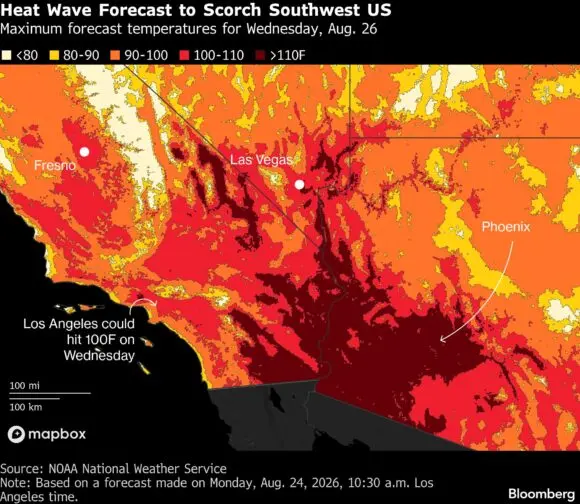
LOS ANGELES — Southern California is bracing for a punishing and potentially historic heat wave as a sprawling, high-pressure weather system that has baked Texas and the broader American Southwest expands aggressively westward. The atmospheric dome is currently stripping vital moisture from the region’s terrain, setting the stage for days of unrelenting triple-digit temperatures, strained public infrastructure, and a drastically elevated threat of fast-moving wildfires.
The National Weather Service (NWS) has issued an extensive series of heat advisories and excessive heat warnings stretching more than 200 miles (322 kilometers) southeast, running uninterrupted from Santa Barbara along the picturesque central coast all the way to the U.S.–Mexico border. Forecasters warn that this weather pattern will not break quickly, locking in dangerous conditions for much of the week and posing severe health risks to millions of residents, particularly vulnerable populations without adequate air conditioning.
Main Facts
The current meteorological crisis is driven by an intense mid-level ridge of high pressure—colloquially known as a "heat dome"—that has dominated the weather across Texas and the Southern Plains for weeks. As this massive dome shifts its axis westward, it has compressed and heated the air mass over the Desert Southwest and the Pacific Coast.
- Geographic Scope: Heat alerts blanket a massive corridor of Southern California, affecting coastal valleys, metropolitan centers, and rural interior communities alike.
- Temperature Projections: In downtown Los Angeles, daily high temperatures are forecast to approach or eclipse the 100°F (38°C) mark consistently through Friday. A short distance inland, the conditions are significantly more severe; the San Fernando Valley and surrounding inland basins are projected to see thermometers surge toward 110°F (43°C).
- The Wildfire Threat: Beyond human discomfort and health strains, the primary danger lies in the rapid desiccation of the local ecosystem. The prolonged heat is aggressively pulling moisture out of local vegetation, soils, and brush.
- Wind Dynamics: While California’s traditional peak wildfire season typically aligns with the arrival of the offshore Santa Ana winds in late autumn and winter, meteorologists warn that localized wind phenomena—such as the warm "sundowner" winds expected to cascade down from the mountains into Santa Barbara County each night—could provide the exact catalyst needed to ignite or rapidly spread flames.
Chronology of the Weather Event
Understanding how this heat wave materialized helps contextualize its severity and stubborn persistence.
Phase 1: The Southern Plains Build-Up (Late July to Early August)
For weeks, a stationary upper-level high-pressure system sat over Texas, trapping hot air and creating drought-intensifying conditions across the South-Central United States. Meteorologists at the Weather Prediction Center (WPC) noted that the ridge acted like a atmospheric lid, preventing cloud formation and allowing solar radiation to continuously bake the soil.
Phase 2: The Western Migration (Mid-Week)
By the beginning of the current week, steering currents aloft began pushing the center of the high-pressure ridge westward toward the Great Basin and the Mojave Desert. As the dome expanded, its outer fringes compressed the marine layer along the Southern California coastline, effectively shutting off the cooling morning stratus clouds ("June gloom" remnants) that typically moderate coastal temperatures during the summer months.
Phase 3: Terrain Drying and Peak Temperatures (Current Days)
With the marine layer suppressed, brilliant sunshine has beaten down unimpeded on Southern California’s topography. The relative humidity plummeted into the single digits in interior valleys. According to NWS telemetry, soils that managed to retain some residual moisture from localized winter rains are now rapidly turning to dust, creating an exceptionally dry fuel bed across regional hillsides.
Phase 4: The Nighttime Threat and Weekend Outlook (Projected)
Unlike typical heat waves where temperatures drop significantly after sunset, meteorologists warn that warm nighttime lows will offer little relief to residents. In Santa Barbara County, descending mountain winds will keep overnight temperatures abnormally high. Forecasters project that these sweltering conditions will persist through at least Friday afternoon before a very gradual cooling trend begins over the weekend.
Supporting Data and Meteorological Analysis
To fully grasp the gravity of the Southern California heat wave, examining the underlying meteorological data provides a clear picture of an environment pushed to its limits.
Temperature Anomalies
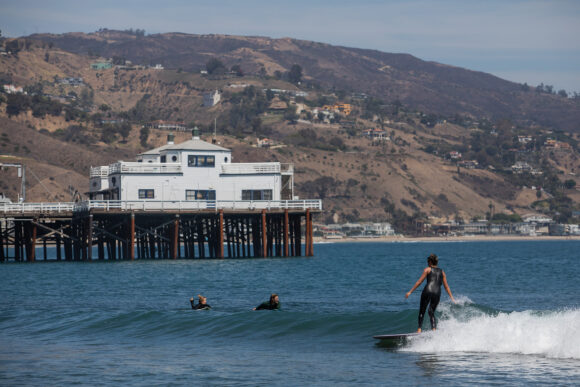
The forecast highs for downtown Los Angeles (approx. 100°F) and the San Fernando Valley (approx. 110°F) sit roughly 10 to 15 degrees above historical climate averages for this time of year. While coastal pockets will experience modest moderation due to ocean proximity, even beachside communities like Malibu are feeling the oppressive weight of the thermal dome.
Fuel Moisture and Vegetation Stress
Cody Snell, a meteorologist at the U.S. Weather Prediction Center, emphasized that the regional landscape was already primed to support high-intensity fires even before this heat wave set in.
- Live Fuel Moisture Content (LFMC): Field measurements taken by forestry agencies indicate that chaparral and brush moisture levels are sitting well below critical thresholds for summer.
- Dead Fuel Accumulation: Years of alternating drought and sporadic heavy rainfall have left behind thick layers of fine dead grass beneath woody shrubs. This "fine fuel" is acutely sensitive to relative humidity drops.
- Wind Sensitivity: "Any wind at all would be enough to spread fires," Snell warned. When relative humidity drops below 15% and temperatures exceed 100°F, even minor wind gusts—such as thermal updrafts or afternoon sea breezes—can transform a small spark into an aggressive, crown-scorching wildfire.
Official Responses and Public Safety Measures
In response to the escalating danger, local governments, emergency management agencies, and utility providers across Southern California have mobilized resources to protect public health and prevent catastrophic infrastructure failures.
Local Government and Emergency Services
- Cooling Centers: Municipalities throughout Los Angeles County, Orange County, and the Inland Empire have activated emergency cooling centers. Libraries, senior centers, and community facilities have extended their operating hours to provide air-conditioned sanctuary for unsheltered populations and residents whose home cooling systems may fail.
- Red Flag Warnings and Fire Bans: The U.S. Forest Service and CAL FIRE have elevated staffing levels and prepositioned firefighting aircraft and ground crews. Red Flag Warnings have been enacted in wind-prone mountain passes and canyon areas, banning unauthorized campfires and restricting the use of heavy machinery that could throw off sparks.
- Health Advisories: County public health departments have issued comprehensive advisories urging residents to limit strenuous outdoor activities during peak heating hours (10:00 a.m. to 6:00 p.m.), stay hydrated, and check on elderly neighbors, pets, and individuals with chronic medical conditions who are uniquely susceptible to heat exhaustion and heatstroke.
Grid Operators and Utility Preparedness
The California Independent System Operator (CAISO) and major utilities like Southern California Edison (SCE) are monitoring the electrical grid closely.
- Power Demand: Extreme heat drives up residential and commercial air conditioning demand, pushing the power grid toward peak capacity.
- Conservation Calls: While rolling blackouts are not immediately anticipated, utilities have urged consumers to voluntarily reduce electricity usage during late afternoon and early evening hours—typically by raising thermostats to 78°F, turning off non-essential appliances, and delaying heavy energy use until nighttime.
- Public Safety Power Shutoffs (PSPS): In areas facing the highest combination of high heat, low humidity, and dangerous winds, utilities retain the authority to temporarily shut off power to specific distribution lines to prevent electrical equipment from sparking a wildfire.
Implications: Climate Trends and the Future of California Summers
While severe heat waves are a historically understood feature of the American Southwest, the trajectory of events like the 2026 late-summer dome underscores broader, systemic shifts in California’s climate and environmental profile.
The Evolution of Fire Season
For generations, California experienced a distinct "fire season" generally bookended by autumn winds and winter rains. However, as climatologists frequently note, that paradigm has fundamentally broken down.
- Year-Round Vulnerability: Fire season has effectively become a year-round phenomenon. High-pressure ridges arriving earlier in the summer and lingering later into the fall mean that the window for safe prescribed burns is shrinking, while the window for catastrophic wildfires is expanding.
- The Urban-Wildland Interface: With millions of residents living in close proximity to brush-covered hillsides—the wildland-urban interface—the convergence of extreme heat, dry vegetation, and human activity creates a volatile mathematical equation for emergency responders.
Infrastructure and Urban Planning Realities
The persistent heat wave also highlights ongoing vulnerabilities in urban infrastructure. Los Angeles, traditionally celebrated for its temperate Mediterranean climate, features large swathes of older housing stock lacking central air conditioning.
- The Urban Heat Island Effect: Densely built environments featuring asphalt, concrete, and minimal tree canopy trap heat locally, causing nighttime temperatures in concrete-heavy neighborhoods to stay significantly higher than surrounding rural areas.
- Long-Term Adaptation: City planners face mounting pressure to accelerate green infrastructure initiatives—such as planting millions of trees, painting roofs and asphalt with solar-reflective coatings, and upgrading electrical grids to handle the permanent shift toward higher baseline temperatures.
As Los Angeles and the broader Southern California region hunker down for the remainder of this grueling week, the immediate focus remains on life safety, fire prevention, and weathering a meteorological event that serves as a stark reminder of the region’s shifting environmental baseline.
