

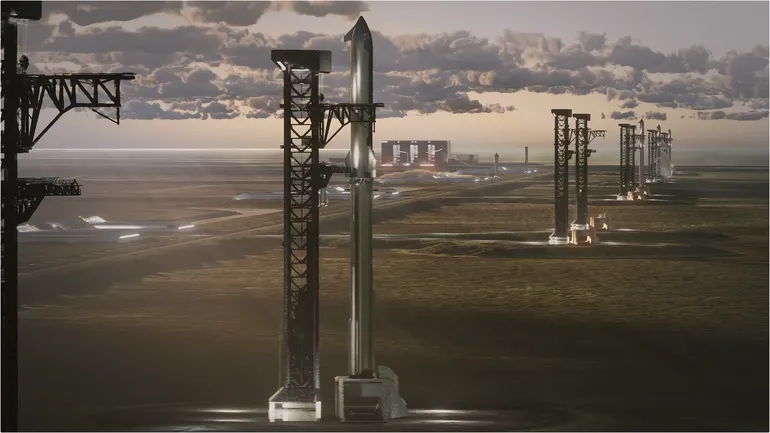
BATON ROUGE, La. — In an era where commercial spaceflight is accelerating at a breakneck pace, SpaceX is charting a bold new course that merges interplanetary ambitions with heavy-duty terrestrial ecological restoration. The aerospace giant is laying the groundwork for its fourth major launch facility, choosing a strategically vital yet environmentally fragile stretch of coastline in Vermilion Parish, Louisiana.
While the project promises to inject massive economic momentum into the local supply chain and align with aggressive federal directives to supercharge U.S. space infrastructure, it also places SpaceX at the center of a complex environmental landscape. The chosen land, formerly controlled by fossil fuel giant ExxonMobil, carries a legacy of coastal erosion and storm vulnerability. Rather than ignoring these challenges, SpaceX is pledging an unprecedented engineering effort to halt marsh deterioration, shore up eroding coastlines, and turn the construction of a rocket launch pad into a catalyst for large-scale ecological revival.
Main Facts: The Vermilion Parish Spaceport Project
At the heart of this endeavor is SpaceX’s Starship—a fully reusable, heavy-lift transportation system engineered to carry both crew and cargo exceeding 100 metric tons. Designed to service Earth orbit, the Moon, Mars, and deep-space destinations, Starship requires state-of-the-art infrastructure capable of supporting unprecedented launch cadences.
To meet this demand, SpaceX selected a coastal site in Vermilion Parish, Louisiana, for its newest launch and test facility. However, building a spaceport in a region defined by fragile wetlands requires a radical departure from traditional industrial construction.
- The Infrastructure Goal: Construction will involve the creation of specialized launch pads, processing facilities, and heavy transport networks designed to handle giant rocket hardware.
- The Environmental Reality: The build site is situated in a high-risk natural disaster zone. According to risk assessments by software developer Augurisk, Vermilion Parish holds a natural disaster risk score of 61%, having weathered 43 declared disasters over the past two decades, predominantly driven by violent hurricanes and tropical storms.
- Economic Integration: To source regional talent and materials, SpaceX has integrated with Source Louisiana, a digital platform that connects local businesses with major project contracts and vendor opportunities. The state is actively encouraging local enterprises to register and update their profiles to qualify for upcoming SpaceX supply chain bids.
- Community Engagement: To foster local goodwill and transparency, SpaceX has announced plans to host a series of town halls and public information sessions in surrounding communities, allowing residents to voice concerns and learn firsthand about the project’s scope.
Chronology: From Oil Legacy to Aerospace Frontier
The transformation of the Vermilion Parish site represents the latest chapter in a long history of industrial land use along the Gulf Coast.
- The 1930s to Present (The Oil Era): For nearly a century, the site and its surrounding marshlands were heavily utilized by the oil and gas industry. Decades of extraction left behind an intricate web of canals, drilling sites, and infrastructure that ultimately contributed to severe ecological degradation.
- The Legal Battles: For over a decade, local Louisiana governments engaged in sweeping litigation against major oil and gas entities—including ExxonMobil—alleging that industrial operations severely polluted coastal marshes and accelerated land loss.
- July 31, 2026 (The Settlement): ExxonMobil officially reached a comprehensive settlement with the Louisiana government and affected coastal parishes, as outlined in a securities filing. The company denied liability or wrongdoing, noting that the settlement did not constitute an admission of fault.
- August 19, 2026: The Times-Picayune/NOLA.com reported on the transaction details, bringing widespread public attention to the shift in land ownership as ExxonMobil’s former holdings paved the way for SpaceX’s new spaceport initiative.
- August 20, 2026: President Donald Trump signed a pivotal National Space Transportation policy memorandum, incentivizing private sector investment in domestic space infrastructure and establishing a federal goal of facilitating more than 1,000 commercial launches and reentries annually by 2030.
- Late August 2026: SpaceX executives released video statements on social media platform X, detailing the immediate priorities for the Louisiana site, which center heavily on wetland restoration and shoreline stabilization before any physical launch infrastructure is erected.
Supporting Data: The Scale of Coastal Vulnerability in Louisiana
To understand why SpaceX’s approach to the Vermilion Parish site is so unique, one must examine the staggering environmental data defining Louisiana’s coast.
A comprehensive 2025 analysis by The Times-Picayune and The Advocate revealed the alarming extent of Louisiana’s land loss:
- Massive Deficit: The state has lost more than 1,900 square miles of land since the 1930s. Much of this loss is attributed to historical oil and gas infrastructure, where wells that once sat securely on solid ground are now completely submerged in open water.
- Submerged Hazards: Investigators identified more than 3,600 oil and wells drilled on land that now sit underwater, alongside at least 610 entirely lost wells and an indeterminate number of undocumented relics.
- Vermilion Parish Erosion: Locally, the statistics are stark. Vermilion Parish lost an estimated 95 square miles of land between 1932 and 2015. Predictive environmental models indicate that the region could lose an additional 360 square miles through 2070 if aggressive mitigation strategies are not implemented.
These figures underscore the precarious nature of the Gulf Coast. For a high-tech aerospace facility to survive in this environment, coastal defense is not merely a supplementary goal—it is an absolute prerequisite for operational survival.
Official Responses: SpaceX and State Agencies Weigh In
Recognizing the sensitivity of developing in a vulnerable wetland, SpaceX leadership has emphasized a collaborative, defensive environmental strategy from day one.
“That’s actually some of the first work that you will see happening on site is getting access to the property so that we can get equipment in to start restoring the wetland and making sure that we stop the erosion on the shoreline,” said Bobby Peden, vice president of Starbase test and launch at SpaceX, in a video statement released on X.
This sentiment was echoed by Sheila McCorkle, vice president of Starship legal and regulatory at SpaceX, who highlighted the sheer engineering scale required to protect the future launch site.
“In order for us to build our infrastructure, to bring the launch pad, to bring the rockets here, we’re going to have to literally shore up the shoreline,” McCorkle stated. “It’s going to be a historic coastal restoration in partnership with Pecan Island and the state and Vermilion Parish to bring the marsh back to make sure we have proper storm protection.”
Beyond engineering teams, Louisiana Economic Development (LED) officials confirmed that SpaceX has engaged in active consultations with the Louisiana Department of Wildlife and Fisheries, the Coastal Protection and Restoration Authority (CPRA), and various local conservation groups. These multi-agency dialogues are designed to craft rigorous mitigation frameworks that protect native fisheries, avian species, and delicate marsh ecosystems from potential aerospace disruptions.
Implications: A New Paradigm for Commercial Space and Environmental Stewardship
The establishment of SpaceX’s Louisiana spaceport carries profound implications for both the commercial aerospace industry and the regulatory environment of the United States.
1. The Intersection of Aerospace and Ecological Engineering
Historically, major industrial and aerospace developments have faced fierce pushback from environmental groups over habitat disruption. By embedding heavy coastal restoration directly into the primary phase of construction, SpaceX is attempting a novel blueprint: utilizing private capital to reverse historical environmental degradation. If successful, the project could establish a new standard for heavy industry operating in ecologically fragile coastal zones.
2. Alignment with National Space Policy
The timing of the Vermilion Parish project aligns perfectly with the White House’s renewed push for commercial space dominance. The National Space Transportation policy memorandum signed by President Trump aims to dramatically scale up U.S. launch capabilities to over 1,000 flights per year by the end of the decade. Crucially, the policy explicitly directs federal agencies to:
- Expedite permitting and environmental reviews.
- Develop new cost-recovery transparency policies.
- Implement a robust space transportation industrial base strategy.
By expanding its footprint beyond Texas (Starbase) and Florida (Kennedy Space Center), SpaceX is diversifying its geographic launch capacity, ensuring that national launch throughput is not bottlenecked by regional weather patterns or localized infrastructure limits.
3. Economic Revitalization for Local Communities
For Louisiana, which has historically relied heavily on the boom-and-bust cycles of the fossil fuel sector, the arrival of SpaceX offers a high-tech economic diversification. Through platforms like Source Louisiana, local fabricators, engineers, and service providers have a direct pathway to lucrative aerospace supply contracts.
However, challenges remain. Balancing the intense sonic and physical demands of orbital-class rocket launches with the fragile ecology of the Vermilion Parish marsh will require perpetual oversight, transparent community dialogue, and unwavering commitment to the promised restoration efforts.
As SpaceX brings its heavy machinery into the Louisiana wetlands, the world will be watching to see if private enterprise can successfully forge a coexistence between the violent thunder of deep-space exploration and the quiet, vital resilience of America’s vanishing coastlines.
