

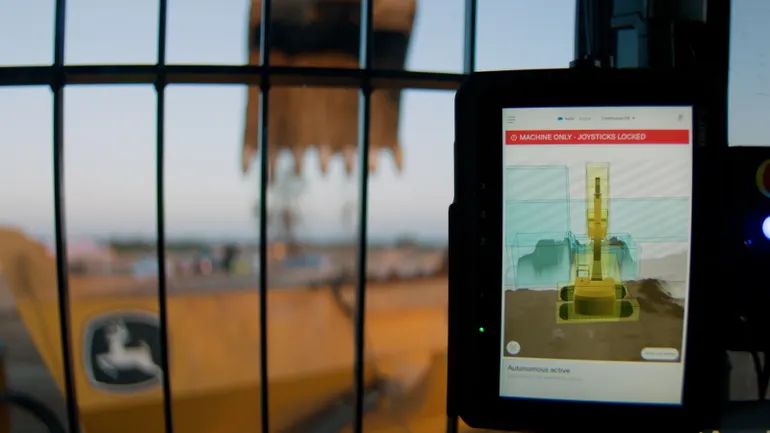
On construction sites across the United States, a quiet revolution is taking place inside the operator’s cabin. For generations, the low hum of diesel engines, the clanking of metal tracks, and the silhouette of a human operator peering through reinforced glass were the defining characteristics of heavy earthmoving. Today, however, a growing number of excavator cabs sit entirely empty.
Bedrock Robotics, a San Francisco-based construction technology firm, announced the commercial deployment of fully autonomous excavators on active, high-stakes infrastructure projects nationwide. This milestone marks the culmination of years of intensive development, signaling that heavy machinery automation has officially transitioned from experimental R&D to mainstream jobsite reality.
As venture capital pours into construction technology—exemplified by Swiss-based Gravis Robotics securing a staggering $200 million Series A funding round from tech investment giant SoftBank on the very same day—the global building sector stands on the precipice of a paradigm shift.
Main Facts: The Technology and Current Deployments
At the heart of this transformation is Bedrock Robotics’ flagship Operator system. Rather than manufacturing entirely new robotic vehicles, Bedrock utilizes a sophisticated retrofit approach. The system equips existing contractor fleets with a comprehensive suite of advanced sensors, high-performance computing hardware, and proprietary machine learning models. This hardware-software integration allows standard excavators to operate completely without onboard human operators.
The technology has already broken ground on critical, high-profile infrastructure projects:
- Nevada Water Treatment Facility: Deployed in active partnership with major general contractor Sundt Construction, the autonomous excavators are assisting in the rigorous excavation and preparation phases of essential municipal water infrastructure.
- Massive Civil Sitework Project: In collaboration with Zachry Construction, Bedrock’s autonomous fleet is tackling a massive 1.2-million-cubic-yard civil earthmoving project, demonstrating the technology’s capability to handle industrial-scale volumes.
According to the company, the installation process for the Operator system is remarkably streamlined, taking place in a single day. Once upfitted, a site manager inputs the project’s parameters and initial excavation plan. The machinery then perceives its dynamic environment, executes complex digging and grading tasks autonomously, and safely navigates standard jobsite conditions alongside human workers and other heavy machinery.
Safety protocols are deeply embedded in the architecture of the system. If the excavator’s 360-degree sensor layout detects a person, an unauthorized vehicle, or an unexpected obstacle entering its safety zone, the machine automatically pauses or comes to a complete, controlled stop.
Chronology: From Stealth Mode to Commercial Reality
The journey toward autonomous heavy machinery has been swift, characterized by aggressive capital raises, strategic testing phases, and rapid scaling:
- July 2025: Bedrock Robotics officially launched out of stealth mode, announcing an impressive $80 million in combined Seed and Series A funding. The industry immediately took notice of the startup’s pedigree, noting its roots in autonomous vehicle technology.
- Late 2025 to Mid-2026: Throughout this roughly one-year period, Bedrock’s technology underwent rigorous real-world testing under strict human supervision. These pilot programs allowed engineers to fine-tune machine learning models, test sensor reliability in adverse weather, and validate safety redundancies on live jobsites.
- February 2026: Bolstered by early successes, Bedrock Robotics closed a massive $270 million funding round to scale its autonomous construction technology and expand its operational footprint.
- August 2026: Bedrock officially announced the commercial deployment of its fully autonomous excavators on critical U.S. infrastructure projects, moving past the testing phase and into live, unsupervised execution. On the exact same day, industry competitor Gravis Robotics announced its $200 million Series A funding, underscoring a broader, sector-wide rush toward automation.
Supporting Data: Addressing the Skilled Labor Shortage
To understand why Bedrock and its investors are betting heavily on excavators, one must look closely at the economics and demographics of the modern construction workforce.
Excavators are widely recognized as some of the most difficult and demanding machines to operate efficiently. Industry data indicates that it typically takes an apprentice roughly five years of hands-on experience to truly master an excavator—learning how to grade with millimeter precision, manage soil stability, and optimize cycle times. Consequently, contractors face a persistent, acute labor shortage for skilled operators, leading to project delays, inflated labor costs, and scheduling bottlenecks.
Furthermore, excavators represent a significant capital investment for contractors, often making up approximately 25% of a typical heavy construction fleet. Automating this specific asset class unlocks massive efficiency gains.
The financial backing behind these innovations reflects immense market confidence:
- Bedrock Robotics has accumulated over $350 million in total funding since its inception (including its $80 million initial launch and subsequent $270 million raise).
- Gravis Robotics’ recent $200 million SoftBank-backed Series A proves that institutional investors view construction robotics as one of the most lucrative and necessary frontiers for enterprise automation.
Official Responses: Insights from Leadership
Boris Sofman, CEO of Bedrock Robotics, spoke with Construction Dive regarding the technological hurdles, safety measures, and future ambitions of the company. Sofman brings deep expertise from the autonomous vehicle sector, and his insights shed light on how lessons learned from self-driving cars are being adapted for industrial applications.
"Our sensor suite and machine learning models are designed with safety in mind, and have been rigorously tested in real-world environments and in simulation," Sofman explained. "Our sensor layout gives the machines a 360-degree field of view, eliminating the dangerous blind spots for human operators. These machines will only operate autonomously in conditions that have been approved, and if the system detects any faults, it pauses work and comes to a stop."
Sofman also highlighted the transformative impact these systems have on project timelines, particularly as contractors face pressure to move unprecedented volumes of earth.
"We are seeing increasing projects with millions of cubic yards of earth to be moved," Sofman told Construction Dive. "As we expand to broader operational hours, such as nighttime, and automate more machines that work together with excavators, we can directly compress the schedules of these projects and provide huge value to both the contractors and their end-customers."
From Robotaxis to Jobsites: Navigating Past Hurdles
Much of Bedrock’s founding team traces its lineage back to Waymo, the pioneering robotaxi company that now operates autonomous vehicle fleets across numerous major U.S. cities, including San Francisco.
While Waymo has achieved notable safety milestones—with studies from the Insurance Institute for Highway Safety (IIHS) indicating that its autonomous cars are involved in fewer crashes than human-driven vehicles—the urban deployment of autonomous passenger cars has occasionally hit public snags. For instance, during San Francisco’s Fourth of July celebrations, dozens of Waymo vehicles found themselves trapped in a massive traffic gridlock, unable to autonomously navigate the chaotic human crowds and sudden street closures.
When asked whether Bedrock’s construction robots might face similar urban deployment anomalies, Sofman dismissed the comparison, pointing to the fundamentally controlled and distributed nature of construction sites.
"Bedrock’s machines, by nature of how they’re used by our customers, will be distributed across sites all over the country," Sofman noted. "This minimizes our risk exposure to these types of surges." Unlike public city streets filled with unpredictable pedestrians, cyclists, and erratic drivers, construction sites are bounded, regulated environments with clearly defined operational parameters.
Implications: The Future of Heavy Construction
The commercialization of fully autonomous excavators is not merely a technological novelty; it represents a fundamental restructuring of how heavy civil infrastructure is built. The implications of this shift span workforce dynamics, project management, and equipment versatility.
1. Compression of Project Schedules
By enabling machines to work around the clock—transitioning seamlessly from daytime shifts to unsupervised nighttime operations—contractors can dramatically shorten delivery timelines. On massive civil projects where every day of delay incurs substantial financial penalties, continuous automated earthmoving can save millions of dollars.
2. Evolution of the Human Workforce
Rather than completely eliminating human involvement, automation is shifting the nature of construction labor. Human workers are transitioning from manual operators inside cramped cabs to remote site managers, fleet supervisors, and robotic technicians. This shift could potentially attract a new demographic of tech-savvy workers to the construction industry, helping to alleviate the chronic labor deficit.
3. Expansion Beyond Excavators
Bedrock Robotics has made it clear that excavators are merely the beachhead for a much broader technological invasion of the jobsite. CEO Boris Sofman has outlined aggressive goals to extend the Operator system and similar autonomous architectures to the remainder of the heavy machinery ecosystem.
"Excavators are only the starting point for Bedrock, and we specifically built our technology and infrastructure to extend far beyond a single machine type," Sofman stated. "Eventually, we’ll expand to other highly used and in-demand machines."
Industry analysts expect bulldozers, wheel loaders, motor graders, and off-highway dump trucks to be the next targets for retrofitted autonomy. As these disparate machines learn to communicate and coordinate their movements on a unified digital platform, the fully autonomous jobsite—once a futuristic science-fiction trope—rapidly approaches commercial ubiquity.
