

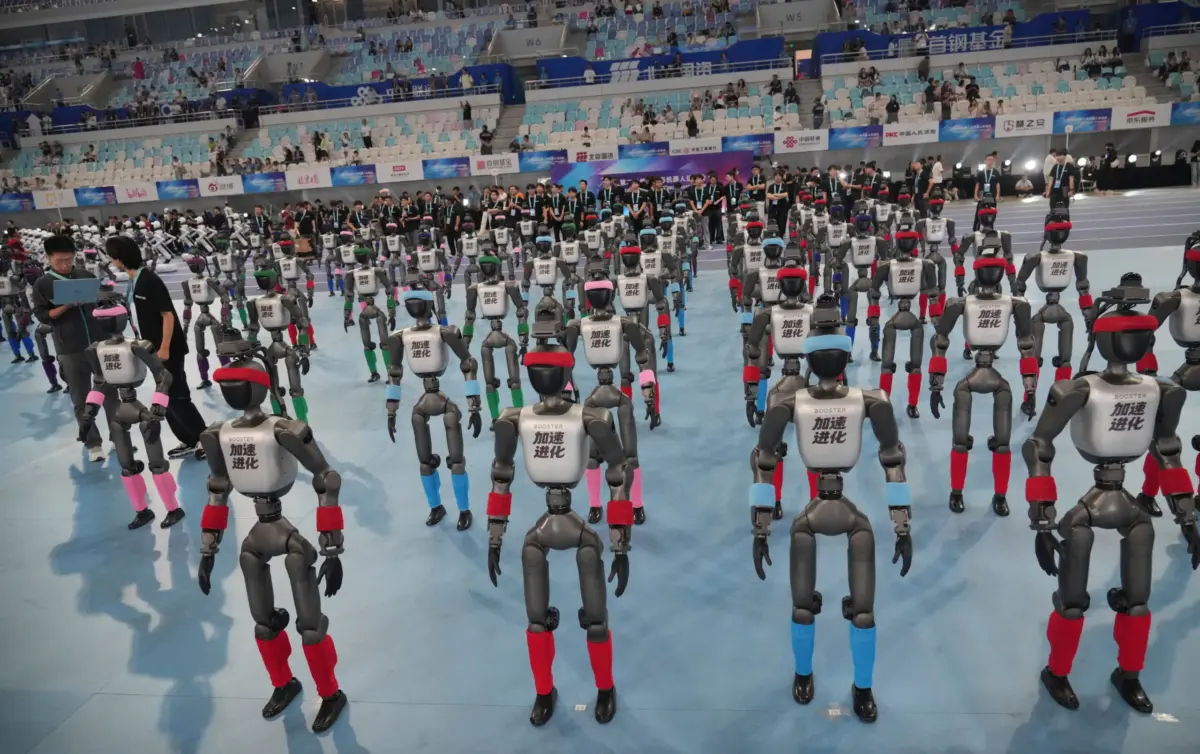
Inside a sprawling training facility in southern China, more than 100 humanoid robots stand in neat, silent rows. Nearby, a dozen human trainers wearing virtual reality headsets guide a select few through simple, repetitive chores: sorting plastic crates, packaging dry noodles, and operating espresso machines.
Yet, the performance is far from seamless. The humanoids move with a deliberate, awkward slowness. A novice trainer might coax a single, usable movement out of a machine after 300 attempts; an experienced operator achieves success once every 50 tries.
This facility, located in Liuzhou and visited by Reuters in April, captures the central tension defining China’s unprecedented push into humanoid robotics. Across the country, government funding and manufacturing investments are racing far ahead of the machines’ actual capabilities. While Chinese state planners and venture capitalists are pouring billions into building a dominant global footprint, the robots themselves largely remain confined to choreographed internet sensations—executing kung fu routines, synchronized dances, and boxing matches—rather than performing versatile labor on open-ended factory floors.
Main Facts: Overcapacity Meets the "IQ" Deficit
China’s humanoid-robot industry is expanding at a breakneck pace, fueled by a classic state-directed industrial playbook. Mirroring previous strategies deployed for electric vehicles (EVs) and solar panels, Beijing is subsidizing a strategic sector early, fostering hyper-competition, and driving down hardware costs to capture global market share.
According to BofA Global Research, the global humanoid market shipped roughly 20,000 units last year, with Chinese manufacturers accounting for a staggering 95% of that total. Official projections from China’s Ministry of Industry and Information Technology (MIIT) indicate the country expects to build more than 100,000 humanoids this year, with global annual shipments forecasted to reach 1.2 million units by 2030.
Yet, this hardware dominance masks a fundamental technological bottleneck: the robots lack the cognitive dexterity required for general-purpose work.
"The robots’ IQ is too low," said Tang Wenbin, co-founder and CEO of AI robotics venture Yuanli Lingji, during a March industry panel. "A lot of what we see is dancing disguised as working."
Unlike software chatbots powered by large language models (LLMs) that process text, factory humanoids require vision-language-action (VLA) models. These systems must process vast quantities of real-time visual data and instantly convert physical observations into precise mechanical actions—such as calculating the exact force needed to turn a screw or gripping a delicate piece of fabric.
Industry experts note that these models struggle with the "last millimeter" of execution. A robot trained to perform a task at one workstation will frequently fail if the lighting changes, the object shifts by a fraction of an inch, or the surrounding equipment is altered. Furthermore, while the industry possesses roughly 500,000 hours of high-quality training data, analysts estimate it needs upwards of 100 million hours to achieve true physical intelligence.
Chronology of the Boom: From Spectacle to Subsidies
The acceleration of China’s humanoid sector has unfolded rapidly through a series of key policy milestones, procurement surges, and market entries:
- October 2024: Robot maker UBTech secures an $18 million tender from the Guangxi regional government to establish the Liuzhou training facility, laying the groundwork for large-scale embodied AI data collection.
- Late 2024: UBTech wins major new contracts worth at least $123 million to supply state-owned enterprises with humanoid hardware, overshadowing the firm’s total annual humanoid revenue.
- May 2025: Component supplier Lingyi iTech launches a "super factory" in Beijing’s Yizhuang tech zone, targeting an initial output of 10,000 embodied-intelligence robots annually, scaling to 500,000 by 2030.
- June 2025: MIIT and the state-assets regulator announce a mandate requiring 10 Chinese provinces to establish at least 20 real-world training sites each for humanoids and AI systems.
- July 2025: The U.S. Trump administration bans imports of new Chinese humanoid robots, citing potential threats to the American AI industry and risks of cyber disruption. Gan Xiaobin, an MIIT official, publicly projects Chinese production to exceed 100,000 units for the year.
- August 19, 2025: Unitree, the world’s largest seller of quadruped robot dogs and a leading humanoid producer, makes its historic Shanghai trading debut. Shares surge more than fivefold, valuing the company at roughly $50 billion before stabilizing.
- April 2026: Startup X Square Robot expands its AI training initiatives across 100 households to expose vision models to variable lighting and cluttered real-world environments.
- July 2026: At the RoboCup international competition in South Korea, teams overwhelmingly rely on Chinese-manufactured humanoid platforms, underscoring Beijing’s growing hardware monopoly.
- August 2026: The World Humanoid Robot Games open in Beijing, highlighting the government’s ongoing emphasis on technological spectacle.
Supporting Data: Financials, Subsidies, and Falling Prices
An examination of hundreds of corporate filings, government procurement records, and interviews with 40 industry executives reveals an ecosystem heavily propped up by public funds.
- Public Procurement Spree: National, provincial, and local governments spent at least $230 million purchasing humanoids and related training systems in the first half of the year, a dramatic increase from $62 million the previous year and just $6 million in the corresponding 2024 period.
- Subsidy Reliance: Financial disclosures highlight deep financial exposure to government support. Hangzhou-based Deep Robotics revealed that subsidies accounted for roughly 42% of its $4.2 million net profit last year.
- Deflationary Pressures: Fierce competition is driving down market prices. Morgan Stanley projects the average price of a humanoid will drop 15%. Leju Robotics’ full-size Kuavo humanoid saw its average price fall 26% year-on-year to about $46,000. Meanwhile, daily rental rates for promotional dancing robots have plummeted from roughly $1,500 down to $440–$600.
- Enterprise Scaling: Major utilities and industrial players are committing vast sums. In April, power utility State Grid announced a $1 billion plan to deploy AI-enabled humanoids and robot dogs for substation inspections, projecting annual labor savings of up to $119,000 per unit.
Official Responses and Industry Skepticism
Despite the torrent of state capital, government agencies have largely remained silent regarding structural overcapacity and commercial viability. Representatives from the Ministry of Industry and Information Technology, the State Council Information Office, UBTech, Unitree, and Xiaomi declined or did not respond to requests for comment.
Market analysts and industry executives, however, are vocal about the risks. Kevin Xu of U.S. investment firm Interconnected Capital noted that founders within the ecosystem privately describe the sector as a bubble.
"There will 100% be a consolidation sooner or later," Xu warned. "It’s just a matter of who and how ugly."
Furthermore, conventional industrial automation poses an economic challenge to the general-purpose humanoid. In hyper-competitive sectors like automotive manufacturing, specialized robotic arms and automated guided vehicles are faster, more reliable, and far cheaper. Xiaomi’s Beijing EV plant achieves 91% automation using over 700 industrial spot-welding robots, while Geely’s Zeekr brand relies on robotic arms for active assembly lines, relegating humanoids to minor sorting tasks.
Niche commercial applications are beginning to emerge. Galbot, for instance, is deploying wheeled humanoids in pharmacies across two dozen cities to pick medicine packets from shelves. The robots achieve a success rate exceeding 95% and can complete a retrieval task in about a minute, operating continuously to offset slower individual speeds.
Global Implications: Supply Chains and Strategic Fallout
China’s state-engineered strategy is designed to stimulate what experts call the "Hunger Games" model of industrial development. Lizzi Lee, an economist at the Asia Society Policy Institute, explains that the strategy intentionally floods the market with subsidies and overcapacity to accelerate learning and innovation.
"Waste is not an accident in this model, but rather part of the discovery mechanism," Lee said. While the inevitable result is a high failure rate and depressed pricing that makes immediate profitability nearly impossible, the surviving firms typically emerge as globally dominant players.
This trajectory carries profound geopolitical implications. By establishing a firm grip on the global supply chain for robotics hardware—evidenced by international robotics teams adopting Chinese platforms—Beijing aims to secure critical technology leadership and displace Western competitors.
Conversely, this dominance has triggered defensive measures abroad, culminating in trade restrictions by Western nations eager to protect domestic high-tech industries. As Chinese robotics startups race to secure capital before potential market consolidation in late 2026 or 2027, the ultimate gamble remains: whether state-backed volume can successfully bridge the vast chasm between robotic spectacle and true economic productivity.
