

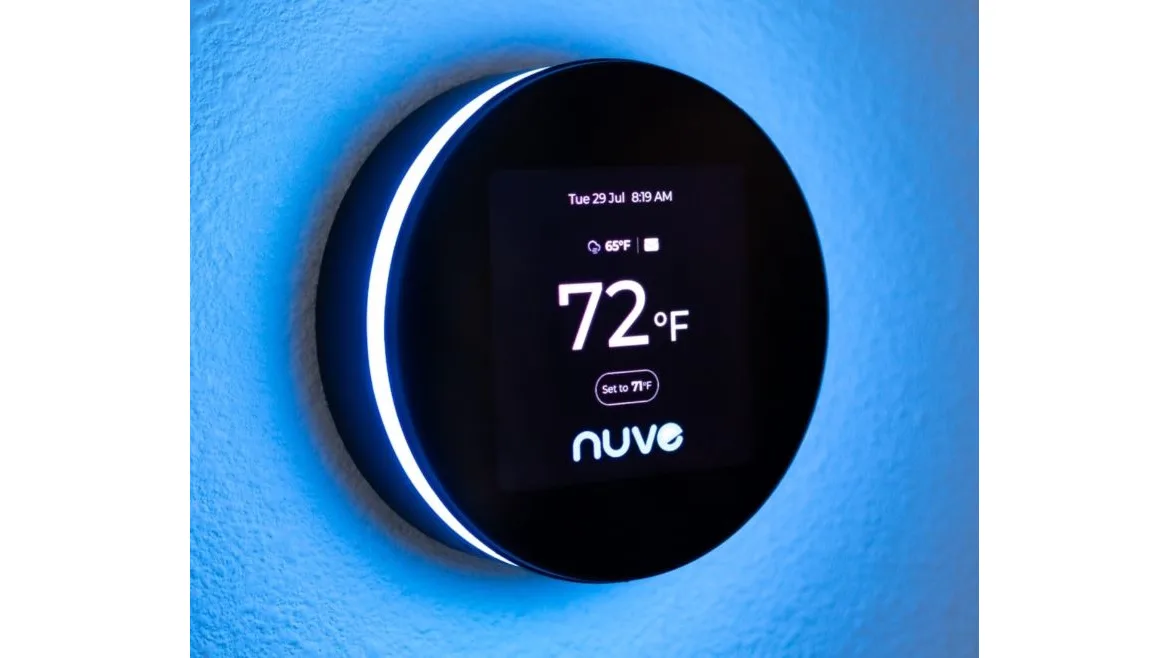
TUSTIN, Calif. — In an era where smart-home technology continually redefines residential and commercial building management, Nuve Controls has officially launched its flagship product: the Sofia AI Thermostat. Designed to merge intuitive consumer-facing features with powerful, behind-the-scenes diagnostic tools for HVAC professionals, this next-generation device aims to reshape how homeowners interact with their indoor environments while cementing a continuous digital bridge between clients and service contractors.
Featuring a sleek, modern round-screen aesthetic, customizable backlighting, and robust artificial intelligence capabilities, the Sofia AI Thermostat arrives at a pivotal time in the HVAC industry. As consumer demand for comprehensive indoor air quality (IAQ) monitoring, energy efficiency, and seamless smart-home integration accelerates, Nuve Controls has engineered a platform that addresses both end-user comfort and contractor profitability.
Main Facts: Core Specifications and Capabilities of the Sofia AI
At its architectural core, the Sofia AI Thermostat is engineered for near-universal compatibility. It supports the vast majority of residential and commercial heating, ventilation, and air conditioning systems that utilize a standard 24 Vac control circuit. This broad compatibility spans traditional gas and oil furnaces, boilers, modern air-conditioning equipment, heat pumps, and complex dual-fuel hybrid systems. Furthermore, the device accommodates whole-home or localized accessories, including humidifiers, dehumidifiers, and dedicated ventilation systems.
One of the most persistent hurdles in smart thermostat retrofits—the absence of a common (C) wire—has been proactively addressed by Nuve Controls. The Sofia AI includes Common Wire Adapter (CWA) capabilities, allowing technicians and DIY installers to deploy the device smoothly even in older homes lacking dedicated power wiring. Measuring a compact 5.2 by 5.2 by 1.17 inches, the unit fits cleanly on most walls, offering a low-profile footprint dominated by its vibrant, adjustable display.
Beyond basic temperature regulation, the thermostat functions as an environmental command center. It incorporates 2.4 GHz Wi-Fi connectivity and integrates smoothly with mainstream smart-home ecosystems like Amazon Alexa and Google Assistant. For homeowners, the accompanying mobile application unlocks full remote management, customized heating and cooling scheduling, a dedicated vacation mode, and a suite of intelligent alerts. These notifications cover critical thresholds, including temperature extremes, humidity imbalances, carbon monoxide (CO) warnings, system efficiency drops, and active ventilation requirements.
Crucially, the Sofia AI places a heavy emphasis on atmospheric health by monitoring carbon dioxide-equivalent ($textCO_2texte$) levels. When indoor air becomes stagnant or polluted, the unit can automatically notify users and trigger ventilation protocols to ensure optimal oxygenation and health standards are maintained indoors.
Chronology: The Evolution Toward AI-Driven HVAC Integration
The release of the Sofia AI Thermostat is the culmination of years of shifting paradigms within the HVAC and smart-device sectors. Understanding its market entry requires looking at how the industry has evolved over the past decade:
- Phase 1: The Basic Digital Transition (Early 2010s): Programmable thermostats began replacing traditional mercury and analog dials. While they offered time-based scheduling, they lacked adaptability, remote connectivity, and real-time diagnostic feedback.
- Phase 2: The First-Generation Smart Wave (Mid-to-Late 2010s): Wi-Fi-enabled thermostats entered the mainstream, allowing users to adjust temperatures from smartphones. However, these devices primarily focused on energy savings and aesthetic appeal, offering little functional utility to the contractors servicing the underlying equipment.
- Phase 3: The IAQ and Diagnostics Revolution (2020–2025): Driven by global health events and a heightened awareness of indoor air quality, consumers began demanding visibility into particulate matter, humidity, and ventilation. Simultaneously, HVAC contractors faced labor shortages and rising service costs, creating an urgent market need for remote diagnostic tools.
- Phase 4: The AI Era and Ecosystem Convergence (2026 and Beyond): The launch of platforms like the Sofia AI Thermostat marks the current standard: an era where artificial intelligence predicts equipment failure, monitors complex air quality metrics, and deeply integrates with contractor Customer Relationship Management (CRM) workflows.
Nuve Controls positioned the development of the Sofia AI around this fourth phase, ensuring that the device would not merely serve as a wall-mounted remote control, but as an active node in a larger service ecosystem.
Supporting Data: Engineering and Performance Metrics
To validate its position in a crowded marketplace, Nuve Controls has packed the Sofia AI with a dense array of technical specifications designed to protect expensive HVAC hardware while maximizing efficiency.
Installer and System Protection Features
For HVAC technicians, setting up a thermostat often involves balancing energy efficiency with equipment protection. The Sofia AI provides granular configuration options that prevent short-cycling and premature wear on mechanical components:
- Compressor and Auxiliary Heat Lockouts: Protects heat pump compressors from running during dangerously low ambient outdoor temperatures and manages auxiliary strip heat activation.
- Adjustable Temperature Differentials: Allows contractors to fine-tune how aggressively the system responds to temperature swings.
- System Run Delays & Minimum Equipment Run Times: Prevents rapid on-off cycling that can strain blower motors, compressors, and electrical relays.
- Fan Dissipation Settings: Ensures residual conditioned air is fully evacuated from the ductwork after a heating or cooling cycle concludes.
- Overcool-to-Dehumidify Operation: Utilizes the cooling equipment to pull excess latent moisture out of the indoor air even after the target temperature has been satisfied.
Warranty and Reliability
Backing up its robust feature set, Nuve Controls offers a five-year limited warranty on the Sofia AI Thermostat. This extended warranty period signals manufacturer confidence in the unit’s internal build quality, solid-state sensors, and electrical durability against power surges and thermal fatigue.
Official Responses and Industry Perspectives
Industry analysts and trade representatives have closely watched the rollout of AI-integrated thermostats, noting that the relationship between equipment manufacturers, contractors, and consumers is undergoing a fundamental restructuring.
"The modern homeowner expects absolute transparency regarding their indoor environment, while contractors require operational efficiency to remain profitable in a competitive service market," notes an industry product specialist familiar with the launch. "Devices like the Sofia AI bridge that gap by turning passive environmental control into an active data pipeline."
Contractors who have beta-tested the CRM integration and remote monitoring suites have praised the reduction in redundant service calls. By having access to equipment performance-testing functions prior to rolling a truck, technicians can diagnose whether a customer’s complaint stems from a simple thermostat setting error, a failing capacitor, or a true mechanical breakdown.
Furthermore, the onboarding workflow—which allows technicians to authorize the device during installation and automatically populate customer information directly into compatible CRM platforms—drastically cuts down on administrative friction. Field data entry errors are minimized, and client databases remain meticulously up to date without manual transcription.
Implications: What the Sofia AI Means for Homeowners and Contractors
The introduction of the Sofia AI Thermostat carries significant implications for both residential end-users and the professional HVAC trade.
For Homeowners: Proactive Health and Energy Management
For the everyday consumer, the shift from reactive heating and cooling to proactive environmental management is profound. Traditional thermostats only react when a room becomes too hot or too cold. The Sofia AI, by continuously tracking $textCO_2texte$ levels, humidity, and carbon monoxide risks, acts as a guardian of domestic health.
The inclusion of mobile app controls, vacation modes, and smart alerts means homeowners can drastically reduce utility waste while away, while remaining confident that their home is safeguarded against extreme weather events or mechanical failures. If a system begins losing efficiency—perhaps due to a clogged air filter or a failing inducer motor—the thermostat’s intelligent alert system notifies the user before a catastrophic breakdown leaves them without heating or cooling.
For Contractors: Transforming Service Models into Recurring Revenue
For HVAC contracting businesses, the implications are even more transformative. Historically, the relationship between a contractor and a homeowner ended the moment the installation technician drove away, only to resume sporadically during seasonal maintenance tune-ups or emergency repair calls.
The Sofia AI Thermostat redefines this dynamic by embedding the contractor directly into the homeowner’s digital ecosystem. Through mobile app access, integrated service request buttons, and seamless CRM synchronization, contractors can build long-term service agreements (maintenance plans) tied directly to the health of the thermostat.
Remote diagnostics allow service managers to review equipment performance metrics from the office. If a heat pump is struggling to reach its setpoint or drawing abnormal electrical current, the contractor can reach out to the homeowner proactively—often scheduling a service visit before the homeowner even realizes a component is failing. This level of proactive customer service not only drives high customer satisfaction and loyalty but also transforms traditional, transactional HVAC businesses into predictable, recurring-revenue service providers.
Conclusion
As smart-home technology matures, the bar for what consumers and professionals expect from climate control hardware continues to rise. The Sofia AI Thermostat from Nuve Controls represents a comprehensive response to this evolution. By uniting universal system compatibility, sophisticated IAQ and $textCO_2texte$ monitoring, and deep contractor diagnostic tools into a single, elegantly designed round-screen interface, Nuve Controls has set a new benchmark for residential and commercial environmental management. As more homes adopt these intelligent systems, the boundary between living comfort and professional maintenance will continue to dissolve, ushering in a smarter, safer, and more connected future for the HVAC industry.
