

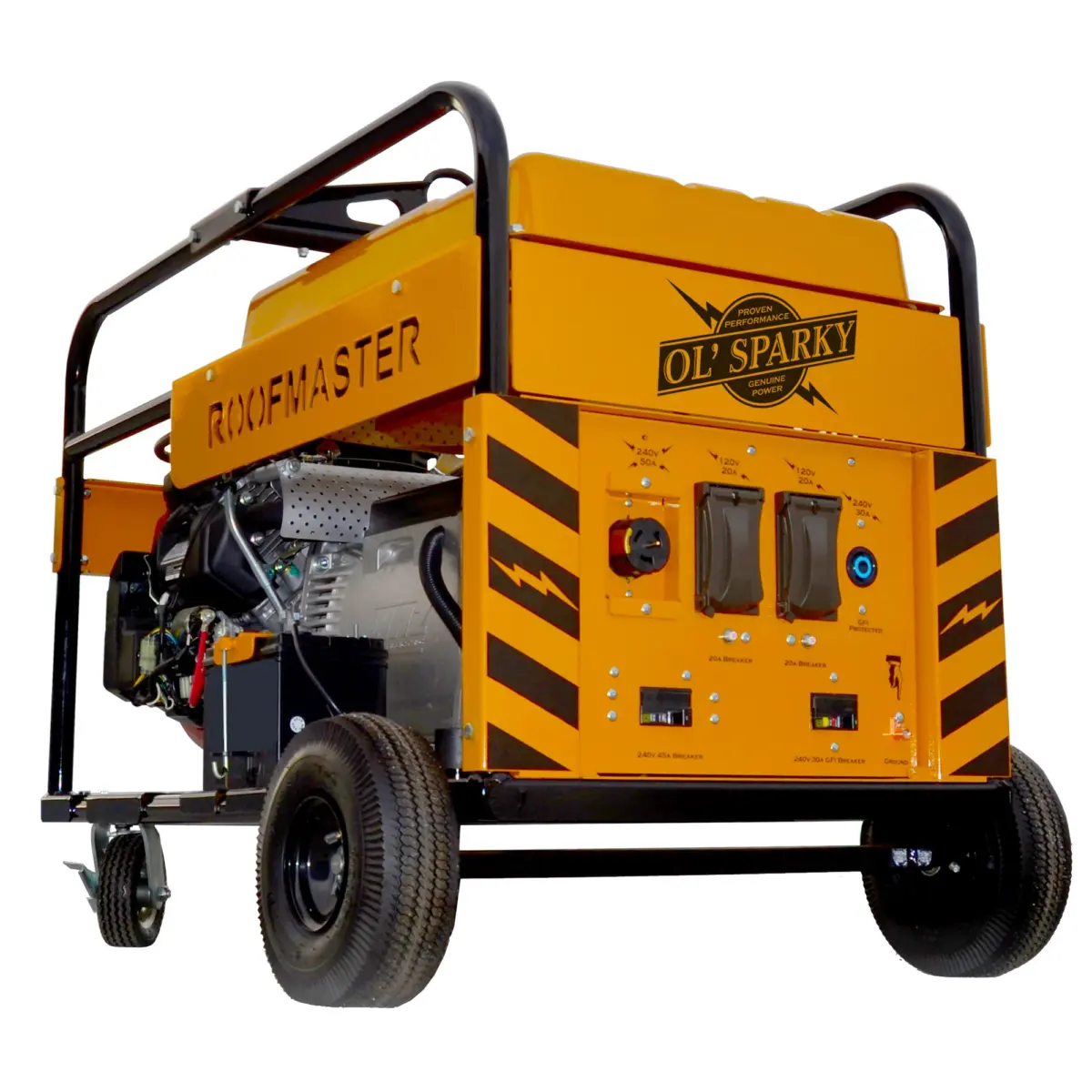
In the demanding world of industrial construction, commercial roofing, and geomembrane installation, field equipment must operate under harsh, unpredictable conditions. While contractors routinely account for weather, physical wear, and logistical delays, a silent and invisible threat regularly cripples high-value machinery on job sites worldwide: Total Harmonic Distortion (THD).
Often dismissed by operators as a technical niche or an aggressive sales pitch from premium equipment manufacturers, THD is a critical physical reality of electrical engineering. The quality of portable power supplied to sophisticated machinery—such as Leister automatic hot-air welders—can mean the difference between a highly productive shift and a catastrophic, multi-thousand-dollar equipment failure.
According to industrial field experts, including Ryen Van Grol, a veteran Territory Sales Manager specializing in industrial welding systems, using low-grade, consumer-targeted generators to power highly sensitive electronic tools is one of the most common and expensive mistakes made by modern contractors.
Main Facts: The Anatomy of Power Quality and Generator Limitations
At its core, Total Harmonic Distortion (THD) is a mathematical measurement of how much an electrical voltage waveform deviates from a clean, perfect sinusoidal wave. In an ideal electrical grid, alternating current (AC) power is delivered as a smooth, continuous sine wave. However, when generators produce power, or when certain loads are introduced to a circuit, this wave becomes distorted.
Ideal Sine Wave (Clean Power, <5% THD)
      .-.      .-.      .-.
    .'   '.  .'   '.  .'   '.
___/_______'/_______'/_______'___
  '         '         '         '

Distorted Waveform (High-THD Power, >25% THD)
     _/_      _/_      _/_
    /        /        /
___/______'__/______'__/______'___
  '         '         '         '
The THD Threshold Discrepancy
The primary conflict in field power distribution lies in the massive discrepancy between what standard portable generators produce and what sensitive microprocessors require:
- The Retail Standard: The vast majority of portable generators sold at "big box" home improvement stores are designed for residential emergency backup or basic mechanical tools. These units frequently produce power with a THD of 25% to 30%.
- The Industrial Electronic Standard: For tools containing digital control boards, microcontrollers, and sensitive heat-regulation circuits, the maximum acceptable THD threshold is strictly under 6% to 7%.
The Alternator Quality Gap
The root cause of high THD in cheap generators lies in their internal construction. Budget-friendly generators utilize lower-quality copper or aluminum windings, fewer poles, and inferior automatic voltage regulators (AVRs) within their alternators. These cost-cutting measures limit the alternator’s ability to maintain a clean sine wave under load. In contrast, premium industrial generators are engineered with high-grade, precision-wound alternators and advanced electronic filtering designed specifically to suppress harmonic noise.
Chronology: The Evolution of Field Power and the Rise of the Digital Job Site
To understand how THD became such a pervasive issue for modern contractors, it is necessary to examine the technological shift that has occurred on job sites over the last four decades.
[1980s: The Analog Era] ----------------> [2000s: The Digital Transition] --------> [Present: The Modern Mismatch]
• Purely mechanical/resistive tools      • Microprocessors added to field tools    • Highly sensitive computerized tools
• High tolerance for "dirty" power       • Increased vulnerability to power spikes  • Widespread use of cheap, high-THD generators
• Basic generators sufficed              • Rise of electronic control boards        • Epidemic of fried circuit boards
Phase 1: The Analog Era (1970s–1980s)
During this period, field tools were almost entirely mechanical or purely resistive. Saws, drills, basic heaters, and early welding equipment relied on simple carbon-brush motors and basic heating elements. These tools possessed a high tolerance for "dirty" power. If a generator’s voltage fluctuated or its waveform was heavily distorted, a circular saw might run slightly hotter or slower, but it would rarely suffer permanent damage. Consequently, generator manufacturers prioritized raw wattage output over power quality.
Phase 2: The Digital Transition (1990s–2000s)
As industrial processes demanded greater precision, tool manufacturers began integrating microprocessors into field equipment. Hot-air welders, for instance, transitioned from basic rheostat dials to digital control panels capable of monitoring and adjusting temperature and drive speed in real-time. These advancements allowed contractors to meet stricter quality control standards, but they also introduced highly sensitive integrated circuits (ICs) and solid-state relays to the harsh environment of the construction site.
Phase 3: The Modern Mismatch (2010s–Present)
As digital tool technology advanced exponentially, consumer-grade generator manufacturing underwent a race to the bottom. Big-box retail chains flooded the market with inexpensive, high-wattage portable generators designed to appeal to budget-conscious homeowners and general contractors.
Today, this has culminated in a widespread mismatch crisis. Contractors frequently purchase state-of-the-art, computerized installation tools worth thousands of dollars, only to plug them into budget generators that deliver highly distorted, volatile electrical currents. The result is an epidemic of fried circuit boards, erratic tool behavior, and premature motor failure.
Supporting Data: Linear vs. Non-Linear Loads and the Physics of Destruction
To fully grasp why high THD and poor power management damage equipment, it is essential to analyze how different types of electrical loads interact on a single generator.
| Feature | Linear Loads | Non-Linear Loads |
|---|---|---|
| Typical Equipment | Screw guns, Sawzalls, incandescent lights, basic heaters, radios | Leister welders, computers, variable frequency drives (VFDs), LED drivers |
| Current Draw | Continuous, proportional to the voltage sine wave | Abrupt, pulsing intervals |
| Impact on Waveform | Minimal distortion; draws current smoothly | Highly distorting; introduces harmonic currents |
| Vulnerability | Low; highly resilient to electrical noise | High; sensitive to voltage spikes and harmonic heating |
The Danger of Mixed Loads
A common operational error on job sites is plugging both linear and non-linear tools into the same generator. Ryen Van Grol warns strongly against this practice:
"If you are running an auto welder, you should never use anything on that same generator that has a linear load (screw gun, sawzall, radio, battery chargers, etc.). The constant on/off surge of these tools creates inconsistent power and can lead to expensive repairs to electrical boards and motors."
When a high-draw linear tool like a reciprocating saw (Sawzall) or a heavy-duty screw gun is switched on, it demands a massive, sudden inrush of current. Because a portable generator has limited rotational inertia and response time, this sudden demand causes an immediate voltage sag, followed by a massive voltage spike (back-EMF) when the trigger is released.
For a sensitive automatic welder running on the same circuit, these rapid voltage swings force the onboard voltage regulators to work overtime. Over minutes or hours, this electrical stress overheats the capacitors, degrades the silicon wafers inside microchips, and eventually burns out the main control boards.
Generator Circuit Load Sharing Danger:

[Generator]
    │
    ├──► [Linear Load: Sawzall] ────► Sudden On/Off Triggers (Spikes & Sags)
    │                                          │
    │  (Electrical Back-EMF & Harmonics) ──────┘
    ▼
[Non-Linear Load: Leister Welder] ◄─── (Damages Sensitive Microchips & Boards)
The Cost-Benefit Reality
The financial data associated with power-related equipment failures highlights the risks of using inadequate generators:
- Cost of a Premium Automatic Hot-Air Welder: $6,000 – $12,000+
- Cost of a Cheap "Big Box" Generator (High THD): $500 – $900
- Cost of a Premium, Low-THD Industrial Generator: $2,500 – $5,000
- Average Cost of a Single Control Board Replacement: $1,500 – $3,000 (excluding lost labor and project downtime)
If a contractor saves $2,000 by purchasing a cheap generator, but suffers just one control board failure, that initial saving is instantly erased by repair costs and project delays.
Official Responses: Manufacturer Standards and Engineering Guidelines
Recognizing the severe impact of power quality on tool longevity, leading industrial manufacturers and engineering bodies have established clear, uncompromising guidelines regarding acceptable power sources.
Leister Technologies and Hot-Air Equipment Manufacturers
Leister and other high-end plastic welding manufacturers explicitly state in their warranty and operating manuals that power sources must meet strict electrical parameters. Most hot-air welder manufacturers recommend that all portable generators have a maximum THD of less than 5% to 6% to avoid damaging sensitive electronic control components.
Technical support departments frequently report that when damaged machines are returned for diagnostic evaluation, a high percentage of failed circuit boards show clear signs of overvoltage stress and thermal damage caused by harmonic distortion. Manufacturers are increasingly denying warranty claims when diagnostic logs indicate the machine was subjected to poor-quality power.
Ryen Van Grol’s Industry Guidance
As a Territory Sales Manager working directly with field operators, Ryen Van Grol emphasizes the importance of verifying manufacturer specifications before operating equipment:
"The manufacturer of your generator should have specifications regarding the THD. If this information is not readily available, it is likely that the generator is not suitable for your sensitive equipment. My advice would be: if you are willing to spend good money for top-of-the-line equipment, protect your investment by purchasing the appropriate generator."
Electrical Engineering Standards (IEEE 519)
The Institute of Electrical and Electronics Engineers (IEEE) addresses harmonic limits in the widely cited IEEE 519 standard, "Recommended Practice and Requirements for Harmonic Control in Electric Power Systems." This standard establishes that for general systems operating under 69 kV, the total voltage distortion should not exceed 5%. This scientific benchmark aligns directly with the requirements set by industrial tool manufacturers, confirming that any power source exceeding this limit is unsuitable for sophisticated electronics.
Implications: Protecting Investments and Ensuring Operational Efficiency
The technical realities of THD and load management carry major operational and financial implications for contractors, project managers, and business owners.
     High-THD Power Source Used
                 │
        ┌────────┴────────┐
        ▼                 ▼
[Immediate Risks]  [Long-Term Costs]
• Erratic Operation • Voided Warranties
• Failed Welds      • Premature Motor Wear
• Blown Circuits    • Project Delay Penalties
1. Operational Downtime and Project Penalties
In commercial roofing, civil engineering, and landfill lining projects, work is highly dependent on the weather. If a primary automatic welder burns out due to a power surge, the entire crew can be sidelined. In many commercial contracts, failing to meet daily installation milestones carries heavy financial penalties. The cost of a premium generator is negligible compared to the cost of a stalled project.
2. Lifespan of Auxiliary Components
While control boards are the most sensitive components, high THD also damages electric motors. Distorted waveforms cause "harmonic heating" in the windings of electric motors, which degrades insulation over time. This leads to premature motor failure, even in tools without advanced digital displays.
3. Best Practices for Field Power Management
To safeguard expensive equipment and maintain high productivity, field supervisors should implement the following rules:
- Verify Generator THD Before Purchase: Always demand written verification of a generator’s THD rating from the manufacturer. Look for units explicitly marketed as having "clean power" (typically inverter generators or premium industrial units with digital AVRs).
- Enforce Strict Circuit Separation: Dedicate a high-quality, low-THD generator exclusively to sensitive electronic tools (like automatic welders). Never allow crew members to plug auxiliary tools (saws, drills, chargers, or heaters) into the same power source.
- Inspect Power Cords and Connections Daily: Damaged extension cords, loose plugs, and oxidized connectors increase resistance, causing voltage drops and localized heating that mimic the effects of high THD. Ensure all cables are of the correct gauge for the run length and amperage draw.
- Invest in Inverter Technology: For mid-range power needs, inverter generators are highly effective. They convert AC power to DC, then digitally invert it back to a near-perfect AC sine wave, consistently delivering a THD of under 3%.
By understanding the physics of power quality and treating portable generators as a vital component of their technical system—rather than a cheap commodity—contractors can protect their machinery, avoid costly downtime, and secure their bottom line.
