

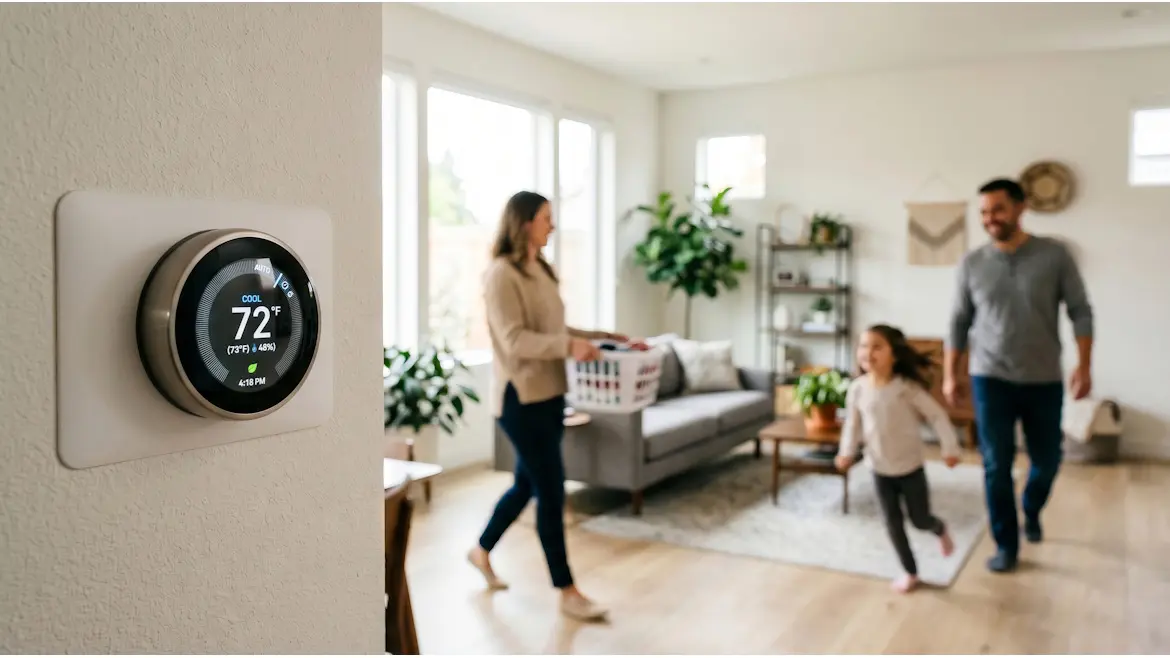
The residential thermostat has undergone one of the most remarkable transformations in the history of home technology. What began decades ago as a simple, mercury-filled dial clicking softly on a hallway wall has steadily evolved into a sophisticated, data-driven comfort hub. Early programmable models gave homeowners their first taste of energy management by allowing basic scheduling setpoints. Later, the advent of Wi-Fi thermostats introduced mobile device control and fundamental usage insights, setting the stage for digital ubiquity in the home.
Even within the broad "conventional" category today, options vary widely. Homeowners and contractors can choose from simple battery-powered models to advanced smart thermostats that connect to home Wi-Fi networks yet still communicate with residential split systems using traditional 24-volt on/off signals.
However, a new paradigm has arrived. The next major leap in the evolution of climate control is the communicating thermostat. Instead of merely sending rudimentary on/off calls down a low-voltage wire, communicating thermostats exchange continuous, real-time data streams with the split system. Acting as an integrated platform, they enable the coordinated modulation of capacity, airflow, and complex multi-zone comfort strategies.
Chronology of Thermostat Evolution: From Mercury to the Smart Hub
To understand the profound impact of today’s communicating technology, it is helpful to trace the chronological milestones that shaped the modern HVAC landscape:
- The Mechanical Era (Mid-20th Century): Dominated by bimetallic strips and mercury switches, thermostats offered manual temperature adjustments with wide deadbands, leading to notable temperature swings.
- The Programmable Revolution (1980s–1990s): The introduction of digital displays and microprocessors allowed users to program schedules based on the time of day, theoretically saving energy when homes were vacant, though many users found programming overly complex.
- The Wi-Fi and Connected Era (Late 2000s–2010s): Internet-connected thermostats introduced remote smartphone access, geofencing, and basic energy usage reports. While revolutionary for user convenience, most of these devices still relied on traditional 24V binary signals to control the heating and cooling equipment.
- The Communicating Era (Present Day): Modern communicating thermostats bypass traditional 24V constraints by using digital communication protocols. They allow every part of the HVAC system—from the compressor and blower motor to the zone dampers—to talk to one another in real time, maximizing efficiency and unlocking advanced diagnostic capabilities.
Precision, Efficiency, and Smart Comfort for Homeowners
Communicating thermostats provide a level of system integration, real-time data exchange, and control precision that traditional 24V thermostats simply cannot achieve. In a conventional setup, a thermostat merely tells the system to turn on or off at full blast. In contrast, communicating thermostats continuously share operating parameters—such as indoor temperature, relative humidity, actual airflow rates, duct static pressure, and compressor speed—allowing variable-capacity systems to execute fine-tuned capacity modulation.
This continuous data loop allows the HVAC equipment to adjust blower revolutions per minute (RPM), compressor hertz (Hz), and airflow profiles with exceptionally high resolution. The direct result is a dramatic reduction in cycling losses, vastly improved part-load efficiency, and steadier indoor conditions. Homeowners experience tighter temperature control, quieter operation due to the elimination of abrupt speed transitions, superior humidity stability, and transparent diagnostic feedback.
The Power of Advanced Zoning Integration
When a communicating thermostat is integrated with a communicating zoning system, the operational benefits expand exponentially. Traditional zoning relies on simple open/close damper logic tied to local thermostats, often resulting in static pressure spikes and mechanical stress. A communicating zoning controller, however, synchronizes zone calls, sensor data, damper positions, and equipment capacity within a unified control loop.
This architecture typically features one primary master communicating controller paired with multiple communicating secondary zone thermostats installed throughout the home. These secondary units continuously transmit localized temperature, humidity, and demand signals to the master controller.
[Secondary Zone Thermostat 1] --
[Secondary Zone Thermostat 2] ----> [Master Communicating Controller] <---> [Variable-Capacity HVAC Equipment]
[Secondary Zone Thermostat 3] --/
This hierarchical data exchange allows the system to:
- Prevent destructive static-pressure spikes in the ductwork.
- Intelligently resolve conflicting demands across different areas of the house.
- Modulate dampers proportionally to deliver the exact cubic feet per minute (CFM) of airflow required in each specific space.
As a result, notoriously difficult spaces—such as bonus rooms over garages, finished basements, and sunrooms—maintain stable, comfortable conditions. The system successfully avoids the severe energy penalties associated with large temperature swings and aggressive recovery cycles. By conditioning each zone based on real-time usage patterns and sensor feedback, overall comfort uniformity and system operating efficiency increase, helping homeowners reduce monthly utility bills.
Grid-Interactive Performance and Regulatory Compliance
Beyond individual home comfort, communicating thermostats play a critical role in modern grid-interactive building performance. As utility companies rapidly expand demand response (DR) incentive programs, variable-speed split systems must meet increasingly specific control behaviors and reporting requirements.
Chief among these is AHRI 1380, an industry standard that governs the assessment of automated demand response functionality in residential and commercial HVAC equipment. Unlike traditional demand response models—which merely allowed a utility signal to cycle a thermostat off or adjust its setpoint blindly—AHRI 1380 requires participating equipment to not only respond to grid stress signals but also report back confirming that it has successfully adjusted its usage. This creates a closed-loop, verifiable system.
By enabling precise, automated load shedding and load shifting, communicating controls help utility providers stabilize the electrical grid and reduce peak demand without negatively impacting human occupants. When paired with communicating thermostats, variable-capacity systems can finely modulate compressor output and airflow to achieve controlled load reductions. This ensures the home stays comfortable while simultaneously relieving strain on aging electrical infrastructure across the United States.
Supporting Data: Efficiency and Market Shifts
Industry data underscores the rapid shift toward communicating and variable-capacity equipment. According to recent HVAC market analyses:
- Energy Savings: Homes equipped with communicating variable-speed systems and advanced zoning routinely report energy savings of 15% to 30% on heating and cooling compared to single-stage systems paired with basic thermostats.
- Humidity Control: Variable-speed equipment managed by communicating thermostats can remove up to 20% more moisture from indoor air during peak cooling months, enhancing comfort and preventing mold growth.
- Diagnostic Precision: Field studies indicate that access to real-time system parameters cuts diagnostic time on service calls by nearly 40%, transforming reactive repairs into proactive maintenance.
Official Industry Responses and Field Perspectives
Industry leaders and field contractors have been vocal about the operational shift brought on by communicating technology.
"Communicating thermostats streamline installations by automatically identifying connected equipment and applying proper configuration settings," notes an industry product manager. "This reduces startup time, eliminates manual dipswitch adjustments, and ensures the system is commissioned correctly right out of the box."
Contractors praise the deep system visibility these platforms provide. By exposing in-depth operational data—such as live compressor capacity, historical airflow profiles, and exact sensor readings—technicians can fine-tune performance for peak comfort, efficiency, and reliability. Standardizing these configuration and startup processes reduces installation variability and costly callbacks.
In the field, innovative hardware solutions are lowering barriers to entry. For example, communicating thermostats like the Smart Home Control 510 (SHC510) from Bosch Home Comfort allow contractors and homeowners alike to view live system data. While many competitive thermostat platforms charge recurring subscription fees or lock advanced analytics behind paywalls, platforms like the SHC510 provide open access to these critical insights at no additional cost.
HVAC service technicians emphasize that this data access changes the nature of service calls. By reviewing system data and fault codes in advance of a dispatch, contractors can arrive on-site with the correct replacement parts already in hand. This eliminates multiple service trips, minimizes system downtime, and drastically improves overall service efficiency—savings that ultimately flow down to homeowners through faster repairs and lower service costs.
Operational Implications for Contractors and Homeowners
The widespread adoption of communicating thermostats carries profound implications for all stakeholders in the residential construction and home services sectors:
- For Contractors: Training technicians to understand digital communicating protocols is no longer optional; it is a core competency. Contractors must transition from basic electrical troubleshooting to data-driven system analysis. Those who embrace these platforms will see shorter installation windows, fewer callbacks, and stronger customer loyalty.
- For Homeowners: The shift toward communicating technology means homes are more comfortable, energy bills are lower, and HVAC equipment operates with greater longevity due to reduced mechanical stress. Furthermore, participation in utility demand response programs can yield direct financial incentives for the homeowner.
- For Manufacturers: Equipment design must continue to prioritize open, reliable communication protocols. Interoperability between different system components and adherence to standards like AHRI 1380 will dictate market success in the coming decade.
Conclusion: A Smart Pairing for High-Efficiency Systems
When paired with modern high-efficiency variable-speed equipment, communicating thermostats unlock the full performance envelope these complex systems were engineered to deliver. They successfully unify heating and cooling equipment, zoning components, environmental sensors, and grid-response requirements into a cohesive, intelligent control architecture that maximizes comfort, efficiency, and operational awareness.
Homeowners benefit directly from superior indoor comfort, precise humidity management, and tangible energy savings. Meanwhile, contractors gain a smoother, faster installation experience supported by real-time diagnostic insights. As connected HVAC technologies continue to mature, communicating thermostats will undoubtedly remain at the center of the smart home, guiding the industry toward a more efficient, responsive, and sustainable future.
