

Introduction: The Evolution of Commercial Indoor Environments
Not long ago, defining a high-performance commercial or institutional building was relatively straightforward. Success was measured primarily through basic energy efficiency metrics and broad occupant comfort thresholds. If a building maintained a reasonably stable temperature and kept utility bills from skyrocketing, it was often considered high-performing.
Today, however, the benchmark for architectural and engineering excellence has shifted dramatically. A truly high-performance building now demands an intricate ecosystem of highly efficient HVAC equipment, connected comfort networks capable of reacting instantaneously to fluctuating indoor and outdoor environmental parameters, elevated indoor air quality (IAQ) and precise humidity control, robust remote monitoring, and advanced diagnostic capabilities. Furthermore, these facilities rely heavily on data-driven technologies to maintain peak operational efficiency throughout their lifecycle.
“A high-performance building is one that delivers measurable reductions in energy consumption while enhancing occupant comfort, indoor air quality, and operational efficiency,” explains Rosa Leal, director of commercial product strategy and customer experience at Rheem North America. “This is achieved through the integration of high-efficiency HVAC systems, optimized ventilation strategies, and intelligent controls, aligned with key technical standards.”
As global decarbonization mandates tighten, corporate sustainability goals expand, and occupant expectations for healthy spaces rise, the heating, ventilation, and air conditioning (HVAC) industry is undergoing a structural transformation. This article explores the core metrics of high-performance buildings, reviews the historical shift toward smart engineering, analyzes hard data and expert commentary from top manufacturers, and examines the cutting-edge technologies driving this revolution.
The Three Pillars of High-Performance HVAC
Industry leaders across the HVAC manufacturing and digital controls sectors generally agree that a high-performance building’s mechanical and environmental systems should be judged by three foundational metrics: energy efficiency, occupant comfort, and system reliability.

1. Energy Efficiency and Carbon Reduction
Energy efficiency remains the most visible and heavily regulated pillar of green building design. Beyond lowering utility bills, high-efficiency equipment directly reduces a facility’s carbon footprint. Modern high-performance strategies rely on reduced peak HVAC loads and sophisticated automation systems that dynamically adjust equipment operation based on real-time environmental changes, shifting utility pricing, and fluctuating occupancy levels.
2. Occupant Comfort Beyond the Setpoint
Historically, comfort was evaluated entirely by whether a thermostat setpoint was met. Today, experts argue that true comfort must be experienced holistically by the people inside the space. This encompasses a delicate balance of ambient temperature, relative humidity, IAQ, and mechanical system noise suppression.
“Comfort should be measured by the way occupants feel it. Don’t grade HVAC on setpoints alone,” notes Tyler Haak, vice president of U.S. digital buildings services at Schneider Electric. “By tracking elements like hot/cold complaints and overrides, facilities professionals can produce proof points of whether the system is truly delivering.”
3. Reliability, Diagnostics, and Predictive Maintenance
System reliability underpins the entire operational lifecycle of a commercial facility. Modern high-performance systems leverage automated fault detection, connected monitoring, predictive maintenance algorithms, and remote diagnostics. Reliable systems drastically minimize unplanned downtime, extend the operational life of expensive mechanical assets, and lower overall long-term operating costs.
“A truly high-performance HVAC system should help improve energy efficiency, reduce emissions, support occupant comfort and indoor air quality, and make operations more reliable and easier to manage,” says Brian Fox, director of digital sales for the Americas commercial HVAC division at Trane Technologies.

Chronology of the Smart Building Revolution: From Manual Controls to Artificial Intelligence
To understand where modern commercial HVAC stands today, it is essential to trace the historical progression of building automation and climate control technologies:
- The Pneumatic and Standalone Era (Pre-1980s): HVAC systems relied on pneumatic controls or basic electromechanical thermostats. Buildings operated on fixed schedules, and adjustments required manual intervention by facility engineers walking the floors.
- The Dawn of DDC (1980s–1990s): Direct Digital Control (DDC) systems and early Building Management Systems (BMS) emerged. For the first time, operators could monitor multiple mechanical zones from a centralized computer terminal, laying the groundwork for programmable scheduling and basic energy management.
- The Connected and Communicating Era (2000s–2010s): Open communication protocols like BACnet and LonWorks allowed equipment from different manufacturers to interoperate. Web-enabled controllers enabled remote access, while condensing boilers and variable-frequency drives (VFDs) unlocked unprecedented part-load efficiencies.
- The AI and Electrification Era (Present Day): Today’s high-performance buildings integrate electrification heat pump technology, wireless IoT sensors, cloud-based analytics, and machine learning artificial intelligence (AI). Systems no longer just follow instructions—they anticipate building demand, analyze weather patterns, and self-optimize in real time.
Supporting Data and Industry Metrics
The integration of advanced software platforms, high-capacity heat pumps, and intelligent controllers yields profound quantitative benefits for building owners and facility managers. Based on manufacturer data and industry benchmarks, the implementation of modern high-performance technologies delivers striking results:
- Software-Driven Optimization: Centralized platforms like Schneider Electric’s EcoStruxure can reduce engineering time and project costs by up to 80%, slash ongoing maintenance costs by up to 75%, and cut structural carbon emissions by up to 50%.
- Cloud-Based Artificial Intelligence: Cloud optimization services, such as Trane’s AI Control, can decrease heating and cooling energy expenditures by up to 25% while dropping HVAC-related carbon emissions by as much as 40%.
- High-Efficiency Thermal Equipment: Advanced hydronic condensing boilers, such as the Weil-McLain SlimFit series, achieve thermal efficiencies of up to 96.1%, utilizing modular 6:1 turndown ratios to eliminate cycling losses during partial-load operations.
- Advanced Packaged Heat Pumps: Expanded commercial lines like Rheem’s Renaissance Classic Plus achieve efficiency metrics up to 12 EER, 17.6 IEER, and Coefficients of Performance (COP) reaching 3.6 at 47°F and 2.5 at 17°F, proving that all-electric systems can thrive in demanding climates.
Product Spotlight: Innovations Driving High-Performance Buildings
The ACHR NEWS recently spoke with representatives from leading HVAC manufacturers to examine specific products designed to meet the rigorous demands of today’s high-performance commercial and institutional buildings.
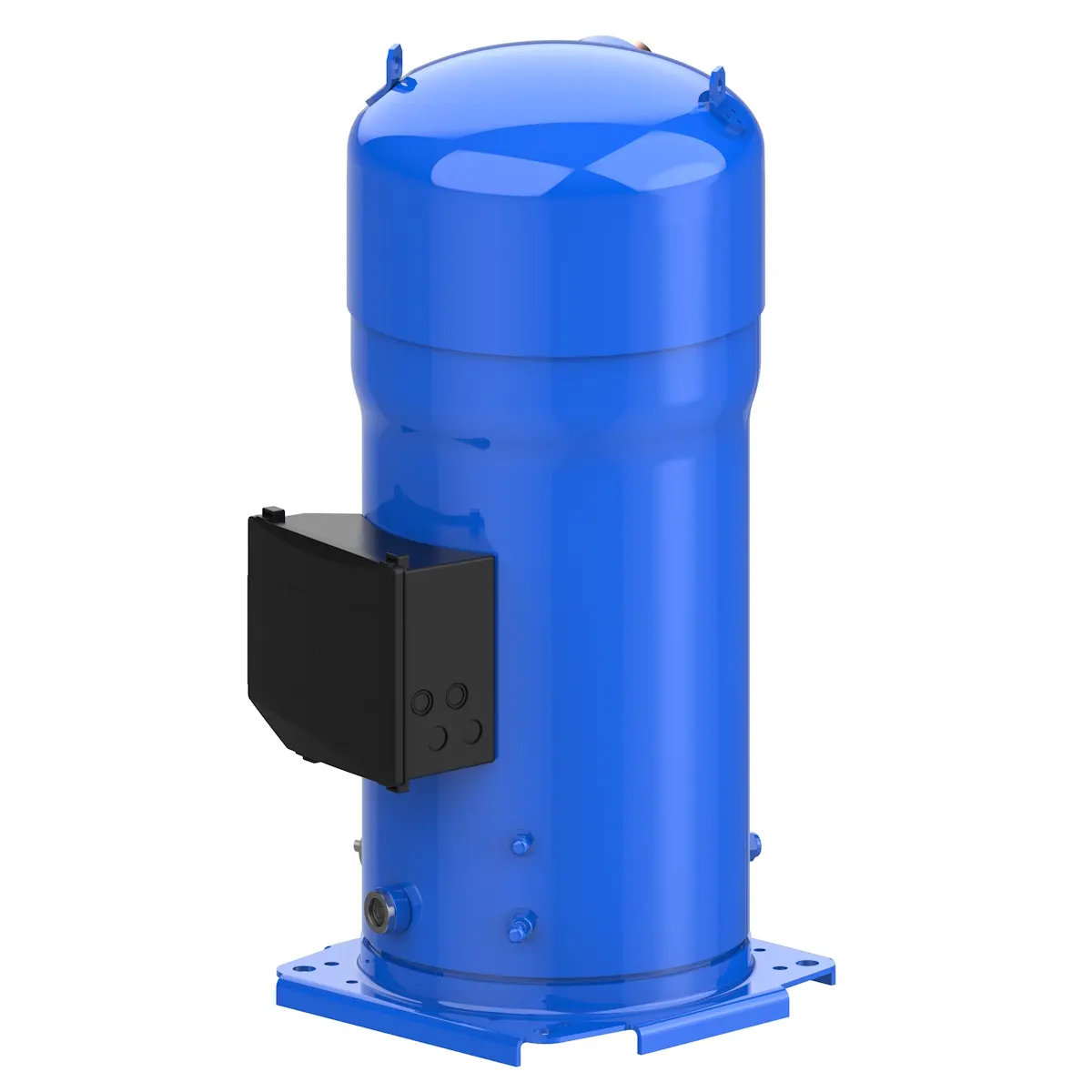
1. Danfoss PSG Compressor: Electrifying High-Temperature Heating
For decades, high-temperature industrial processes and older commercial buildings designed around 180°F hot water infrastructure were tethered to fossil-fuel-fired boilers. The Danfoss PSG scroll compressor shatters this barrier by producing condensing temperatures of up to 212°F, enabling full electrification via heat pumps.
Using low-global-warming-potential (GWP) refrigerants like R1234ze, the PSG supports heat recovery, process heating, and district heating applications.
“This is of most interest to older buildings or more industrial buildings that were designed to operate with 180°F hot water,” explains Brian Dail, application engineering manager at Danfoss. “The Danfoss PSG compressor can allow manufacturers to replace a gas or oil-fired boiler with a fully electric heat pump, even when the water needs to reach very high temperatures.” Available in 105 m³/h and 140 m³/h capacities, multiple units can be manifolded to scale capacity.

2. EcoStruxure from Schneider Electric: Centralized Intelligence
Managing modern multi-system facilities requires breaking down silos between HVAC, power distribution, and lighting. Schneider Electric’s EcoStruxure software platform provides a centralized, data-rich window into all building operations.
“By combining real-time data collection with AI-driven analytics, the platform enables facility teams to continuously monitor and optimize building performance,” says Tyler Haak. The system autonomously tracks heating and cooling loads, occupancy habits, IAQ metrics, and lighting levels to trigger automated adjustments. Particularly valuable for corporate offices, educational campuses, and healthcare networks, EcoStruxure bridges the gap between sustainability targets and day-to-day operational reliability.
3. Rheem Commercial Heat Pumps: All-Electric Packaged Versatility
Rheem Manufacturing Co. has expanded its Renaissance Commercial Classic Plus line of packaged heat pumps, introducing units ranging from 6.5 to 10 tons (RHPDYC series). These all-electric heating and cooling solutions feature advanced smart controls and variable-speed components.
“Advanced smart controls and variable-speed components optimize operation based on building demand, while dehumidification capabilities, integrated economizers, indoor air quality features, and Rheem’s patented Micro Channel Heat Exchanger technology help improve efficiency, humidity control, and overall system performance,” states Rosa Leal. Ideal for schools and hospitality settings, these packaged systems simplify installation by housing heating, cooling, and ventilation in a single footprint while advancing decarbonization objectives.
4. SimpleLink from Mars Air Systems: Dynamic Environmental Separation
Air curtains play a critical role in high-traffic entryways by shielding conditioned indoor spaces from outdoor weather, dust, and insects. However, traditional on/off air curtains often run inefficiently. Mars Air Systems’ SimpleLink Controller introduces smart modulation to air curtain technology.

The SimpleLink system automatically adjusts fan speed, thermal output, and runtime based on real-time doorway conditions. “In a high-performance building, it allows the air curtain to maintain a strong environmental separation barrier while using only the energy needed for the conditions at that moment,” explains Naga Thiyagarajan, director of engineering. By monitoring door traffic every three minutes, SimpleLink prevents protection gaps during heavy use while minimizing motor wear. Wireless commissioning via smartphone and seamless BMS integration make it an asset for hospitals, transit hubs, and retail stores.
5. Weil-McLain SlimFit Boiler: Precision Hydronic Efficiency
Because commercial buildings operate at partial load for the vast majority of the year, seasonal efficiency is paramount. Weil-McLain’s SlimFit condensing boiler delivers up to 96.1% thermal efficiency across capacities ranging from 550,000 Btuh to 2 million Btuh.
Featuring a durable cast aluminum heat exchanger, a 6:1 turndown ratio for precise load-matching, and Advanced Unity controls, the SlimFit series manages sequencing, outdoor reset, domestic hot water priority, and BAS integration. “Since most commercial buildings operate at partial load for much of the year, the combination of modulation, condensing technology, and advanced controls can significantly reduce fuel consumption while maintaining occupant comfort,” notes James Farrell, commercial specialist at Weil-McLain.
6. AI Control from Trane: Cloud-Based Machine Learning
Retrofitting an entire building’s mechanical infrastructure is often cost-prohibitive. To solve this, Trane introduced AI Control, a cloud-based service designed to layer intelligence directly over existing building automation infrastructure.
“Rather than requiring a major hardware overhaul, it works with connected systems to apply deep learning and continuously optimize HVAC performance,” says Brian Fox. By ingesting variables such as local weather forecasts, occupancy schedules, and fluctuating utility tariff rates, Trane’s AI Control dynamically adjusts setpoints in real time. This approach represents the future of architectural engineering: maximizing performance through cloud intelligence without necessitating complete mechanical replacements.

Implications for the Future of Commercial Real Estate
The convergence of electrification, machine learning, and advanced equipment design carries profound implications for building owners, facility operators, and real estate developers:
- Asset Valuation: Buildings equipped with smart, decarbonized HVAC systems will command higher market valuations and lease rates as corporate tenants increasingly prioritize environmental, social, and governance (ESG) compliance.
- Workforce Transformation: As systems become more automated and data-dense, the role of the facility manager is evolving from reactive maintenance to analytical system supervision. Mastery of cloud dashboards, AI analytics, and smartphone commissioning tools is becoming a baseline requirement for modern technicians.
- Regulatory Compliance: With municipal and federal governments enacting strict carbon emissions caps and energy-use intensity (EUI) standards, investing in high-performance equipment like high-temperature heat pumps and condensing boilers is no longer just a sustainability preference—it is a legal necessity to avoid financial penalties.
Conclusion
The definition of a high-performance building has matured from a simple checklist of energy-saving components into a dynamic, interconnected discipline. Today’s commercial and institutional facilities rely on a synergistic network of advanced compressors, smart heat pumps, modulating air barriers, high-efficiency hydronic boilers, and cloud-based artificial intelligence. As manufacturers continue to innovate, the industry is proving that superior energy efficiency, absolute environmental reliability, and exceptional occupant comfort can coexist in a single, elegantly managed ecosystem.
