

By Construction & Infrastructure Desk
Published: October 2026
Main Facts: The Hidden Gridlock Threatening the Data Center Boom
In the high-stakes, hyper-accelerated world of hyperscale data center development, the most critical threat to project schedules is rarely material lead times or supply chain bottlenecks for primary structural components. Instead, the ultimate chokepoint lies hidden beneath the earth: a high-density, subterranean gridlock of mechanical, electrical, and plumbing (MEP) utilities that must be meticulously situated before a single yard of concrete can be poured for the building slab.
Before the superstructure begins to rise, hundreds of specialized trade workers converge on the exact same footprint, fighting for physical space. These crews attempt to simultaneously install high-density underground power duct banks, vital municipal and on-site infrastructure, and massive chilled-water loops necessary to cool future generations of AI and cloud-computing servers.
Managing this chaotic subsurface ballet requires modern project managers to abandon rigid, linear scheduling models. In their place, builders must pivot toward real-time, in-the-field agility. For MEP engineers, general contractors, and field superintendents, mastering this level of hyper-coordinated logistics has become the defining challenge—and competitive differentiator—of contemporary industrial construction.
Chronology: From Civil Earthworks to the Commissioning Critical Path
The lifecycle of a hyperscale data center project follows a compressed, unforgiving timeline where a delay in early civil phases cascades exponentially through later stages. Understanding the chronologic progression of a modern data center build reveals why precision timing is non-negotiable.

Phase 1: Civil Earthworks and Subsurface Gridlock (Months 1–4)
The project kicks off with mass excavation, grading, and the immediate installation of deep underground infrastructure. During this window, trade partners must execute simultaneous trenching for high-voltage power duct banks, domestic water supplies, fire protection lines, and complex closed-loop chilled-water networks. Because this work occurs within a strictly bounded footprint, spatial conflicts are inevitable unless managed through advanced digital visualization and daily micro-scheduling.
Phase 2: The Structural Slab and Foundation Pour (Months 5–6)
Once subsurface utilities are installed, they must be rigorously validated to ensure zero placement errors. Autonomous layout tools and augmented-reality verification are deployed before the concrete slab is poured. A single misplaced conduit or misaligned utility stub at this stage can result in catastrophic rework, requiring concrete demolition that halts the entire master schedule.
Phase 3: Superstructure and Core Shell Erection (Months 7–10)
With the foundation set, structural steel, precast concrete walls, and roof decking are erected. Concurrently, off-site prefabrication units—such as modular electrical rooms, skid-mounted pump packages, and multi-service rack assemblies—are delivered to the site. This phase shifts thousands of hours of dangerous overhead labor away from the crowded jobsite, significantly mitigating the "Focus Four" safety hazards (falls, struck-by incidents, caught-in/between hazards, and electrocutions).
Phase 4: Interior Fit-Out and Zone-Based Management (Months 11–14)
As the building envelope closes, the number of craft workers on-site expands exponentially. To maintain order, project management transitions from overarching milestone tracking to localized, quadrant-based supervision. Dedicated area superintendents take ownership of specific zones to police trade sequencing, ensuring that high-voltage electrical, fluid piping, and low-voltage network cabling converge on server and cooling equipment in precise harmony.
Phase 5: The Commissioning Critical Path (Months 15–18)
The final leg of the project involves system integration and testing. Because tight hyperscale schedules demand simultaneous workflows, network, fluid, and power systems must arrive at every rack and cooling unit in lockstep. If a wall is erected out of sequence or a power line is energized prematurely, crews are forced into emergency shutdowns and costly resets—derailing the commissioning timeline and jeopardizing client service-level agreements (SLAs).

Supporting Data: The Metrics of Modern Jobsite Risk and Efficiency
The operational realities of building multi-hundred-megawatt data centers are underscored by stark industry metrics regarding safety, scheduling volatility, and labor density:
- The 10-to-12 Week Fallacy: In modern data center construction, market forces, weather volatility, and shifting equipment delivery windows render traditional master schedules looking past 10 to 12 weeks virtually obsolete. Successful teams rely on continuous, rolling two-week operational plans.
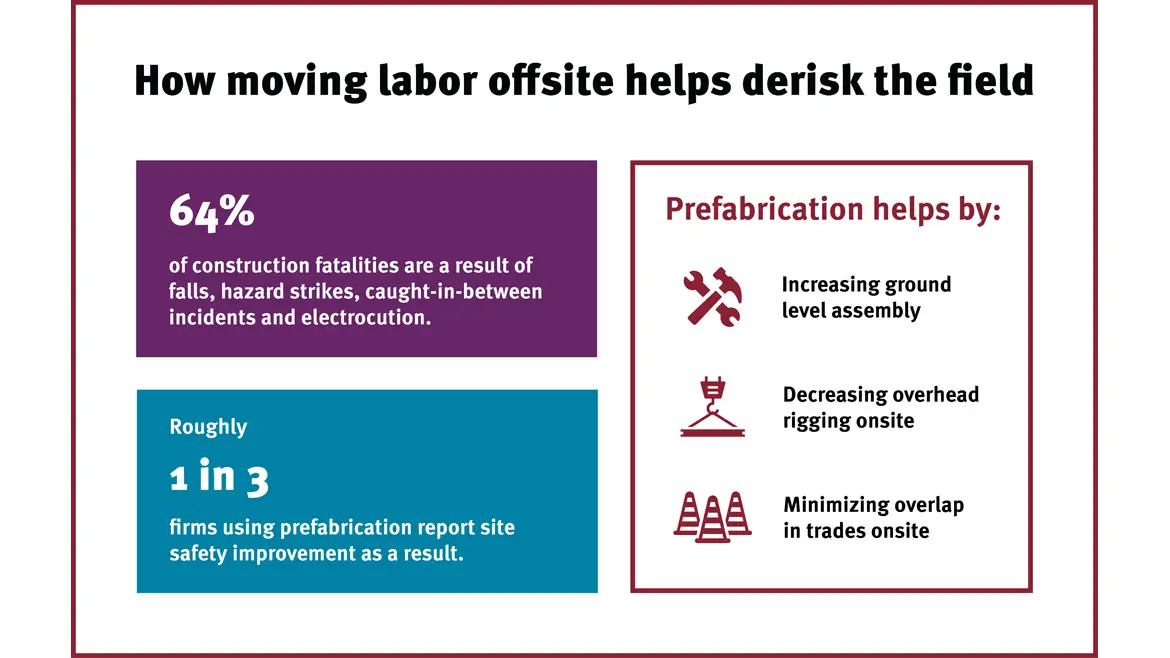
- The "Focus Four" Hazard Reality: According to federal safety data, construction’s "Focus Four" hazards—falls, struck-by, caught-in/between, and electrocution—account for 64 percent of all jobsite fatalities. Strategic off-site prefabrication targets these specific risks by eliminating dangerous overhead rigging and hot work in cramped, active environments.
- Exponential Labor Scaling: As a data center transitions from civil earthworks to interior fit-out, the on-site workforce expands from dozens of heavy-machinery operators to hundreds—and sometimes thousands—of specialized craft workers operating simultaneously within a tight physical footprint.
- Tri-System Convergence: A typical hyperscale facility requires the simultaneous, error-free integration of three distinct, mission-critical utility systems: network (data), fluid (cooling), and power (electrical). A sequencing failure in any one of these three streams instantly halts the commissioning critical path.
Official Responses: Insights from Industry Leaders
As data center developers grapple with unprecedented demand driven by artificial intelligence and hyperscale cloud expansion, construction executives are rethinking traditional jobsite methodologies.
Industry veterans emphasize that communication models must evolve alongside technological advancements. Bryan Larson of McGough Construction notes that managing modern technical jobsites resembles "synchronized swimming," where individual brilliance matters far less than collective timing and spatial awareness.
"In data center construction, things move too fast to rely on rigid, long-term master schedules that fail to account for daily realities," industry operations experts explain. "When your construction teams operate with a unified script, you minimize field risk, protect the craft workforce, and unlock a standard of execution that delivers hyperscale facilities at a pace the modern market demands."
Furthermore, engineering firms stress that digital transparency is no longer a luxury—it is an operational baseline. By pairing autonomous drone mapping with Building Information Modeling (BIM), project engineers can isolate remaining underground utility lines in real time. This allows excavation crews, steel erectors, and concrete contractors to share a single source of truth, virtually eliminating blind excavations and costly utility strikes.

Implications: Redefining Competitive Advantage in Data Center Construction
The shift toward radical collaboration, digital visualization, and localized field management carries profound implications for the broader construction and technology sectors.
1. The Death of the Siloed Trade
Historically, MEP contractors, civil crews, and structural teams operated in relative isolation, completing their scopes sequentially and handing off the project like a baton in a relay race. Today, the compression of hyperscale schedules makes sequential workflows impossible. Trades must operate concurrently, requiring a cultural shift toward radical transparency, shared risk, and daily alignment touchpoints.
2. Prefabrication as a Core Competency
The integration of off-site prefabrication is transitioning from a cost-saving measure to a vital risk-mitigation strategy. By moving complex mechanical skids, electrical power distribution units (PDU), and multi-trade rack assemblies to controlled factory environments, general contractors can guarantee quality control, drastically reduce field congestion, and protect workers from high-risk overhead and hot-work environments.
3. Technology Integration at the Edge
The successful delivery of a 2026-era data center relies heavily on field-level technology adoption. Augmented-reality hard hats synced directly to BIM models, autonomous layout robots, and drone-generated progress maps are proving to be decisive assets. Firms that successfully bridge the gap between digital office engineering and messy, boots-on-the-ground field execution will capture an outsized share of the booming data center market.
Conclusion
On a modern data center development campus, logistics can no longer be treated as an afterthought or managed through fragmented communication channels. True project velocity requires an operational culture that embraces flexibility, respects the specialized expertise of trade partners, and leverages visual coordination tools to align work happening both above and below ground. For the builders shaping the digital infrastructure of tomorrow, mastering this delicate orchestration is the ultimate competitive advantage.
