

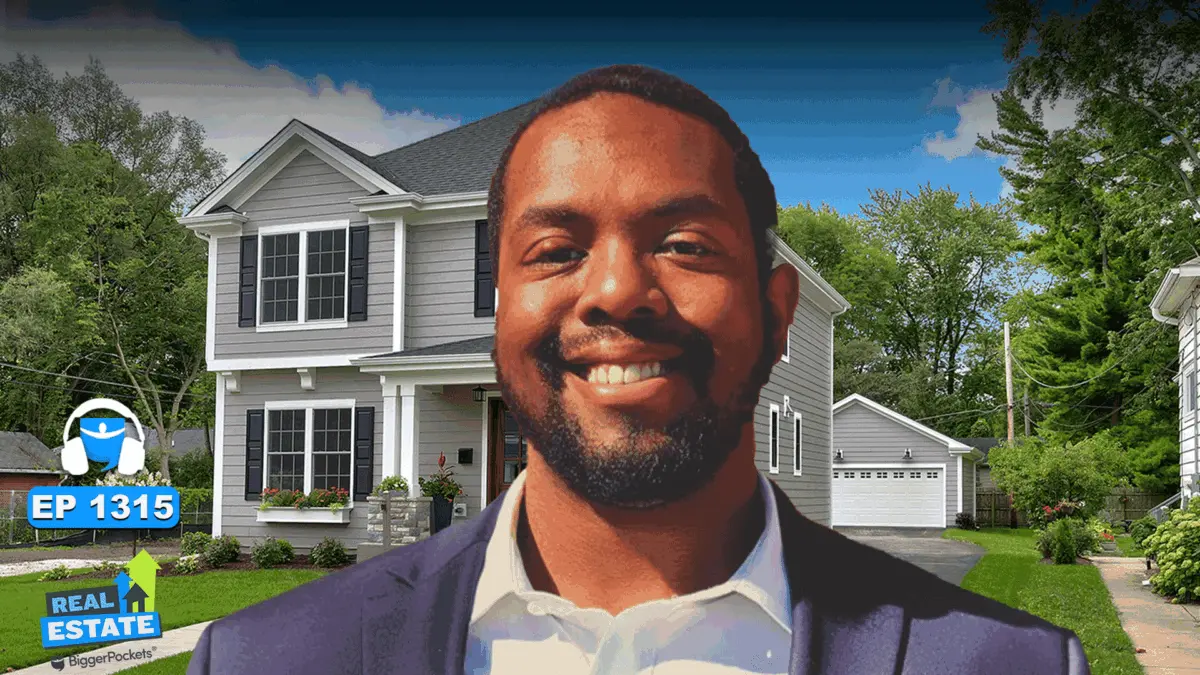
The modern American dream is often packaged as a steady corporate ladder climb, a 401(k) match, and a retirement gold watch at age 65. For Aaron Murphy, that script began to unravel during a routine corporate meeting in Baltimore. Listening to a company vice president attempt to inspire a room of weary employees with the stark reality—"We don’t want to do this work, but we have to do it or we’re not getting paid"—Murphy realized he was trapped in a system that offered no true security, only cyclical exhaustion.
Eleven years later, Murphy is taking video interview calls live from Portugal as part of a year-long, round-the-world trip with his wife. He no longer answers to a boss. Instead, he oversees a robust, vertically integrated portfolio of 75 long-term rental units in Maryland, completely replacing his and his wife’s W-2 incomes through a repeatable, methodical real estate investing blueprint.
His journey from a skeptic working a low-base sales job to a multi-family real estate powerhouse offers a masterclass in risk management, operational efficiency, and the power of taking the first imperfect step.
Chronology of an Empire: The 11-Year Evolution
Phase 1: The Awakening and the $12,000 House Hack (2016)
Growing up, Murphy’s early exposure to real estate was far from glamorous. His family attempted flips in rural Maryland, treating young Aaron as unpaid labor—carrying shingles and learning to paint—without seeing financial rewards. "I learned later that we called it character building," Murphy jokes. Consequently, he initially wrote off real estate as a losing game.
After college, Murphy entered software sales, pitching commercial real estate brokers and banks. Immersed in this environment, two realizations struck him: the corporate W-2 life was a dead end, and real estate could be run as a clean, operational business driven by cash flow.
With a modest base salary and no understanding of compound interest, Murphy initially looked at dividend stocks and equities. Math quickly grounded his ambitions. Needing roughly $70,000 a year to live, and believing he needed millions in capital to survive on dividends alone, stocks proved mathematically out of reach.
Real estate, however, offered leverage. In 2016, eyeing pricey $700,000 single-family homes in Washington D.C., Murphy discovered the FHA loan. By looking just outside the city to Hyattsville, Maryland, and utilizing a 3.5% down payment, he purchased his first property: a five-bedroom house for roughly $340,000, putting down just $11,900.
Murphy lived in the basement and rented out the four upper rooms for $700 each. While the property largely broke even after utilities and maintenance, it eliminated his personal housing expense, allowing him to aggressively bank his corporate salary for the next phase.
Phase 2: Stumbling Through the First Multi-Family Deal (2017)
With his savings growing, Murphy purchased his next asset in 2017: a triplex in Hagerstown, Maryland, for $96,000, utilizing a 20% conventional down payment. On paper, it looked like an instant cash-flow machine. In reality, it became a catalogue of rookie errors.
The purchase contract stated the property would be delivered fully occupied. Two weeks before closing, the sellers revealed that two of the three units were vacant—though supposedly ready to rent. Stubbornly wanting to "stand on business," Murphy demanded the sellers fulfill the contract and place tenants before closing.
Without screening criteria in the contract, the sellers rushed problematic tenants into the units. Those tenants triggered Murphy’s first-ever evictions, resulting in thousands of dollars in legal fees and turnover costs. Yet, by persevering, injecting another $20,000 into renovations, and stabilizing the asset, Murphy pushed gross rents to $1,900 a month. Years later, that resilience paid off: the property’s appreciation allowed Murphy to execute a $50,000 cash-out refinance, seeding his future portfolio expansion.
Phase 3: The BRRRR Strategy and Operational Scale (2022–Present)
By 2022, Murphy was ready to exit his corporate job permanently. Moving with his wife to Baltimore, Maryland, they adopted the BRRRR method (Buy, Rehab, Rent, Refinance, Repeat) to scale rapidly.
Targeting distressed row houses priced around $100,000, Murphy budgeted $30,000 to $40,000 for renovations and $20,000 for closing costs. However, early third-party contractor issues quickly threatened to bankrupt his operation. On his first two BRRRR projects, budget overruns totaled $65,000. On his third project—expected to be a light cosmetic rehab—he discovered it needed a full structural gut job costing up to $100,000.
Facing potential financial ruin, Murphy rolled up his sleeves. He hired day laborers and worked alongside them for four to five months, mastering drywall mudding, plaster demolition, and layout optimization. By eliminating general contractor markups and mastering every granular detail of construction, he saved the deal and gained invaluable operational insight.
Supporting Data & Operational Metrics
Murphy’s success is built upon meticulous financial and operational structuring. Rather than relying on luck, he engineered a predictable ecosystem where every stakeholder—from hard money lenders to drywall installers—achieves their goals.
- Portfolio Size: 75 long-term rental units across Maryland (primarily Baltimore city and surrounding counties), consisting of single-family homes, townhouses, duplexes, and triplexes.
- Acquisition Pace: At peak velocity, Murphy executes one complete renovation every 4 to 6 weeks.
- The BRRRR Math: Typical acquisition ($100k) + Rehab ($30k–$40k) + Closing Costs ($20k) = All-In Cost of $150k–$160k. Post-rehab appraisal typically lands between $200k and $220k, allowing for capital recovery via cash-out refinancing.
- In-House Workforce: Day laborers evolved into a dedicated, full-time 1099 construction crew working five days a week exclusively on Murphy’s projects, ensuring zero downtime and standardized material purchasing (SKUs).
Strategic Blueprint: The "What’s In It For Them" Philosophy
Murphy credits his rapid scaling to a counterintuitive realization: real estate investing is not just about properties; it is about human psychology and alignment of incentives.
1. Aligning Incentives Across the Board
- For Contractors: Instead of subjecting contractors to unpredictable start-and-stop schedules, Murphy provides absolute stability—constant, uninterrupted workflow, prompt payment, and clear expectations.
- For Lenders: By working closely with hard money lenders (such as mentor Sean Magner) and DSCR (Debt Service Coverage Ratio) lenders, Murphy ensures transparent communication regarding conservative After Repair Values (ARVs). This structured risk mitigation makes lenders eager to fund his subsequent deals.
2. The Three-Step Mentorship Formula
Rather than paying thousands for formal coaching, Murphy built a network of free, high-level mentors using a strict behavioral framework:
- Reframe the Mentor: Abandon the idea of a single guru holding your hand through emotional risk. Instead, build a network of specialized local practitioners.
- Ask Actionable Questions: Never ask someone to "pick their brain" or broad questions like, "What would you do if you were my age?" Instead, ask hyper-specific, operational questions based on active deals (e.g., "I’m underwriting a two-bedroom rental in Zip Code 21202 for $1,500; does that match your market data?").
- Close the Feedback Loop: Return to the advisor to report how their advice was implemented and what the specific outcome was. This validation triggers a positive psychological feedback loop, turning advisors into lifelong advocates and partners.
Implications: Redefining the Exit Strategy
Murphy’s trajectory illustrates that financial independence through real estate does not require a massive cash windfall, inherited wealth, or speculative stock trading. It requires accepting short-term discomfort in exchange for long-term operational autonomy.
Today, Murphy’s portfolio funds a lifestyle that defies traditional retirement timelines. Operating remotely with a 24-inch monitor and laptop from Portugal, Italy, and Australia, he continues to manage his property teams while enjoying life’s milestones—walking the Great Wall of China, making pasta with Italian chefs, and traveling alongside his wife.
For aspiring investors stuck in the corporate grind, Murphy’s message is clear: the path out is mathematical, tactical, and entirely repeatable. You don’t need a perfect plan from day one; you just need to take the first step, survive the trenches, and build a system that works for everyone involved.
