

WASHINGTON — Over the past decade, the American mortgage lending industry has undergone a radical digital transformation. Borrowers can now snap photos of their W-2s, link bank accounts with a few clicks, and electronically sign reams of closing disclosures from their living rooms. Lenders have poured billions of dollars into user-facing portals, mobile applications, and cloud-based infrastructure to meet consumer demands for a frictionless, Amazon-like experience.
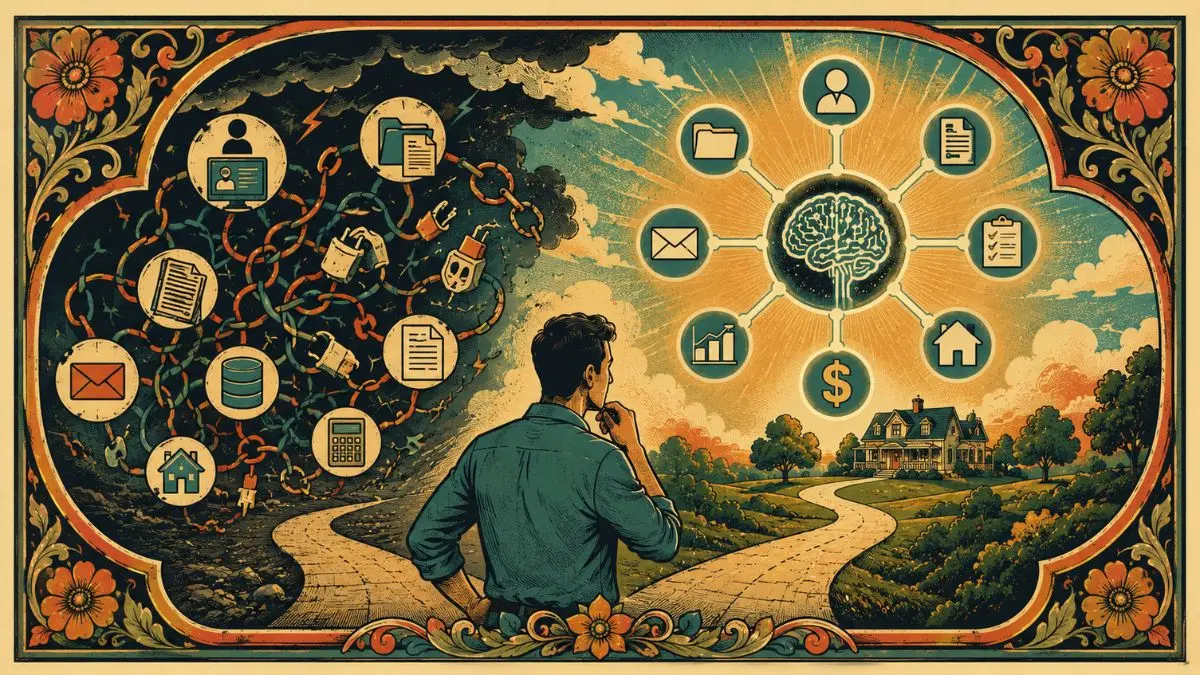
Yet, beneath this polished digital veneer, the operational reality of originating a mortgage remains stubbornly fragmented. While the front-end borrower experience has evolved, the middle and back offices are frequently bogged down by manual workarounds, swivel-chair data entry, and legacy software silos that refuse to speak to one another.
According to industry experts, the modern lending tech stack is a paradox: lenders are deploying state-of-the-art artificial intelligence to ingest data, only to have that data hit a brick wall when moving from point-of-sale (POS) systems to loan origination systems (LOS) and underwriting platforms.
The central challenge facing the mortgage sector is no longer about acquiring digital tools; it is about integration, workflow continuity, and bridging the chasms that exist between disconnected software ecosystems.
Part I: Main Facts and Current Landscape
The latest industry benchmarks underline both the rapid adoption of new technologies and the persistent operational bottlenecks holding lenders back.
The STRATMOR Group recently published its 2025 Technology Insight® Study (TIS) Digital Innovations results, shedding light on how mortgage lenders are actively deploying artificial intelligence within the origination lifecycle. The survey results reveal a significant shift toward AI-driven automation, particularly in document processing and data extraction:
- 68% of lenders now use AI to automatically classify and index incoming loan documents.
- 59% of lenders utilize AI to read and extract text and financial data from those documents.
- Nearly 50% of lenders rely on AI-assisted tools to analyze complex borrower income during the underwriting phase.
These figures demonstrate that lenders are not merely talking about artificial intelligence—they are putting it to work on the front lines of loan processing. However, a glaring operational disconnect emerges immediately after these initial steps are completed.
Realizing the full return on investment (ROI) of mortgage AI depends entirely on what happens after a document is classified, read, or analyzed. If the resulting data cannot move seamlessly through the broader origination process, lenders are forced to perform redundant reconciliation or revert to manual data entry downstream.
For instance, a borrower’s tax return may be perfectly classified and parsed by an AI engine at the point of sale. Yet, when that file reaches underwriting, a loan processor may still re-type or manually verify the figures because the POS and LOS platforms operate on disparate databases. In this scenario, the intelligence generated upstream fails to translate into a fully connected, end-to-end mortgage workflow.
Furthermore, while a fully paperless, frictionless mortgage remains the ultimate industry aspiration, it is not yet practical for every transaction. External and internal friction points—including complex regulatory compliance frameworks, varying closing practices across jurisdictions, and the diverse vendor ecosystem that supports the housing market—continue to impede total adoption. Within the lender’s internal technology environment, the primary obstacle remains stark: POS systems, origination software, underwriting engines, and document management systems (DMS) do not consistently exchange data in real time.
Part II: Chronology of Mortgage Tech Evolution
To understand how the industry arrived at this current juncture of technological disconnect, it is helpful to trace the evolution of mortgage automation over the past thirty years.
The Paper Era (Pre-2000s)
Prior to the digital turn, mortgage origination was an entirely manual, paper-driven endeavor. Borrowers submitted physical tax returns, pay stubs, and bank statements. Underwriters physically calculated income using paper calculators and green ledger sheets. Files were stored in massive filing cabinets, and compliance audits required physical inspection of paper trails. Speed was constrained by human physical capacity, and turnaround times frequently spanned 45 to 60 days.
The First Wave of Digitization (2000s–2010s)
The advent of the internet and early enterprise software introduced the first digital wave. Lenders adopted electronic loan origination systems to replace green sheets. Scanners replaced physical folders with PDF files. However, these early systems were designed primarily as electronic filing cabinets rather than intelligent workflow engines. Data entry remained heavily manual, and systems were built on rigid, on-premise servers that were difficult to update or integrate.
The Point-of-Sale Boom (2015–2020)
Spurred by fintech competition and changing consumer expectations, the mid-2010s saw a massive investment in consumer-facing digital portals. Lenders rushed to deploy slick front-end applications that allowed borrowers to apply for loans online. While this successfully modernized the borrower experience, it frequently exacerbated back-office strain. Lenders created a "digital front door" while leaving the back-office plumbing untouched, resulting in data trapped in isolated silos.
The AI and Cloud Revolution (2020–Present)
Today, the industry is navigating the integration of cloud-based infrastructure, configurable microservices, and generative or predictive artificial intelligence. Lenders are moving away from monolithic legacy software toward modular platforms. However, as the 2025 STRATMOR data illustrates, the industry is currently caught in a transition phase: AI is successfully automating isolated tasks (like document reading and income calculation), but the overarching architecture often fails to connect these islands of automation into a unified continent.
Part III: Supporting Data and the Cost of Staying Disconnected
The financial and operational implications of maintaining disconnected systems are profound. When data cannot flow freely across the origination lifecycle, the cost compounds at every stage of the loan file’s journey.
Consider the lifecycle of a loan past the underwriting milestone. When a file reaches closing, it often carries two distinct versions of the same data: one version that was parsed and read by automated AI, and another version that was manually typed or double-checked by a human loan officer or processor attempting to reconcile system discrepancies.
If either of these data versions contains an error—a transposed digit in a Social Security number, a miscalculated asset balance, or an omitted debt liability—the discrepancy frequently remains hidden until post-closing quality control or investor audit. At that late stage, a minor data-entry gap can quickly transform into a severe balance-sheet problem, leading to loan buyback requests, compliance penalties, or unsellable assets on the secondary market.
The Human Toll on Staff Time
Staff productivity metrics follow a similarly discouraging pattern. In a disconnected technological environment, manual review hours scale directly with loan volume rather than shrinking as technology improves.
Ideally, software automation should decouple operational costs from origination volume, allowing a team to handle twice as many loans with the same headcount. However, because human staff members are perpetually required to check and re-check files at the exact junctions where software systems stop talking to each other, labor costs remain stubbornly high. This human intervention is not optional; regulatory demands leave no room for error.
Regulatory Pressures and Compliance Risk
The regulatory landscape governing mortgage origination in the United States places a massive premium on accurate, traceable documentation. Lenders must meticulously comply with:
- TRID (TILA-RESPA Integrated Disclosure rule)
- RESPA (Real Estate Settlement Procedures Act)
- HMDA (Home Mortgage Disclosure Act)
- Fair Lending Regulations (including the Equal Credit Opportunity Act and the Fair Housing Act)
When information must be manually reconciled between disconnected software platforms, maintaining a clean, consistent, and immutable audit trail becomes exponentially more difficult. Every manual touchpoint introduces the risk of human error, data corruption, and compliance violations—exposing lending institutions to regulatory fines, legal liabilities, and reputational damage.
Part IV: Official Responses and Industry Insights
Industry executives, technology architects, and banking leaders are increasingly vocal about the need to rethink integration strategies. The consensus among market observers is that lenders must shift their focus from acquiring point solutions to building cohesive, interoperable technology ecosystems.
Real-World Success: Connecting the Ecosystem
Proof of what is achievable when systems successfully communicate can be seen in regional institutions that have modernized their tech stacks. Dearborn Bank offers a notable case study in operational efficiency driven by system integration.
By strategically connecting its point-of-sale, origination, and document-processing capabilities—utilizing integrated platforms such as Originate Mortgagebot, MortgagebotLOS, and native workflow automation tools—the bank achieved significant operational gains. Dearborn Bank successfully reduced average application cycle times and increased its overall loan-handling capacity without requiring a proportional increase in headcount or back-office staff.
The operational mechanism behind this success is straightforward: when POS, LOS, underwriting, and DMS platforms are linked via modern Application Programming Interfaces (APIs) and robust integrations, borrower information flows consistently throughout the lifecycle. Duplicate data entry is minimized, and manual reconciliation is drastically reduced. Furthermore, adopting a modular platform architecture gives lenders the flexibility to upgrade individual capabilities (such as adding advanced AI document readers) without needing to rip out and replace their entire core technology stack at once.
Expert Recommendations for Lenders
Technology strategists advise lending institutions evaluating their current infrastructure to focus on several core criteria when building a connected origination process:
- API-First Architecture: Ensure that all software vendors utilized in the origination chain support open, bi-directional APIs that allow real-time data synchronization.
- Elimination of Swivel-Chair Tasks: Audit the loan workflow to identify exact handoff points where staff members are forced to re-key data from one system into another, and prioritize automating those specific bridges.
- Modular Modernization: Avoid "big bang" technology overhauls that paralyze operations. Instead, upgrade and connect systems incrementally, ensuring that data generated upstream is preserved downstream.
- Traceable Compliance Logging: Verify that automated workflows maintain an unbroken digital audit trail, capturing every instance of AI data extraction and human verification for regulatory review.
Part V: Implications for the Future of Mortgage Lending
As the mortgage industry looks toward the latter half of the decade, the implications of this technological inflection point are clear. The distinction between winning and losing lenders will not be determined by who has the flashiest customer portal, but by who has built the most resilient, connected, and intelligent back-office infrastructure.
The Death of the Monolithic Tech Stack
For years, software vendors promised the "all-in-one" monolithic system that would handle every aspect of mortgage origination under a single database. In practice, these monolithic platforms often compromised on depth, forcing lenders to use subpar tools just to maintain system unity.
The future belongs to composable banking—ecosystems built on best-of-breed software solutions that are tightly integrated via cloud architecture and robust middleware. Lenders will increasingly demand that their technology vendors play well with others, making interoperability a non-negotiable purchasing criterion.
The Evolution of the Mortgage Professional
As routine data entry, document indexing, and basic income calculations are increasingly handled by AI and automated workflows, the role of the mortgage professional is evolving. Loan officers, processors, and underwriters are transitioning from data-entry clerks and compliance checkers into strategic advisors, exception handlers, and relationship managers.
However, this transition can only succeed if the technology supports them. If systems remain disconnected, human staff will remain trapped doing the mechanical work of software glue—manually moving data from system A to system B.
Conclusion: The Real Question
Investment in document extraction, automated classification, and AI-assisted income analysis clearly demonstrates that mortgage lenders recognize the immense value of intelligent processing. The industry has proven its willingness to innovate at the edges of the borrower experience.
The real question confronting executives today is not whether artificial intelligence works, but whether that intelligence can survive the journey through the mortgage lifecycle without manual work being reintroduced at every handoff.
Few lenders have the appetite—or the capital—to replace their entire technology stack in a single fiscal year, nor should they attempt to do so. The immediate opportunity, and the ultimate competitive advantage, lies in connecting and modernizing workflows incrementally. By ensuring that the value and data created at the very first stage of a loan application carry seamlessly through to closing and beyond, lenders can finally bridge the gap between digital ambition and operational reality.
