

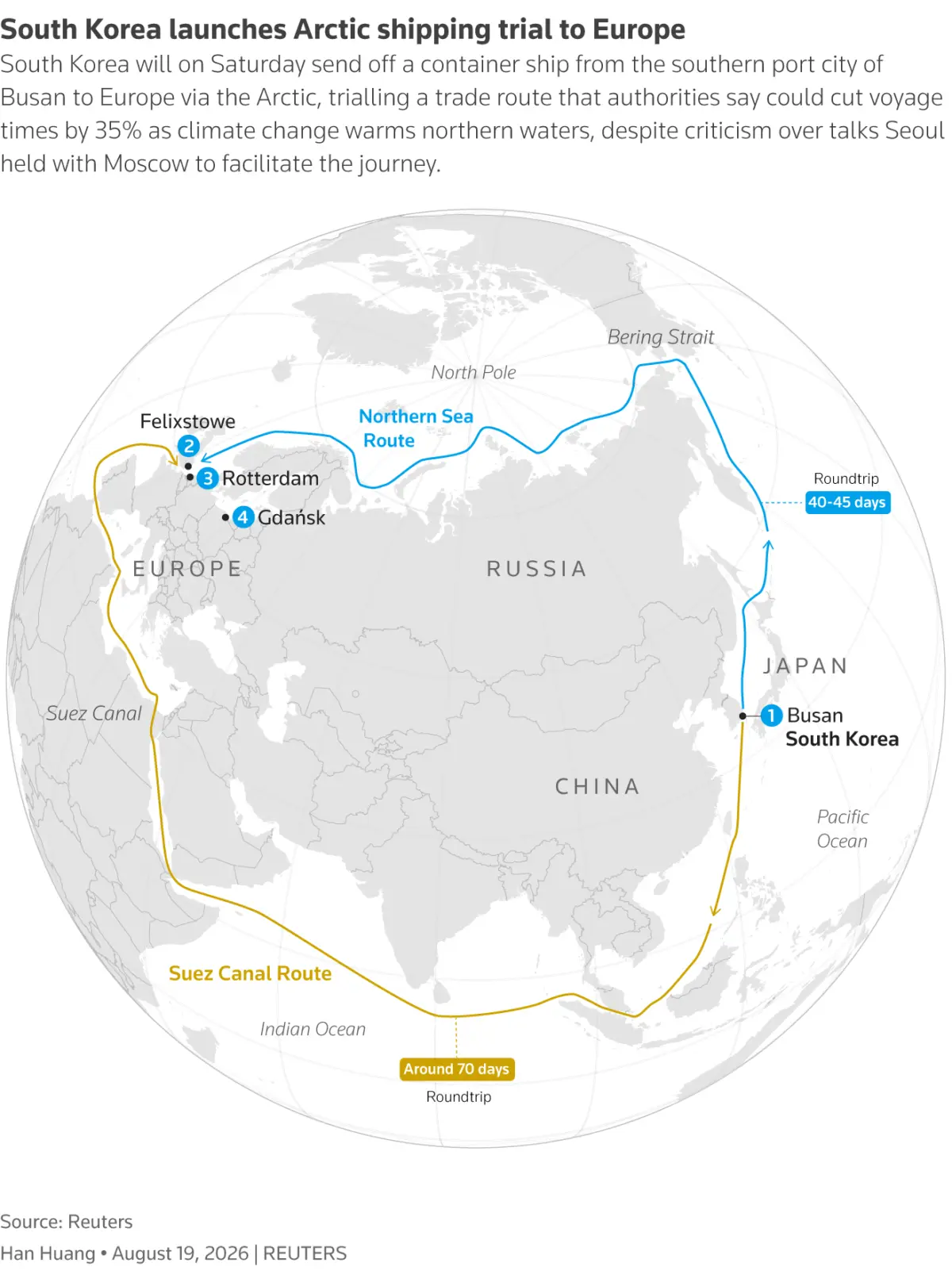
SEOUL — In a move that highlights the complex intersection of accelerating climate change, global commerce, and geopolitics, South Korea is set to flag off a major container ship bound for Europe via the Arctic on Saturday. The voyage represents a historic milestone for Seoul, marking its first-ever commercial cargo journey along the Northern Sea Route (NSR).
While the mission is designed to test the commercial viability of a shorter, climate-altered maritime passageway, it has simultaneously ignited diplomatic friction with Western allies. Because the route hugs Russia’s northern coastline, the endeavor requires direct coordination and administrative approval from Moscow—a reality that runs counter to broader Western efforts to diplomatically isolate the Russian state amid the ongoing war in Ukraine.
As South Korea pushes forward with its national goal of establishing regular, commercial Arctic shipping lanes by 2030, the voyage of the PanStar Acro serves as a high-stakes litmus test for the future of global supply chains, international law, and the mounting commercial scramble for the melting polar north.
Main Facts of the Voyage
The pioneering mission is spearheaded by the South Korean shipping operator PanStar, which was chosen through a government-backed tender to execute the pilot voyage. The vessel designated for the historic journey is a 2,700-TEU (Twenty-Foot Equivalent Unit) container ship originally acquired from HMM and subsequently modified to meet the safety and structural demands of polar navigation.
- The Route: Departing from the southeastern South Korean port of Busan, the PanStar Acro will sail north into the Arctic, making scheduled European port calls at Felixstowe in the United Kingdom, Rotterdam in the Netherlands, and Gdansk in Poland, before charting a course back to Asia.
- Duration: The round-trip journey is projected to take between 40 and 45 days.
- Cargo and Crew: The ship will carry a crew of 20 personnel comprising South Korean and Indonesian nationals. PanStar is aiming to secure at least 1,300 TEU of cargo—including high-value automobile parts, food products, and cosmetics—along with transshipment cargo originating from neighboring China and Japan, where prospective clients have already expressed keen interest.
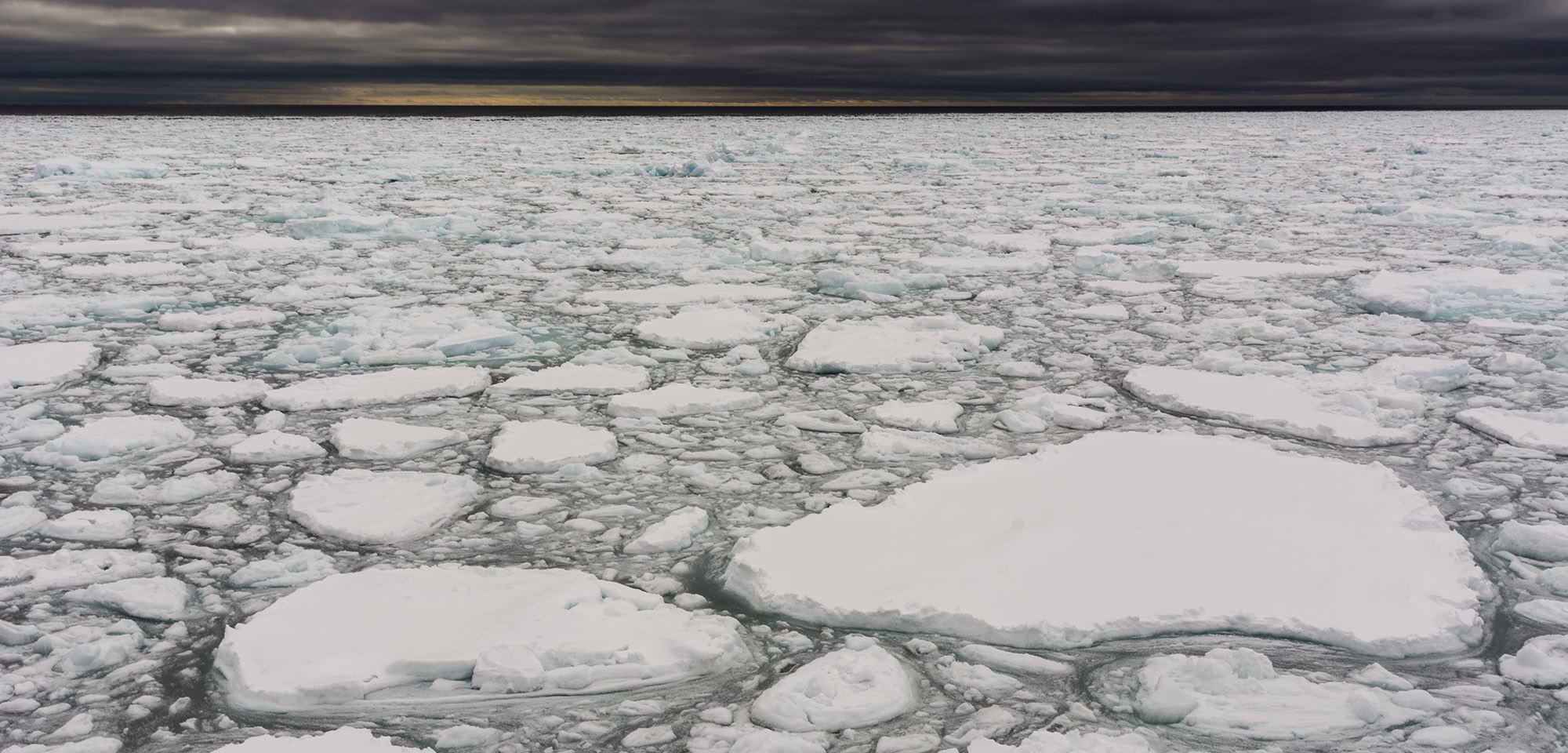
- Strategic Timing: The voyage has been strategically scheduled for September, the period when Arctic sea ice reaches its annual minimum, offering the safest window for navigation without requiring constant, heavy icebreaker escorts.
Chronology of Arctic Policy and Commercialization in South Korea
South Korea’s foray into Arctic shipping is not an isolated event; it represents the culmination of years of strategic planning, political shifts, and maritime research:
- Pre-2022 (Exploratory Phase): Academic institutions and maritime ministries in Seoul began closely monitoring the receding polar ice cap, commissioning feasibility studies regarding the Northern Sea Route as a competitive alternative to traditional southern shipping lanes.
- 2024–2025 (Strategic Pivot): Following the inauguration of President Lee Jae Myung, the development of Arctic shipping pathways was elevated to a top national priority. The administration outlined a vision to transform the port of Busan into a premier global maritime logistics hub.
- Late 2025: Researchers, including former naval officer Hyewon Choi, published critical economic assessments in journals such as Ocean Policy Research, highlighting the high insurance and vessel-sizing costs associated with polar transit while emphasizing the necessity of operational experience.
- Mid-2026: PanStar successfully acquires and modifies the 2,700-TEU container ship, preparing the infrastructure for a government-backed pilot tender.
- September 2026: The PanStar Acro officially launches from Busan, marking South Korea’s maiden commercial Arctic transit to Europe.
- The 2030 Horizon: South Korea establishes a concrete national target to make the Arctic a regular, operational trade route by the end of the decade.
Supporting Data: Climate Realities and Economic Trade-Offs
The commercial viability of the Northern Sea Route is inextricably linked to the rapid degradation of the polar cryosphere. Driven by unprecedented global temperature anomalies, Arctic sea ice has steadily receded, dramatically lengthening the seasonal window during which commercial vessels can traverse northern Siberian waters.
Traffic Trends on the Northern Sea Route
Data compiled by the Norwegian tracking foundation, the Centre for High North Logistics, underscores a steady upward tick in utilization:
- 2022: 43 transits recorded across the NSR.
- 2024: 97 transits.
- 2025: 103 transits executed by 88 distinct vessels, primarily driven by Russian domestic shipping and Chinese commercial ventures.
Distance and Fuel Efficiencies
According to South Korea’s Oceans Ministry, utilizing the Arctic route can reduce the distance between East Asian ports and Northern Europe by up to 35% compared to the traditional, Suez Canal-dependent southern route. This drastic reduction in nautical miles translates into substantial fuel savings and lower direct carbon emissions per voyage under optimal conditions.
Financial and Structural Hurdles
Despite the alluring geography, experts warn that the NSR’s commercial equation remains deeply complicated:
- Seasonal Limitations: The route is fundamentally seasonal. As analysts note, it cannot be utilized year-round and is reliably navigable by standard container vessels for only a brief three-month window during peak summer and early autumn.
- Cost Inflation: Unit transport costs are heavily inflated. Former naval officer and maritime researcher Hyewon Choi pointed out that strict vessel size limitations—dictated by the physical depth and navigational hazards of Arctic straits—prevent economies of scale. Furthermore, specialized polar modifications and exorbitant marine insurance premiums offset many of the fuel-cost savings.
Official Responses and Diplomatic Friction
The decision by Seoul to send a commercial vessel through Russian-controlled Arctic waters has opened a rift between South Korea and its traditional Western partners, who view the move through the lens of international sanctions and geopolitical solidarity.
The Western Diplomatic Backlash
Western governments have made little secret of their displeasure regarding South Korea’s administrative engagement with Moscow to secure necessary permits for the voyage.
"We want to isolate Russia, we don’t want engagement with Russia," said a European diplomat on condition of anonymity, pointing directly to the ongoing war in Ukraine. The diplomat confirmed that these concerns had been formally communicated to South Korean officials.
Furthermore, legal and geopolitical experts warn that if the PanStar Acro encounters trouble—such as becoming trapped in shifting ice packs—and is forced to rely on Russian state-owned icebreakers or emergency rescue services, South Korea could inadvertently find itself in breach of international sanctions regimes targeting Russian infrastructure and state enterprises.
Silence from Ministries
Thus far, official channels have remained tight-lipped. Neither South Korea’s Oceans Ministry nor Russia’s Foreign Ministry responded to repeated requests for comment regarding the diplomatic friction or the operational parameters of the voyage.
Implications for Global Maritime Trade and Geopolitics
The pilot voyage of the PanStar Acro carries profound implications that extend far beyond the immediate commercial interests of a single shipping company or the diplomatic sensitivities of a single season.
The Geopolitical Race for First-Mover Advantage
Underpinning South Korea’s urgency is the aggressive posture of its northern neighbor and regional competitor, China. Beijing has long eyed the Arctic as part of its "Polar Silk Road" initiative, seeking to secure a first-mover advantage in northern logistics. Chinese container firms, such as Sea Legend Shipping, are already laying groundwork with Russian operators to launch regular container services along the NSR.
For Seoul, sitting out the Arctic transition risks conceding a vital future trade corridor to Beijing. As a PanStar official noted anonymously, “Korea must begin accumulating operating experience and data that it has not had until now, if the national goal of commercial scheduled service by 2030 is to be achievable.”
The Environmental Paradox
Perhaps the most striking irony of the Northern Sea Route’s commercial rise is its feedback loop with climate change. The route itself is entirely a product of the rapid melting of Arctic sea ice—a phenomenon driven by global heating that has shattered historical climate records. Opening these waters to commercial shipping to save fuel and time risks normalizing a maritime corridor carved out by environmental degradation, even as the vessels themselves contribute to local black carbon emissions that can accelerate regional ice melt.
Conclusion
As the PanStar Acro casts off from Busan this Saturday, it carries the weight of a changing global economy. For South Korea, the voyage is a calculated gamble: an essential technological and logistical step toward future-proofing its maritime competitiveness. Yet, it also forces Seoul to navigate treacherous diplomatic waters, balancing its long-term economic imperatives against the unified security demands of its Western allies in an increasingly fractured geopolitical landscape.
