

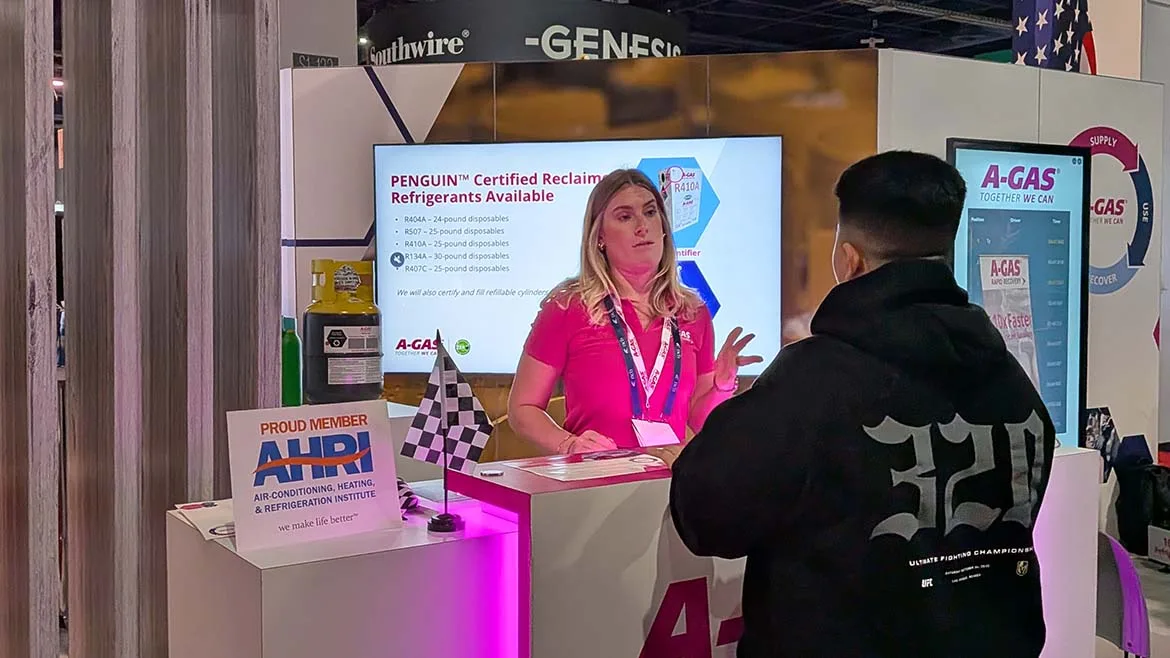
SACRAMENTO, California — As environmental regulations surrounding hydrofluorocarbons (HFCs) tighten nationwide, California continues to serve as the nation’s aggressive regulatory testing ground. In response to recent legislative mandates, refrigerant supplier and lifecycle management leader A-Gas has announced that its Penguin Certified Reclaimed Refrigerants fully comply with the state’s rigorous new standards.
The announcement arrives at a critical juncture for the heating, ventilation, air conditioning, and refrigeration (HVACR) industry. With strict enforcement mechanisms now in place under Assembly Bill (AB) 663, contractors, wholesalers, and equipment manufacturers operating in California must navigate a drastically altered legal landscape. For A-Gas, positioning its product line as fully compliant offers a vital lifeline to industry professionals striving to maintain operations without running afoul of severe state penalties.
Main Facts: Understanding AB 663 and the A-Gas Compliance Strategy
At the core of the recent industry shift is AB 663, a legislative measure designed to close loopholes and clarify previous state efforts to phase down high-global-warming-potential (GWP) refrigerants.
Under the statutory framework of AB 663, certified reclaimed refrigerants enjoy a crucial exemption from broader HFC GWP restrictions. However, earning and maintaining that exemption requires adherence to a strict set of statutory benchmarks. To be legally classified as a certified reclaimed refrigerant in California, a product must meet the following criteria:
- Composition Threshold: Each individual cylinder must consist of at least 85% reclaimed material by weight.
- Industry Standards: The product must hold official Air-Conditioning, Heating, and Refrigeration Institute (AHRI) 700 certification.
- Purity Standards: The chemical makeup must achieve a minimum purity level of 99.5%.
- Processing Origin: The material must be processed exclusively by a reclaimer officially certified by the U.S. Environmental Protection Agency (EPA).
Furthermore, the legislation eliminates historical ambiguities regarding inventory management. Under previous interpretations, some distributors and contractors attempted to rely on grandfather clauses or arguments regarding purchase dates for older stockpiles. AB 663 definitively ends this practice: any stockpiled refrigerant that fails to meet the new statutory standards is deemed strictly noncompliant, regardless of when it was purchased or acquired.
To protect its distribution network, A-Gas has structured its Penguin Certified Reclaimed line to meet or exceed these benchmarks. Every single cylinder is packaged with comprehensive documentation—most notably a certified Certificate of Analysis (COA). This documentation empowers HVACR wholesalers, distributors, and contractors to maintain transparent audit trails, ensuring they can verify compliance during state inspections. Additionally, every cylinder features clear labeling designed for end-to-end traceability, providing tangible proof that only approved, legal refrigerants are entering the California market.
Chronology of Regulatory Shifts: From SB 1206 to AB 663
To fully grasp the significance of A-Gas’s compliance announcement, it is necessary to examine the regulatory timeline that brought California’s HVACR market to this point.
The Foundation: Senate Bill (SB) 1206
Years prior to the passage of AB 663, California set aggressive climate targets aimed at slashing short-lived climate pollutants, including HFCs, which possess a GWP thousands of times greater than carbon dioxide. A major milestone in this effort was Senate Bill (SB) 1206.
Signed into law to curb the cascading emissions of potent greenhouse gases used in stationary refrigeration and air conditioning, SB 1206 established restrictions on the wholesale distribution of virgin HFCs. The state’s goal was to choke off the supply of newly manufactured high-GWP gases, thereby driving the market toward reclaimed alternatives and lower-GWP alternatives (such as HFOs and natural refrigerants).
However, as SB 1206 was implemented, practical ambiguities emerged. Industry stakeholders grappled with gray areas regarding how existing inventories were classified, what specific documentation constituted proof of reclamation, and how enforcement agencies could verify the exact purity and composition of cylinders entering the state distribution chain.
The Legislative Fix: Assembly Bill 663
Recognizing that enforcement loopholes threatened to undermine the state’s environmental objectives, California lawmakers introduced Assembly Bill 663 to refine and strengthen SB 1206.
- Late Summer 2023: Lawmakers draft AB 663 to address the enforcement gaps and inventory ambiguities plaguing the implementation of SB 1206. The bill specifically targets the definition of "certified reclaimed refrigerant," drawing a bright line between legally compliant reclaimed gas and older, unverified stockpiles.
- October 2023: The legislation successfully navigates the state legislature and is officially signed into law, establishing a firm implementation timeline and setting the stage for aggressive enforcement.
- Present Day: With the compliance deadlines and stringent enforcement protocols now fully active, suppliers like A-Gas have mobilized to verify that their commercialized lines—specifically Penguin Certified Reclaimed Refrigerants—seamlessly integrate into the post-AB 663 regulatory reality.
Supporting Data: The Environmental and Market Imperative for Reclaimed Refrigerants
The push toward reclaimed refrigerants is not merely a bureaucratic hurdle; it is a mathematical necessity driven by the federal AIM (American Innovation and Manufacturing) Act and California’s own climate targets.
The National and State Phasedown Schedule
Under the federal AIM Act, the United States is currently executing a phasedown of HFC production and consumption, aiming for an 85% reduction by the year 2036. As virgin HFC production quotas drop year-over-year, the market supply of newly manufactured refrigerants naturally tightens, driving up costs for end-users.
In California, these federal restrictions are compounded by aggressive state-level mandates. Reclaimed refrigerants act as a vital bridge fuel for the HVACR industry. They allow existing equipment—which was designed for older HFCs like R-410A or R-134a—to be serviced, repaired, and maintained throughout its operational lifespan without requiring premature, costly system replacements.
Quality and Purity Metrics
A common misconception among some legacy contractors is that "reclaimed" equates to "inferior." Industry data and strict adherence to AHRI 700 standards systematically debunk this myth.
According to laboratory specifications, A-Gas’s Penguin Certified Reclaimed line undergoes rigorous chemical processing and testing to achieve a minimum purity level of 99.5%—identical to, and in some cases exceeding, the purity specifications of virgin refrigerants straight out of the manufacturing plant. By recycling existing gas molecules, the reclamation process achieves staggering environmental benefits:
- Lifecycle Emissions Reduction: Reclaiming refrigerants prevents the venting of spent gases into the atmosphere during equipment servicing or decommissioning.
- Energy Savings: Producing reclaimed refrigerant requires a fraction of the energy footprint compared to synthesizing virgin HFC molecules from baseline chemical feeds.
- Circular Economy: A robust reclamation infrastructure creates a closed-loop system, insulating the HVACR sector from the volatility of global chemical supply chains.
Official Responses and Industry Stakeholder Perspectives
The rollout of AB 663 and the subsequent alignment of products like A-Gas’s Penguin Certified Reclaimed line have drawn significant commentary from corporate leaders, environmental advocates, and trade associations.
Corporate Leadership on Proactive Compliance
Representatives from A-Gas emphasize that the company’s alignment with AB 663 is rooted in a proactive philosophy of environmental stewardship and supply chain stability. By anticipating regulatory shifts rather than reacting to them, the company aims to shield its downstream partners from legal exposure.
"Penguin Certified Reclaimed Refrigerants allow our partners and customers to fulfill both regulatory and environmental commitments without operational disruption," a company spokesperson noted in a recent corporate release. "By proactively adapting to regulatory changes and providing EPA-compliant, high-purity refrigerants, A-Gas delivers lasting value for HVACR wholesalers, contractors, and technicians."
Industry analysts have praised this approach, noting that supply chain partners who fail to verify the provenance of their refrigerant stock face existential business threats under the new California framework.
The Contractor and Wholesaler Perspective
For HVACR contractors and wholesale distribution hubs operating within California, the regulatory climate has grown increasingly complex. Association leaders have urged their memberships to audit their current inventories immediately.
Wholesalers face unique liabilities. Under AB 663, the distribution or sale of noncompliant refrigerant stock—even if acquired innocently or stored in a warehouse for years—is no longer a minor infraction. Wholesalers who cannot produce valid EPA reclaimer documentation and AHRI 700 test results for their inventory risk being implicated in state investigations.
Consequently, distributors are increasingly partnering with certified lifecycle management firms like A-Gas. By relying on branded, documented lines like Penguin Certified, wholesalers insulate themselves from liability, ensuring that every cylinder leaving their loading dock meets the exact letter of the California law.
Implications for the HVACR Industry: Risks, Penalties, and the Path Forward
The enforcement of AB 663 carries profound implications that extend far beyond the borders of California. As the most populous state with the nation’s largest economy, California often serves as a bellwether for environmental regulations that are subsequently adopted by other states or implemented at the federal level.
Severe Civil and Criminal Penalties
The most striking element of AB 663 is the strictness of its enforcement mechanisms. The legislation eliminates ambiguity surrounding legacy inventories, meaning that any stockpiled refrigerant falling short of the 85% reclaimed weight, 99.5% purity, and AHRI 700 standards is classified as illegal contraband for commercial use or sale.
The sale, distribution, or intentional venting of noncompliant refrigerants in California is no longer met with mere warnings. Violators face steep civil penalties, regulatory fines, and, in severe cases of willful noncompliance or illegal dumping, criminal liabilities. State enforcement agencies are utilizing electronic tracking, auditing, and spot-checks at wholesale houses to verify that all HFC transactions comply with the updated statutory definitions.
Operational Adjustments for Technicians
For the boots-on-the-ground service technician, the regulatory evolution mandates new habits:
- Rigorous Record-Keeping: Technicians must retain comprehensive service records, tracking the exact origin, type, and certification of every pound of refrigerant recovered, reclaimed, or charged into a system.
- Verification of Supply: Field personnel must ensure that the cylinders they purchase from local supply houses feature explicit labeling and documentation proving compliance with AB 663.
- Recovery Protocols: Proper recovery practices are more critical than ever. Recovered gas must be sent to certified reclaimers (such as A-Gas) to be processed back into certified, high-purity product, feeding the circular supply chain rather than being lost to the atmosphere.
Conclusion
California’s Assembly Bill 663 represents a permanent paradigm shift in how refrigerants are managed, regulated, and consumed. While the legal penalties for noncompliance are severe, the regulatory framework also provides a clear, viable path forward for the HVACR industry through the adoption of certified reclaimed alternatives.
By aligning its Penguin Certified Reclaimed Refrigerants with the strictest tenets of AB 663—complete with rigorous purity standards, AHRI 700 certification, and transparent documentation—A-Gas has provided the California market with a reliable compliance toolkit. As the nationwide phasedown of virgin HFCs continues to accelerate, the successful integration of certified reclaimed products will remain an indispensable pillar of a sustainable, legally compliant, and resilient heating and cooling industry.
