

In partnership with Greenworks Commercial
For years, Greenworks Commercial has been a dominant force in the green industry transition, renowned for its high-performance Optimus line of mowers and handheld tools. These innovations have successfully empowered professional lawn care crews to shed their reliance on fossil fuels without ever compromising on cutting performance, durability, or overall productivity. Now, the manufacturer is dramatically expanding its footprint within the commercial landscaping sector.
The introduction of the Greenworks Commercial Optimus Sprayer Spreader is turning heads across the industry—and for reasons that extend far beyond the standard environmental and operational perks of battery power. To uncover how this machine fundamentally reshapes large-scale turf maintenance, we sat down for an exclusive deep-dive with Tony Marchese, Senior Vice President of Sales for Greenworks Commercial. Marchese provided critical insights into the machine’s meticulous design philosophy, its robust engineering, and why it is rapidly becoming an indispensable asset for commercial landscaping fleets nationwide.
Main Facts: The Anatomy of a Battery-Powered Turf Titan
Stand-on sprayer spreaders are the undisputed workhorses of large-area chemical and fertilizer applications. However, until now, they have also been a persistent source of frustration for fleet managers and maintenance mechanics alike.
Traditional gas-powered sprayer spreaders operate in notoriously harsh environments. Because internal combustion engines require vast amounts of ambient air to function, and because they are typically positioned directly beneath the chemical application apparatus, they inadvertently ingest airborne fertilizers and pesticides during treatment cycles. Over time, this chemical ingestion wreaks havoc on carburetors, corrodes engine blocks, and leads to premature mechanical failure. Furthermore, when these gas engines finally require servicing, accessing them is an arduous task—mechanics are forced to dismantle and remove heavy hoppers and intricate spray gear just to reach the power plant.
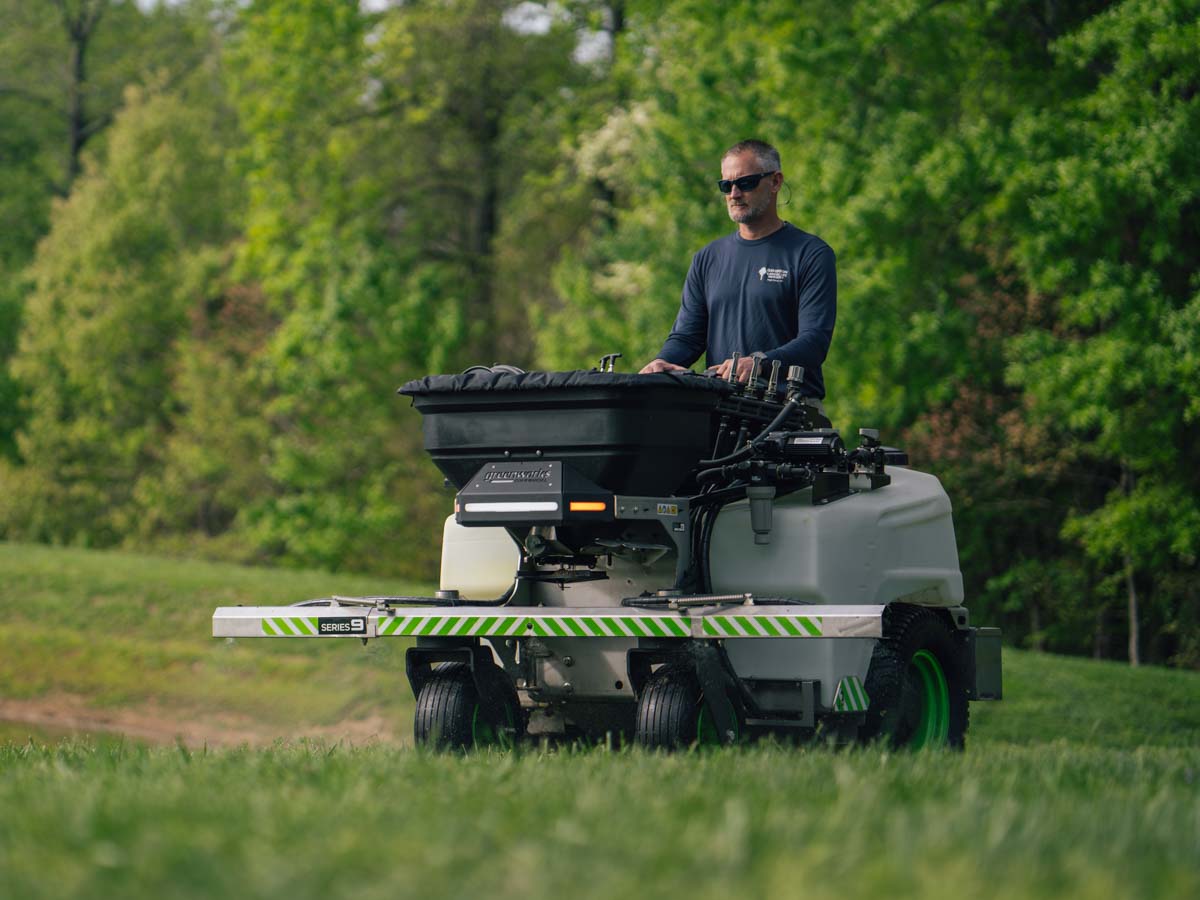
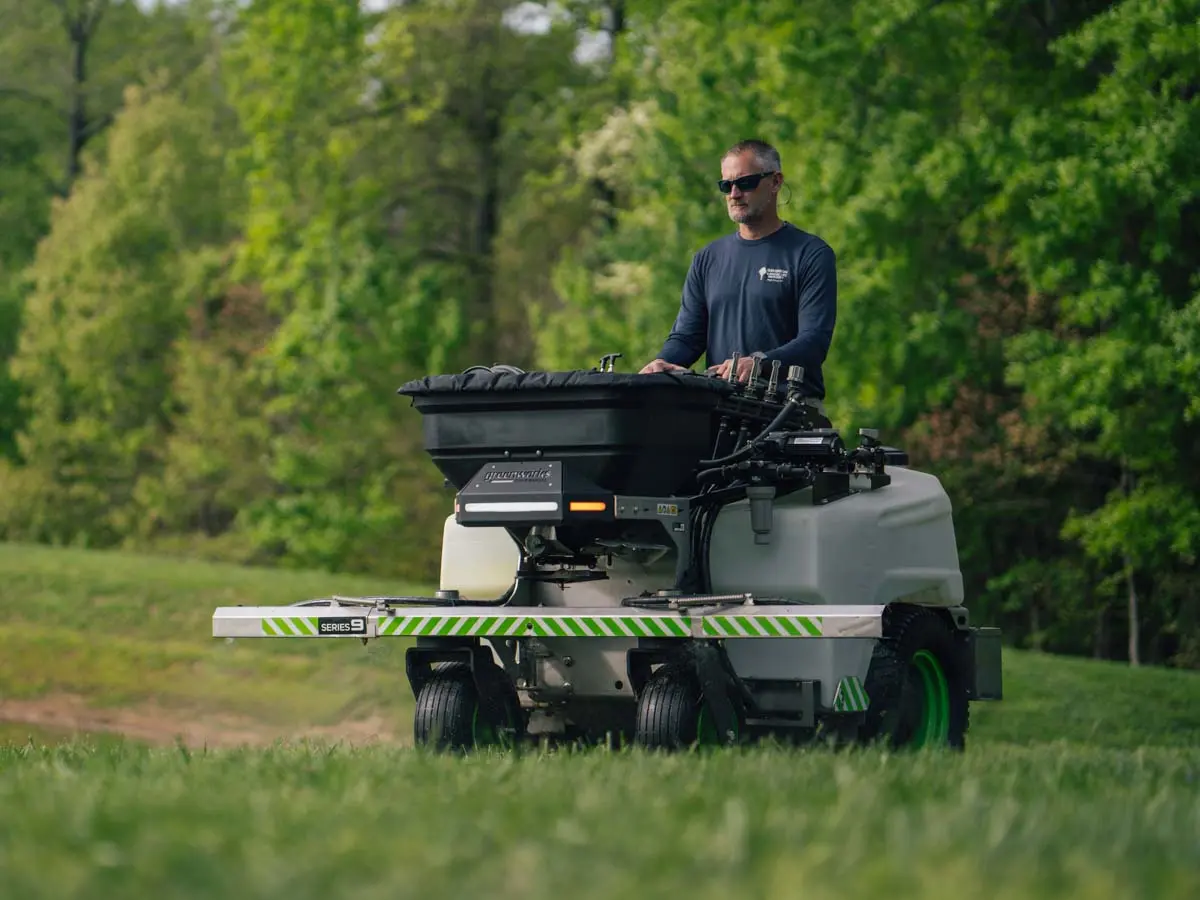
The Greenworks Commercial Optimus Sprayer Spreader eliminates this headache entirely. By transitioning to a purely electric architecture, the machine removes the gas engine from the equation, ensuring that caustic fertilizers and airborne chemicals can never compromise the powertrain.
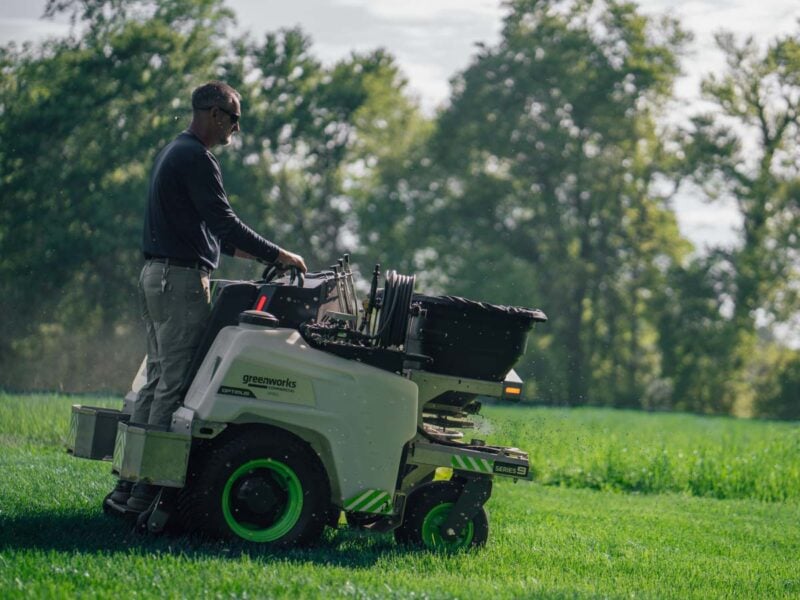
Building upon the proven, highly reliable platform of Greenworks’ existing Optimus 9-series mowers, the engineering team set out to maximize corrosion resistance. The result is a machine constructed entirely of heavy-duty, marine-grade stainless steel. Additionally, Greenworks integrated specialized protections tailored specifically for fertilizer exposure, safeguarding sensitive components—such as the wheel motors—to ensure an exceptionally long service life in corrosive environments.
Crucially, Greenworks Commercial avoided the trap of reinventing the wheel when it came to the application hardware. Rather than designing proprietary spray systems, they partnered with top-tier U.S. manufacturers of commercial spray gear. This means the Optimus utilizes the exact same familiar components found on legacy gas-powered models. Whether a shop is conducting routine maintenance, executing a repair, or swapping out parts, the equipment remains entirely familiar, and replacement parts are readily accessible nationwide.
Chronology: Evolution of the Optimus Platform
The journey toward a fully electric, commercial-grade sprayer spreader was not born overnight. It is the culmination of nearly a decade of rigorous engineering, field testing, and continuous refinement.
- 2015–2020: Greenworks Commercial establishes its reputation in the handheld market, eventually scaling up into zero-turn riding mowers. The foundational 9-series platform begins its decade-long evolution, focusing heavily on operator ergonomics, drive response, and electrical efficiency.
- 2021–2023: As commercial demand for electrification surges, Greenworks introduces the Optimus ecosystem, proving that battery-powered mowers can match or exceed the output of commercial gas equipment. Fleet data highlights a major gap in the market: while mowers are electrifying, chemical application equipment remains chained to problematic gas engines.
- 2024–2025: Greenworks engineering teams collaborate with leading U.S. spray-gear manufacturers to design a corrosion-proof, stainless-steel chassis capable of housing a high-capacity commercial spray system.
- 2026: The Greenworks Commercial Optimus Sprayer Spreader officially launches at an MSRP of $24,999.99. Alongside the flagship 52-inch model, the company lays the groundwork for a forthcoming, more compact variant tailored to tighter residential properties.
Supporting Data: Performance Metrics That Rival Gas
Skeptics of commercial battery power frequently question whether electric alternatives can truly go toe-to-toe with legacy gas machines regarding raw output, range, and operational capacity. According to Greenworks Commercial’s extensive field testing, the Optimus Sprayer Spreader doesn’t just compete with gas—in many categories, it outperforms it.
Capacity and Coverage
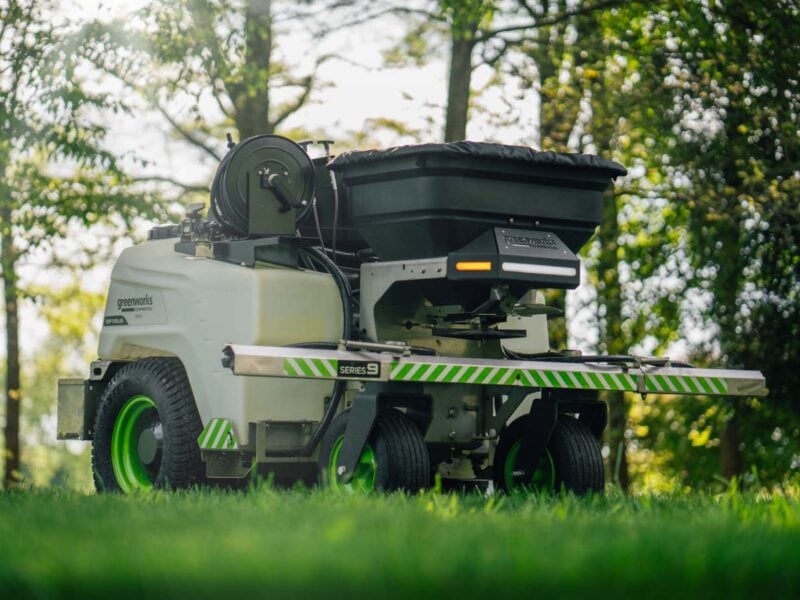
- Liquid Tank Capacity: 60 gallons
- Spray Boom Width: Up to 10 feet wide
- Granular Hopper Capacity: Up to 220 pounds
- Maximum Coverage: Up to 5.5 acres per fill/charge cycle
- Top Speed: 10 MPH (making it significantly faster than the vast majority of competing gas-powered models)
Power and Runtime
Unlike battery-powered mowers—where the vast majority of electrical energy is sapped by spinning heavy steel blades at high RPMs—a sprayer spreader requires considerably less continuous draw for its primary propulsion and fluid delivery.
The Optimus is powered by a robust 8 kWh battery system capable of delivering up to two full workdays of runtime on a single charge. When the workday concludes, the system requires only about two and a half hours to achieve a 100% recharge. Crews can simply plug the machine in overnight and rest assured that it will be fully energized and ready to tackle the next morning’s schedule without downtime.
Acoustic Engineering
Noise pollution is a growing concern for municipal contractors and residential maintenance crews. Greenworks Commercial’s sound-level testing reveals dramatic acoustic improvements:
- Operator’s Ear: Just 66 decibels (dBA)
- At 50 Feet: Only 52 dBA
To put this in perspective, the machine operates quietly enough for crew members to converse in normal speaking tones while working. Bystanders outside the immediate work zone may not even register that the machine is running.
Official Responses: Insights from Industry Leadership
To truly understand the operational impact of the Optimus Sprayer Spreader, one must look at the human element—both the mechanics in the shop and the operators in the field.
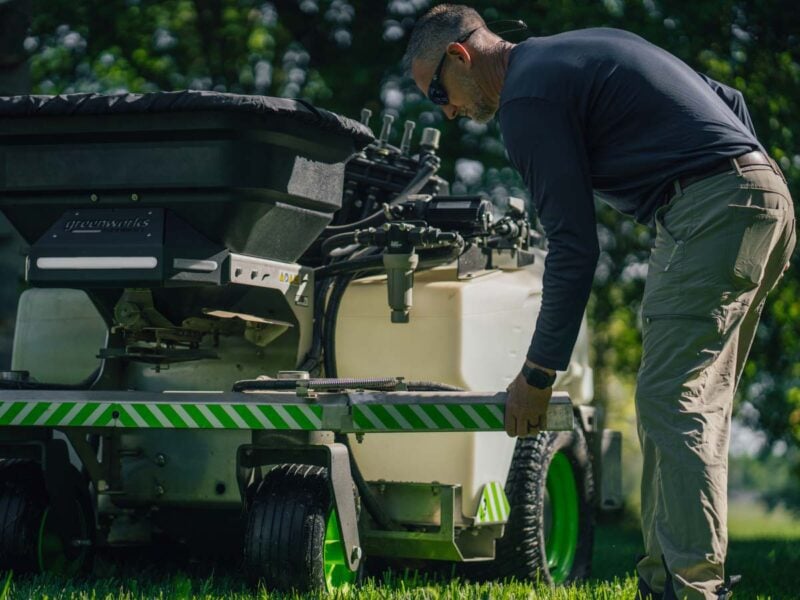
According to Tony Marchese, Senior Vice President of Sales for Greenworks Commercial, the day-to-day maintenance routine for the Optimus has been slashed to the bare minimum. "There’s not even much daily maintenance to perform," Marchese explains. "Just keep the front caster wheels greased up, flush the tank if you need to, and give it a good wash down with a hose."
Eliminating Shop Headaches
For mechanics, the removal of the internal combustion engine is nothing short of a revolution. Without a gas engine drawing in atomized fertilizers, shop bays will see a dramatic drop in carburetor rebuilds, fouled spark plugs, and engine block degradation.
Furthermore, because Greenworks partnered with established American spray-gear manufacturers, shop technicians do not need to undergo specialized retraining to service pumps, valves, or nozzles. Familiar parts catalogs and established supply chains remain fully intact.
Transforming the Operator Experience
Operator fatigue is one of the hidden costs of commercial landscaping. Traditional gas-powered stand-on spreaders create intense radiant heat directly beneath the operator’s platform, turning scorching summer afternoons into an endurance test. The Optimus eliminates this thermal radiation entirely.
In addition to heat reduction, the transition to electric drive systems virtually eliminates high-frequency vibrations that cause hand-arm vibration syndrome (HAVS) and joint fatigue over long shifts. Operators are no longer breathing in exhaust fumes for eight hours a day, keeping them fresher, more alert, and less prone to costly application errors.
Implications: The Smart-Fleet Future of Commercial Landscaping
Beyond mechanical reliability and operator comfort, the Greenworks Commercial Optimus Sprayer Spreader ushers commercial landscaping operations firmly into the era of connected, smart-fleet management.
Advanced Electronics and Security
The machine’s advanced electronic architecture provides real-time operational telemetry via an integrated control screen. Operators can effortlessly adjust application speeds and monitor exact battery charge levels at a glance. More importantly, the system features built-in self-diagnostics that proactively alert users to potential mechanical or electrical faults before they escalate into catastrophic field failures.
Asset protection is another massive win for fleet managers. Equipped with built-in 4G connectivity, the Optimus Sprayer Spreader can be tracked globally via GPS. In the unfortunate event of theft, fleet managers can coordinate directly with law enforcement to recover the unit and can even remotely disable the machine so it cannot be driven until safely secured.
Furthermore, management teams gain unprecedented operational visibility. Fleet supervisors can log into the system to verify which properties their crews serviced, exactly when they arrived, and how long they remained on-site—streamlining invoicing, quality control, and accountability.
Economics and Market Positioning
Priced at $24,999.99, the Optimus Sprayer Spreader commands a premium, but industry analysts note that the total cost of ownership (TCO) rapidly neutralizes the upfront price gap. When factoring in zero gasoline costs, zero engine oil changes, drastically reduced mechanical labor hours, and extended component lifespans through stainless-steel construction, the financial argument for going electric becomes undeniable.
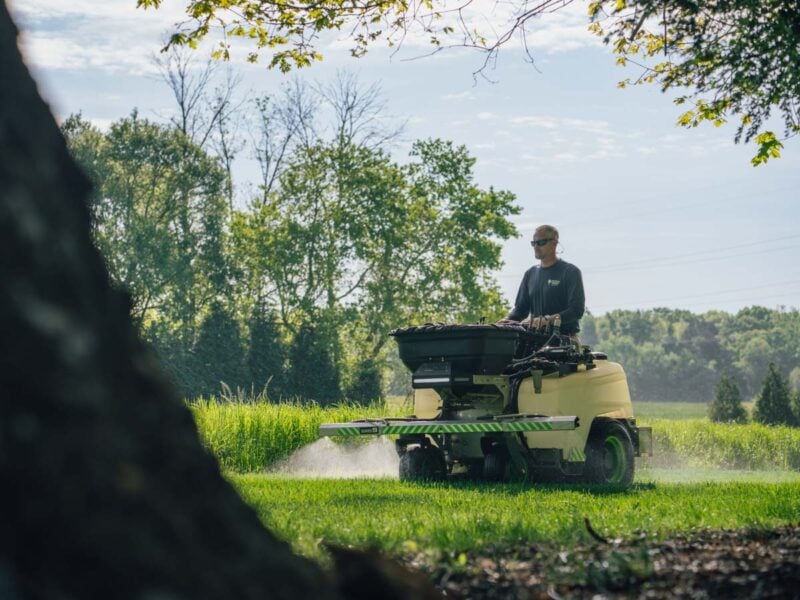
Moreover, the low acoustic signature unlocks new revenue streams and scheduling efficiencies. Because the machine operates at a whisper-quiet 52 dBA at 50 feet, landscaping crews can begin sensitive residential route work much earlier in the morning or operate later into the evening to beat peak summer heatwaves without violating local noise ordinances or waking neighborhood residents. To facilitate this, the Optimus comes standard with integrated, high-output LED headlights, eliminating the need for expensive aftermarket light-kit retrofits.
Ready to Level Up Your Chemical Application Game?
The Greenworks Commercial Optimus Sprayer Spreader represents a paradigm shift in turf management. By uniting zero-gas convenience, extreme durability through stainless-steel engineering, industry-leading runtime, and advanced telematics, it addresses the deepest pain points experienced by both field crews and shop mechanics.
With a 52-inch model already establishing a new benchmark for large-scale application, and smaller footprint variants currently in development, Greenworks Commercial is cementing its status as a definitive leader in the commercial battery revolution.
For professional contractors looking to rid their shops of maintenance nightmares, slash fuel expenditures, and elevate crew productivity, the future is electric. To learn more about the Optimus Sprayer Spreader, view technical specifications, or locate a certified dealer in your area, visit the official Greenworks Commercial website today.
