

By the Pro Tool Reviews Editorial Board
In the fast-evolving world of cordless power tools, manufacturers frequently push the boundaries of physics, releasing mid-torque and high-torque impact wrenches with staggering performance claims. From jaw-dropping nut-busting figures to hyper-efficient brushless motors, the marketing sheets promise absolute job-site supremacy. But how do trade professionals, fleet managers, and DIY enthusiasts separate clever engineering from mere spec-sheet hyperbole?
At Pro Tool Reviews, we believe that real-world performance requires a rigorous, data-driven, and transparent testing methodology. While our primary product roundups provide quick, actionable insights for buyers, the science behind our evaluations involves a meticulous testing protocol. This behind-the-scenes look delves deep into the design philosophy, testing equipment, and analytical rationale we use to crown the best cordless impact wrenches on the market.
Main Facts: The Anatomy of a Comprehensive Tool Shootout
When evaluating a class of tools as demanding as cordless impact wrenches—particularly the fiercely contested mid-torque category—randomized testing simply will not do. To ensure a level playing field, our evaluation framework is built upon three foundational pillars:
- Controlled Power Sources: Standardizing battery technology across all competing brands to eliminate power-delivery bottlenecks.
- Empirical Torque Measurement: Utilizing specialized hardware to gauge real-world output rather than relying solely on manufacturer claims.
- Rigorous Application Testing: Subjecting each tool to punishing, repeatable physical workloads designed to stress-test raw power, durability, and thermal management.
By combining laboratory-grade instrumentation with heavy-duty construction simulations, Pro Tool Reviews generates an objective baseline that exposes how each wrench handles under extreme pressure.
Chronology: The Evolution of Our Testing Protocol
Our testing methodology did not emerge overnight; it is the product of years of refinement, troubleshooting, and collaboration with industry professionals.
- Phase I: The Early Years (Subjective Field Testing): Initially, impact wrench evaluations relied heavily on general user impressions—how a tool felt in the hand while changing tires or assembling scaffolding. While practical, this method lacked the granular data needed to differentiate between top-tier competitors delivering similar user experiences.
- Phase II: Standardizing Fastener Tests: To introduce quantifiable metrics, our team introduced structured wood-driving and bolt-breaking challenges. We discovered early on that traditional lumber introduced too many variables (such as knots, moisture content, and density shifts), leading us to adopt uniform materials like stacked OSB subfloors.
- Phase III: Integrating Precision Torque Hardware: Recognizing the notorious difficulty of accurately measuring impacts, we integrated advanced digital torque testers and specialized heavy-iron rigs. This shift allowed us to capture repeatable peak torque figures and precise break-loose timings, transforming our shootouts into definitive industry benchmarks.
- Phase IV: Expanding to Non-Head-to-Head and High-Torque Models: As battery and motor technologies advanced, our testing ecosystem expanded. We established secondary protocols for compact units—focusing on automotive brake and wheel applications—while partnering with field experts like heavy-equipment ranchers and diesel mechanics to evaluate extreme high-torque platforms.
Supporting Data: The Three Core Performance Tests
To understand how we rank these heavy-duty fastening solutions, one must look closely at our tripartite testing battery. Each test is specifically calibrated to isolate a distinct operational attribute.
1. Battery Selection: Leveling the Playing Field
Power delivery in modern cordless tools is inextricably linked to the energy source feeding them. If you test a mid-torque impact wrench with an undersized battery, you starve the motor of current, resulting in suppressed performance. Conversely, strapping an excessively bulky, high-capacity battery to a compact frame ruins the tool’s ergonomics and balance.
For mid-torque classes, the industry standard is typically a 2P battery configuration, most commonly a 5.0Ah pack. However, to evaluate these tools under optimal, peak-performance conditions, we deliberately select advanced 2P packs—typically ranging from 6.0Ah to 8.0Ah. When given a choice between upgraded cell architectures, such as pouch cells versus tabless designs, we prioritize tabless batteries. This ensures that internal resistance is minimized, allowing the tool to draw maximum current without premature thermal throttling.
2. Inertia Torque Test: Measuring Power Delivery
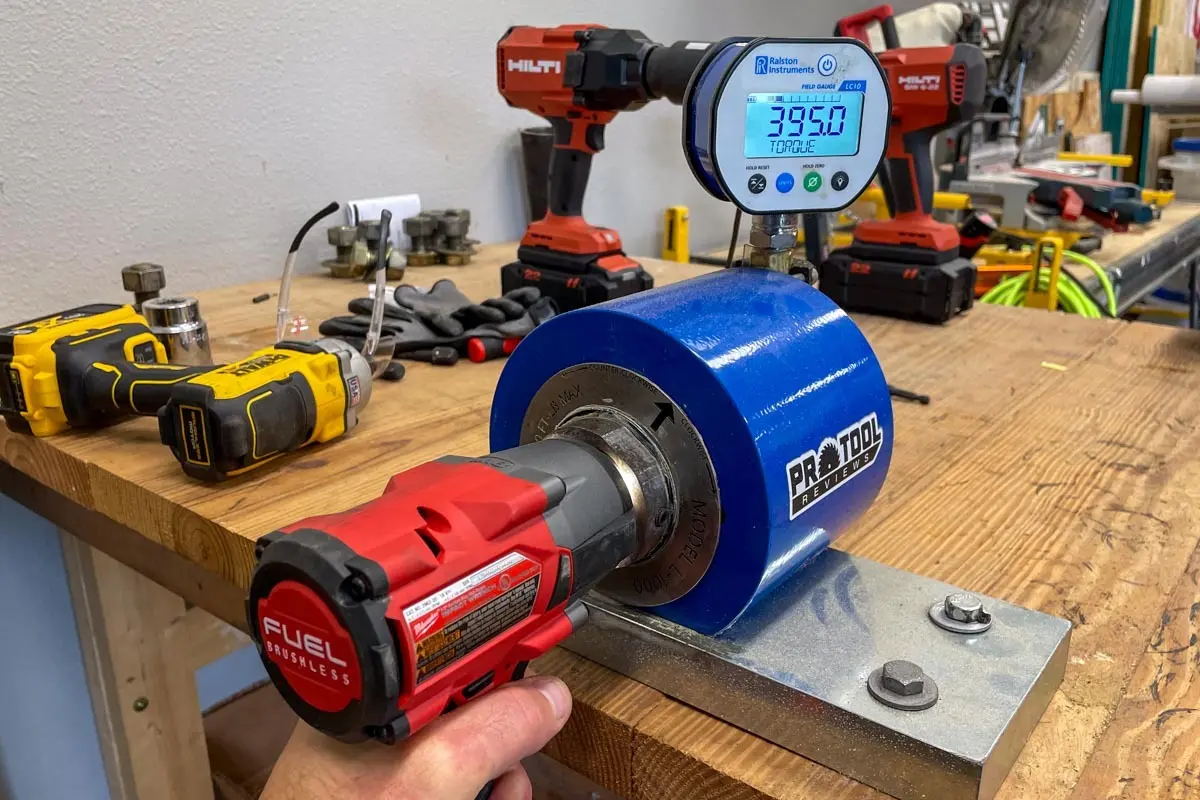
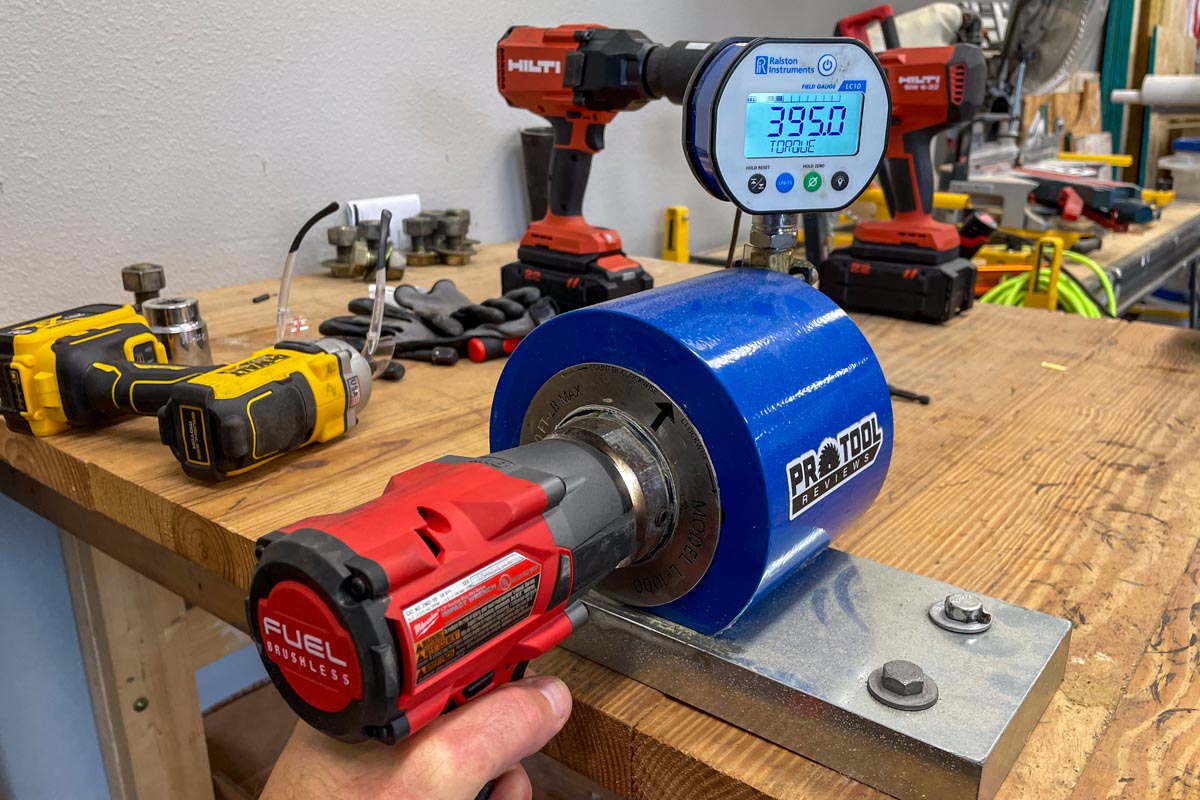
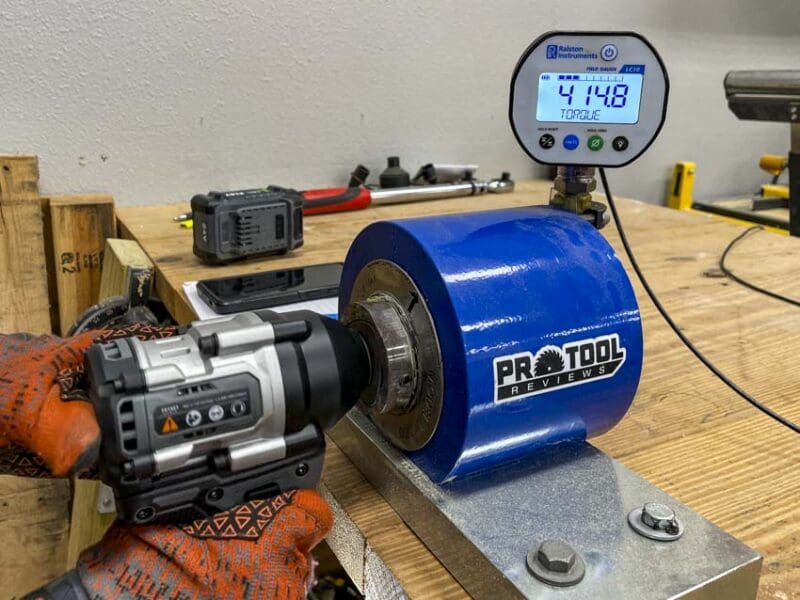
Measuring torque on an impact tool is notoriously difficult due to the rotational, concussive nature of the mechanism. To overcome this, we utilize the Inertia Torque L1000 torque tester, a specialized instrument designed to register real impact force in a controlled, repeatable environment.
Readers examining our spec sheets often notice a distinct discrepancy: the torque values we measure are frequently 20% to 40% lower than the manufacturer’s rated specifications (often capturing 60% to 80% of the advertised ceiling). This variance is a byproduct of the L1000’s mechanical design combined with our strict testing methodology, rather than a failure of the tool.
In industrial maintenance settings, crib managers use the L1000 to track performance degradation over time, signaling when a tool requires servicing or retirement. For our head-to-head reviews, it provides a vital, repeatable baseline.
The Testing Procedure: To allow each impact wrench to deliver peak power without sustaining heat damage, we implement a standardized duty cycle:
- Run the tool in its highest power mode for 5 seconds.
- Rest the tool for 3 seconds.
- Repeat the cycle two more times.
- Record the highest torque reading captured by the L1000.
3. Lag Bolt Test: Measuring Applied Force
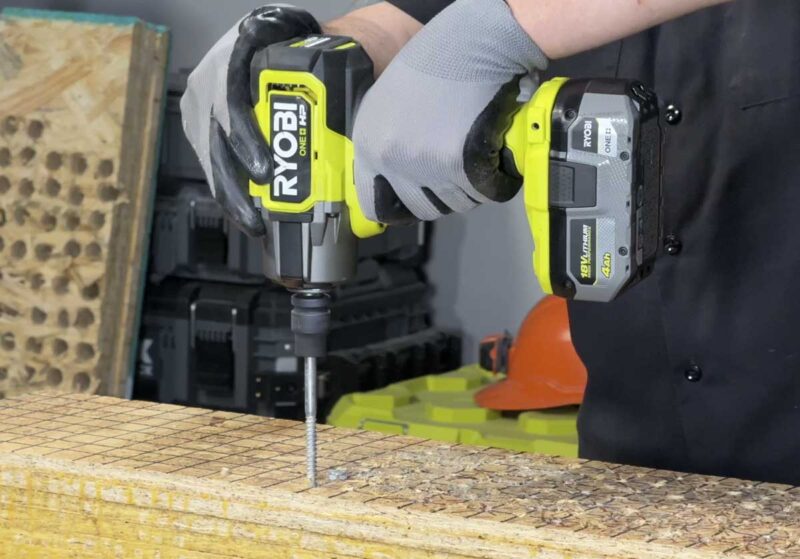
Our second performance evaluation tests the wrench’s ability to drive massive fasteners under heavy resistance. We drive 1/2-inch x 10-inch lag screws into stacked and glued OSB subfloors.
While structural builders would normally drill pilot holes for fasteners of this magnitude, we provide only a modest 2-inch pilot hole. This ensures a straight start while utilizing OSB—a material selected specifically because its uniform density eliminates the natural structural variances and splitting risks associated with traditional dimensional lumber.
The Testing Procedure: This is a brutal endurance challenge; most mid-torque wrenches cannot drive a lag of this size entirely flush within the time limit.
- Each model is given exactly 30 seconds of continuous operation to make as much progress as possible.
- Even if the tool is actively advancing, testing is halted at the 30-second mark to prevent motor burnout and thermal overload.
- Scoring: If the fastener is not driven flush, we measure the remaining distance above the wood surface. If the tool successfully drives it flush, we record the exact completion time.
4. Bolt Breaking Test: Delivering Raw Power
Our final performance test evaluates breakaway torque by measuring the time required to loosen a series of severely torqued fasteners.
We utilize a custom-built, heavy-duty rig featuring eight 1 1/8-inch semi-truck studs mounted through thick angle iron, secured on the front side with matching 1 1/4-inch lug nuts. Using a high-precision digital torque wrench, we pre-torque every single fastener to 500 ft-lbs.
Why do we bypass standard automotive lug nuts? Passenger vehicle lug nuts are typically torqued between 80 and 125 ft-lbs. Modern cordless mid-torque impact wrenches can break those loose effortlessly; attempting to tighten them on the highest power mode would instantly shear the studs.
By utilizing our heavy-duty semi-truck rig, we achieve two critical goals:
- The resistance level is high enough to create meaningful performance separation among competing brands.
- The studs and nuts are rated to handle loads far exceeding our 500 ft-lbs test threshold, safeguarding the rig’s threads from premature destruction.
The Testing Procedure: We record the average time required for each wrench to break loose all eight lug nuts, deliberately excluding the repositioning time needed to reset the tool on subsequent fasteners.
Official Responses: Evaluating Outliers and Specialized Tools
Not every tool on the market fits neatly into a standard head-to-head shootout category. Our testing framework accounts for these variations through tailored evaluation paths:
- Out-of-Loop Mid-Torque Models: Mid-torque wrenches that miss the initial cut for a major head-to-head review are still subjected to our exact testing suite. Because our protocols are entirely standardized and repeatable, their data can be instantly cross-referenced against historical benchmarks to determine their market standing.
- Compact Impact Wrenches: For smaller, compact models, our testing shifts away from heavy industrial rigs and toward real-world automotive tasks—such as wheel changes and brake system servicing. We frequently utilize our bolt-break rig calibrated down to passenger-vehicle torques, supplementing these trials with data from the L1000 torque tester.
- High-Torque Monsters: When reviewing extreme high-torque impact wrenches, our internal laboratory rigs are simply outmatched by the sheer output generated. To properly vet these heavy-duty titans, Pro Tool Reviews collaborates with field professionals—such as agricultural machinery experts and heavy diesel mechanics like Isaac Leuchtefeld. These trade specialists integrate the tools into their daily workflows, providing qualitative feedback on durability, power delivery, and practical utility compared to pneumatic or corded alternatives.
Implications: What This Means for Trade Professionals and DIYers
The implications of our rigorous testing framework extend far beyond a simple product ranking. For professional contractors, fleet mechanics, and serious trade workers, selecting an impact wrench is an investment in job-site productivity and safety.
By stripping away marketing claims and subjecting tools to standardized battery constraints, controlled inertia testing, punishing lag-bolt drives, and 500-ft-lb breakaway challenges, Pro Tool Reviews provides an unvarnished look at engineering reality. When a tool earns a top spot in our roundups, it isn’t because of glossy brochures or sponsored accolades—it has earned its place through measurable, repeatable performance under fire.
Ultimately, understanding how we test empowers consumers to make informed purchasing decisions, ensuring that the tool they pull out of the truck box every morning has the proven grit to get the job done.
