

By Science & Space Desk
The cosmos is a theatre of extreme physics, home to astronomical phenomena that continually push the boundaries of human imagination. From theoretical "black hole stars" to doomed exoplanets scorched into glowing embers by their host stars, the universe rarely fails to astonish. Yet, even within a catalog containing over 1.8 billion mapped stars in our home galaxy alone, astronomers have just identified an object that defies expectations: a star whipping around the Milky Way’s central abyss at velocities that strain credibility.
Meet S301, a hyper-velocity star discovered near the very heart of our galaxy by an international team of researchers at the Max Planck Institute for Extraterrestrial Physics in Germany. Traveling at mind-bending speeds and looping through a region of space governed by extreme gravitational forces, S301 is not merely a cosmic anomaly. It is a key that may unlock long-sought secrets of general relativity, offering astrophysicists an unprecedented laboratory to test the esoteric mechanics of spinning black holes.
Main Facts
S301 has shattered records to become the fastest-moving celestial object ever observed by science. Located in the immediate celestial backyard of **Sagittarius A*—the supermassive black hole lurking 26,000 light-years away at the center of the Milky Way—this diminutive yet ferocious star reaches a blistering peak speed of approximately 15,500 miles per second (mps)**.
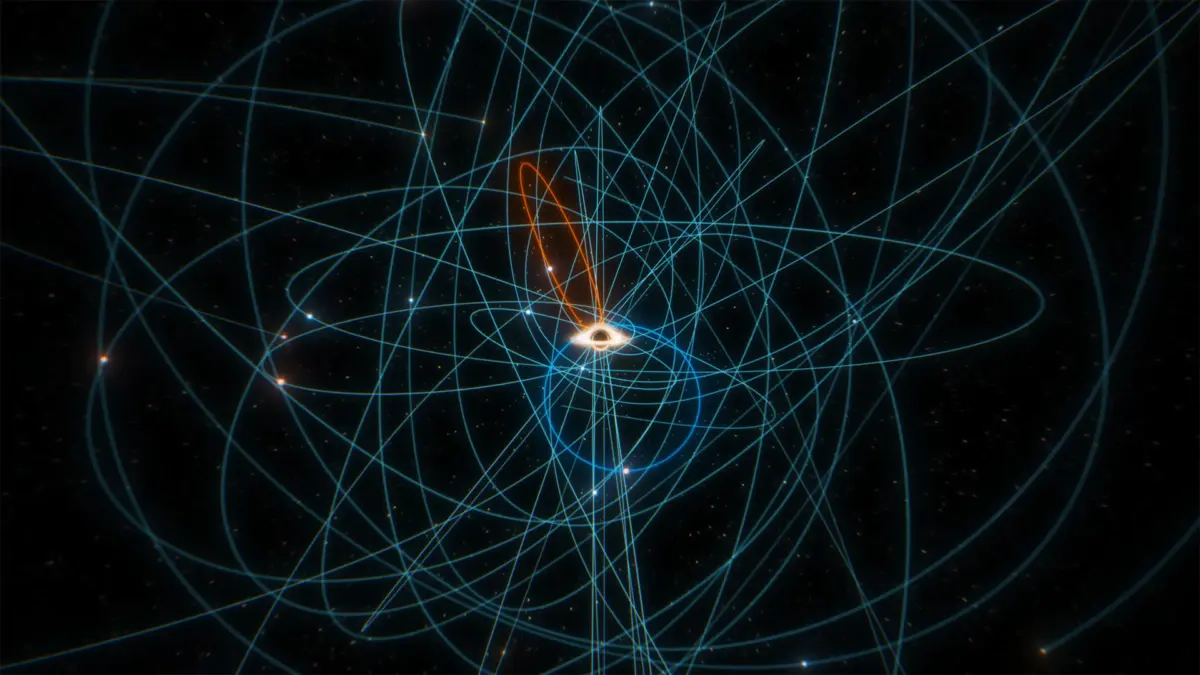
To put that into perspective, S301 accelerates to an astonishing 55.8 million miles per hour (mph) as it executes a razor-sharp slingshot maneuver around the black hole. After passing its closest point of approach, the star decelerates significantly as it embarks on a much wider, more leisurely loop through the galactic center before plunging back inward to repeat its violent orbit.
Furthermore, S301 orbits roughly 10 times closer to Sagittarius A* than the previous record-holder for proximity, a well-studied star known as S2. This extreme intimacy with the black hole subjects S301 to intense gravitational and relativistic environments that no previously observed star has ever experienced. Because it navigates this hazardous celestial zone, S301 is uniquely positioned to feel the rotational ripples of the supermassive black hole, giving scientists a direct window into phenomena previously relegated to theoretical physics.
Chronology of Discovery
The path to uncovering S301 was fraught with technological hurdles. The primary obstacle hindering its discovery was its extreme dimness. S301 is exceptionally faint—roughly two billion times dimmer than Betelgeuse, the red supergiant that shines as the tenth brightest star in the Earth’s night sky. Buried within the dense, dust-obscured glare of the galactic center, the star remained hidden from lesser instruments.
To finally bring S301 into focus, researchers at the Max Planck Institute deployed a coalition of cutting-edge astronomical instruments operated by the European Southern Observatory (ESO) in Chile. The breakthrough detection relied heavily on the GRAVITY instrument at the Very Large Telescope (VLT) and advanced observational techniques designed to filter through the interstellar noise near Sagittarius A*.
Following its initial detection, the research team spent months analyzing positional data, Doppler shifts, and orbital dynamics. By tracing the star’s trajectory backward and forward in time, they mapped its extreme elliptical orbit. The findings were formally published in Nature, detailing not just the star’s jaw-dropping velocity, but its profound implications for testing Albert Einstein’s theories in the harshest gravitational regime imaginable.
Supporting Data and Comparative Metrics
To comprehend the sheer velocity of S301, it is helpful to place its speed alongside other hyper-fast objects in the universe, as well as human-made marvels:

- S301 (Peak Speed): ~15,500 miles per second (approximately 55.8 million mph).
- Previous Record-Holder (Candidate Exoplanet System): A low-mass star and its accompanying super Neptune planet zipping along at a modest 333 mps (1.2 million mph).
- Our Solar System: Travels through space at roughly 140 mps (500,000 mph).
- Parker Solar Probe: The fastest human-made object in history, cruising past the sun at roughly 430,000 mph.
- The Speed of Light: 186,282 mps (the absolute cosmic speed limit).
While S301 falls well short of the speed of light—a realm reserved for massless particles, gravitational waves, and relativistic black hole jets—it comfortably eclipses every known star and planet ever recorded by human instruments.
Official Responses and Expert Analysis
Studying black holes has historically been an exercise in indirect observation. Because black holes possess gravitational fields so intense that not even light can escape their event horizons, scientists cannot image the black hole itself. Instead, they must measure how the black hole alters, shapes, and disrupts the environment around it—much like observing the swirling accretion disk captured in landmark Event Horizon Telescope imagery.
S301 provides a living, moving probe directly inside this invisible arena. By monitoring the star’s motion, researchers can measure phenomena predicted over a century ago by Albert Einstein in his theory of General Relativity.
Chief among these is the frame-dragging effect, also known as the Lense-Thirring effect. According to Einstein’s equations, massive rotating objects do not merely sit passively in space; their immense mass and rotation literally drag the fabric of spacetime along with them, creating a swirling vortex that twists and warps the trajectories of any nearby matter.
To visualize this, imagine standing waist-deep in a swimming pool. If you hold one arm out with your palm flat just beneath the water’s surface and spin your body in a circle, you will notice a rotating whirlpool or wave form in front of your arm as your motion displaces the water. General relativity posits that rotating supermassive black holes do the exact same thing to the four-dimensional fabric of spacetime.
Until now, proving this effect dynamically on a stellar scale has been exceedingly difficult. S301 has changed that equation.
"S301 is the first star to orbit directly in the region around Sagittarius A* where the frame-dragging effect is extreme," said Felix Mang, a Ph.D. student at the Max Planck Institute for Extraterrestrial Physics and the corresponding author of the study, in an official statement. "We’re not just measuring spacetime curvature; we are measuring how it gets distorted by the rotation of the black hole itself. That is unique."
Implications for Future Astrophysics
The discovery of S301 opens a bold new chapter in observational astrophysics. Because no other known celestial bodies venture this close to Sagittarius A*, theorists have long had to rely on mathematical models and computer simulations to predict how matter behaves in the immediate vicinity of a spinning black hole’s ergosphere.
Over the coming decade, the Max Planck Institute research team plans to maintain continuous observations of S301 using next-generation facilities, including the MICADO instrument on the upcoming Extremely Large Telescope (ELT). By tracking the star across its complete multi-year orbit, astronomers hope to refine measurements of Sagittarius A*’s mass and spin rate with unprecedented precision.
These insights will ripple far beyond our local galactic neighborhood. Understanding how supermassive black holes anchor and influence their galactic hosts sheds light on the co-evolution of galaxies and black holes across the cosmos. As instruments grow sharper and our technological reach extends deeper into the dark, S301 stands as a testament to the fact that the universe still holds dynamic, high-speed surprises waiting to be uncovered in our very own cosmic backyard.
