

By Terrence O’Brien
Published: August 22, 2026
Main Facts: The Intersection of Generative Art and Browser-Based Sound Design
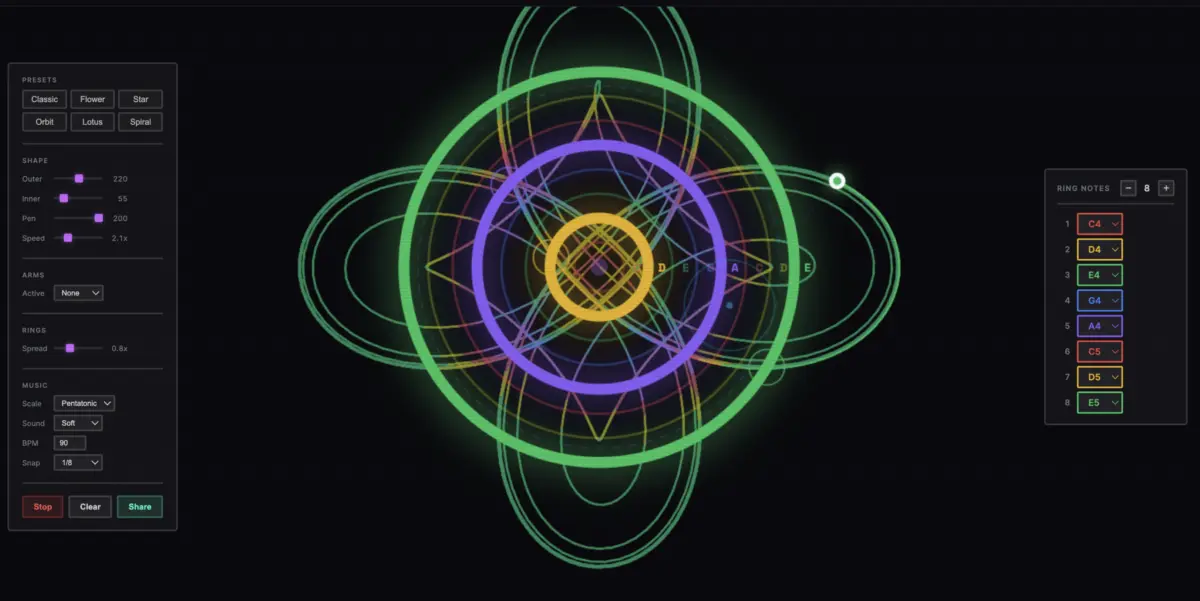
For generations, the classic Spirograph has captured the imaginations of children and adults alike, transforming simple mechanical gears into intricate, mesmerizing geometric patterns. Today, that nostalgic tactile experience has found a digital evolution that bridges visual art and auditory design. Enter the Musical Spirograph, a web-based toy developed by Musical.toys that marries the hypnotic geometry of hypotrochoids and epitrochoids with generative music composition.
At its core, the application is deceptively simple: points dash across a browser window following precise mathematical equations, tracing loops and curves. As these animated points intersect a series of concentric rings mapped across the canvas, they trigger specific musical notes. The result is an interactive, browser-contained sensory experience that is simultaneously soothing, hypnotic, and endlessly entertaining.
Users are given a surprising amount of control over both the visual and auditory parameters of the toy. The platform allows creators to choose from six different virtual rotors, deploy up to three drawing arms simultaneously, manipulate structural patterns, select from six musical scales (or completely customize individual notes), and toggle between six distinct synth presets. While it may suffer from minor audio clipping and lacks advanced routing capabilities like MIDI out, the Musical Spirograph has quickly become a favorite pastime for digital artists, retro-toy enthusiasts, and generative music fans alike.
Chronology: From Childhood Nostalgia to Modern Generative Browsing
The lineage of the Musical Spirograph traces back across two distinct parallel histories: the invention of mechanical drawing toys and the pioneering days of computer-generated music.
- 1965: Denys Fisher invents and introduces the original mechanical Spirograph toy at the Nuremberg International Toy Fair. Originally developed as a drafting tool, it quickly becomes a cultural phenomenon, allowing users to create complex mathematical curves (specifically hypotrochoids and epitrochoids) with colored pens and plastic gears.
- Late 20th Century: Pioneers in electronic and generative music—such as Laurie Spiegel with her landmark Music Mouse software in the 1980s—begin exploring how computers and algorithms can perform autonomous or semi-autonomous musical compositions, laying the groundwork for interactive browser toys.
- August 2026: Musical.toys launches the Musical Spirograph, rolling out a browser-optimized platform that successfully merges the visual mathematics of the 1960s drafting tool with real-time polyphonic tone generation. Within days of its release, the tool begins circulating widely among tech and design communities, capturing the attention of weekend editors, digital creators, and browser-game enthusiasts.
Supporting Data: Customization, Mechanics, and Technical Architecture
To understand why the Musical Spirograph is so captivating, one must examine the depth of its underlying customization engine. The web toy is built on HTML5 canvas and Web Audio APIs, allowing it to run smoothly within standard desktop and mobile browsers without requiring external downloads or heavy installations.
Visual and Mathematical Parameters
- Rotors: Users can choose from six distinct virtual rotors, each dictating the fundamental geometry and rotational speed of the drawing arms.
- Drawing Arms: The platform supports up to three simultaneous arms, allowing for complex, overlapping, and multi-colored geometric lattices.
- Rings and Octaves: The concentric target rings—which act as the structural "triggers" for audio notes—can be expanded outward to span two full octaves, drastically increasing the melodic range of a single session.
Audio and Synthesis Parameters
- Scale Options: The application offers six preset musical scales (ranging from familiar major and minor pentatonic configurations to more experimental modes), alongside a fully manual note customization mode.
- Synth Presets: Users can cycle through six distinct internal synthesizer presets, altering the timbre of the generated notes from bell-like plucks to warm, ambient pads.
- Tempo and Quantization: The rhythm of the composition can be fine-tuned by adjusting the BPM (beats per minute) and applying quantization settings to keep notes locked to a steady musical grid.
Despite these robust features, performance data from early testers highlights certain technical limitations inherent to browser-based audio synthesis. Because the Web Audio API handles polyphony and continuous rendering simultaneously during high-speed multi-arm drawing, the sound engine is occasionally prone to audio artifacts and clipping when too many notes trigger in rapid succession.
Official Responses and Creator Perspectives
While major corporate tech conglomerates have largely focused their efforts on massive generative AI models, independent developers and retro-digital artists continue to champion lightweight, whimsical browser toys that emphasize human interaction and tactile play.

Reflecting on his personal fascination with the medium, The Verge weekend editor and long-time tech journalist Terrence O’Brien shared his enthusiasm for the project:
"I remember having a Spirograph as a kid and being obsessed with it. Its geometric patterns are hypnotic and gorgeous. I also love generative music composition. So bringing those two things together in a browser tab, I’m hooked… Honestly, that alone is fun enough, but you can customize it quite a bit."
Community feedback across social platforms and developer forums has echoed this sentiment. Users have praised the platform’s ability to turn idle web-browsing time into a meditative, creative exercise. However, constructive critiques from the electronic music community have focused heavily on the platform’s connectivity limitations. Many musicians have expressed a strong desire for feature updates that would allow the software to route MIDI data outward, enabling creators to use the mesmerizing visual motions of the Spirograph to sequence external hardware synthesizers or digital audio workstations (DAWs) like Ableton Live and Logic Pro.
Implications: The Future of Browser Toys and Generative Media
The viral success of the Musical Spirograph points to a broader, enduring appetite for lightweight, joyful, and non-monetized interactive art on the internet. In an era dominated by high-stakes productivity apps, algorithmically curated social media feeds, and resource-heavy software suites, simple web toys offer a refreshing mental escape.
1. The Revival of Nostalgic Mechanics
By translating physical childhood toys into digital spaces, developers are finding new ways to engage modern audiences. The nostalgia of the Spirograph combined with modern web audio proves that classic mathematical concepts never truly go out of style; they simply evolve alongside new software capabilities.
2. Democratizing Generative Art
Tools like the Musical Spirograph lower the barrier to entry for generative art and music composition. Users do not need a degree in computer science or music theory to create a complex, evolving audiovisual piece. By simply clicking, dragging sliders, and watching mathematical formulas translate into sound and light, anyone can become an impromptu composer and visual artist.
3. Potential for Professional Integration
As web technologies continue to advance, browser-based tools are increasingly blurring the line between casual toys and legitimate creative utilities. If future iterations of projects like the Musical Spirograph incorporate features such as MIDI out, audio stem exporting, and high-resolution video recording, simple web toys could easily transition into valuable sketchpads for professional electronic musicians and motion designers.
For now, however, its primary value remains precisely what its creators intended: a soothing, hypnotic, and endlessly fun way to get lost in a browser tab for a little while.
