

By Staff Technology Correspondent
Published: August 2026
Main Facts
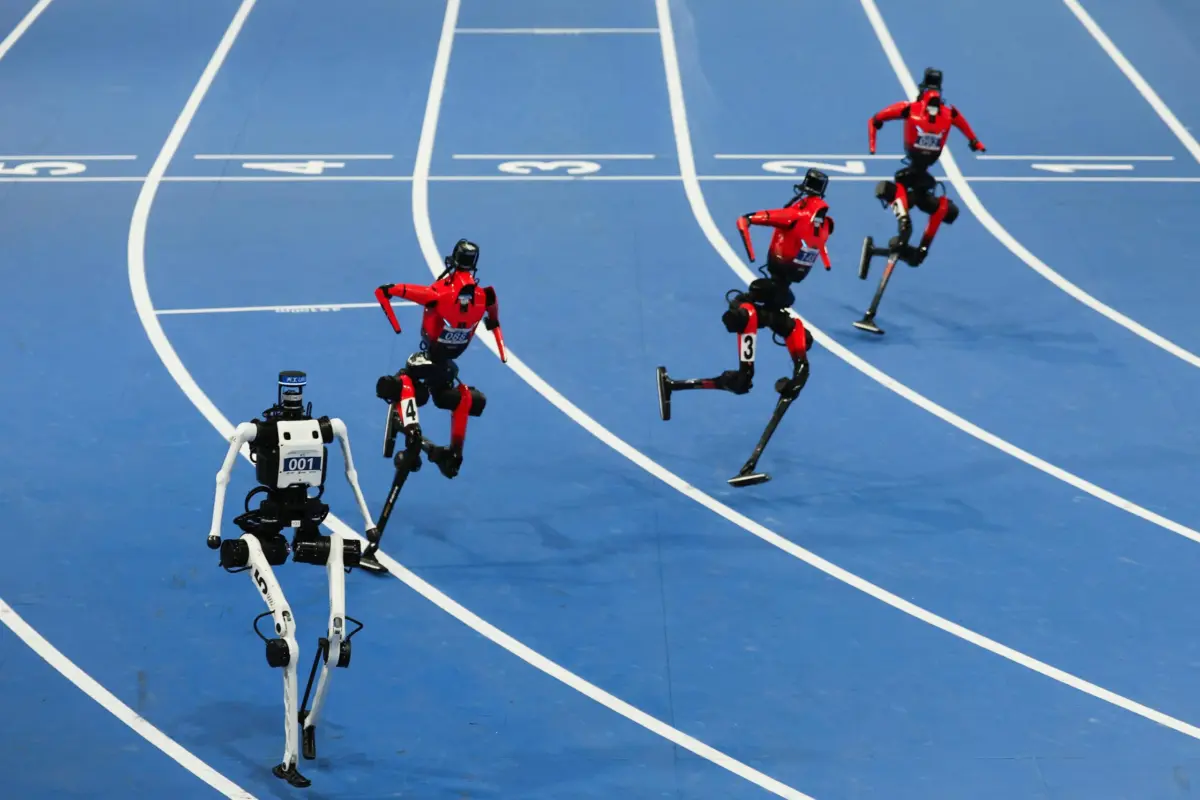
The boundaries between human athletic supremacy and machine capability have officially blurred. At the annual World Humanoid Robot Games in Beijing, a slate of advanced bipedal machines has not merely competed against one another—they have comprehensively dismantled long-standing athletic world records previously held by the fastest biological athletes in history.
In a preliminary heat that sent shockwaves through both the robotics and athletic communities, the Tiangong Ultra—developed by the Beijing Humanoid Robot Innovation Center—blazed across the finish line of the 100-meter dash in a jaw-dropping 9.39 seconds. This performance decisively outpaces the legendary 9.58-second world record set by human sprinting icon Usain Bolt at the World Athletics Championships in Berlin in 2009.
Bolt’s record has stood for nearly two decades as the undisputed benchmark of human speed. Now, a machine has clipped nearly two-tenths of a second off that time.
The Tiangong Ultra was not alone in its historic feat. Hot on its heels during the same preliminary heat was Lightning, a bipedal robot developed by consumer tech giant Honor, which crossed the finish line in 9.47 seconds—also well under Bolt’s historic threshold.
The dominance of these robotic athletes extended far beyond the short sprint. Later in the competition, the Tiangong Ultra returned to the track for the 400-meter event, obliterating the human world record of 43.03 seconds—set by South Africa’s Wayde van Niekerk at the 2016 Rio Olympics—by clocking an astonishing 38.16 seconds.
The World Humanoid Robot Games, frequently dubbed the "Robot Olympics," has quickly evolved from a niche engineering showcase into a multi-national technological spectacle. The ongoing games feature over 2,056 advanced robots hailing from 16 countries, competing across a grueling gamut of athletic categories including sprinting, long-distance running, high jumping, football, and even combat sports like boxing.
However, watching these machines compete offers a visceral reality check. Unlike human Olympians who celebrate with a victory lap, these high-speed sprinting bots frequently fail to decelerate in time. Viral footage from the event shows numerous robots crashing at terrifying speeds into heavily cushioned arena walls, scattering carbon-fiber and titanium debris before being scooped up and carted away on stretchers by engineering crews.
Chronology of the Event
The trajectory of the World Humanoid Robot Games reflects the breakneck pace of modern artificial intelligence and mechanical engineering.
- The Inception (2025): The World Humanoid Robot Games debuted as a modest international exhibition designed to push the envelope of bipedal balance, power delivery, and thermal management in humanoid platforms. Early iterations focused heavily on basic locomotion, stability on uneven terrain, and simple object manipulation.
- Early 2026 (The Build-Up): Laboratories across Asia, North America, and Europe spent the months leading up to the second annual games optimizing their actuators, lightweight composite chassis, and reinforcement learning algorithms. Industry observers noted a sudden pivot toward explosive speed and high-torque movement capabilities, shifting the focus from slow, deliberate androids to dynamic, agile runners.
- Saturday Preliminaries (The Record-Breaking Heat): During the opening weekend of the 2026 Games in Beijing, the preliminary heats for the 100-meter dash took place. Observers expected respectable sub-12-second or even sub-11-second times, given previous academic trials. Instead, the Tiangong Ultra and Honor’s Lightning shocked spectators by breaking the 9.6-second barrier on their first serious competitive outings.
- Mid-Week Endurance and Sprints (The 400-Meter Shock): Capitalizing on its momentum, the Tiangong platform was entered into the 400-meter event. By maintaining an aggressively forward-leaning posture and utilizing real-time ground-force feedback loops, the robot maintained a blistering pace that human physiology simply cannot match over a full lap, stopping the clock at 38.16 seconds.
- Current Status: As the games progress through combat, team sports, and complex obstacle courses, engineers are simultaneously working around the clock to repair crash-damaged hardware, adjusting braking algorithms to prevent high-speed collisions with stadium architecture.
Supporting Data and Technical Breakdown
To understand how a machine achieves a sub-9.4-second 100-meter dash, one must examine the staggering engineering metrics underlying modern bipedal robotics.
The Contenders
- Tiangong Ultra (Beijing Humanoid Robot Innovation Center): Built with an ultra-lightweight magnesium-aluminum alloy and carbon-fiber reinforcement. It utilizes custom high-torque brushless motors capable of instantaneous directional adjustments. Its stride frequency is nearly double that of an elite human sprinter, minimizing ground contact time to maximize propulsion.
- Lightning (Honor): Leveraging advanced smartphone-derived neural processing units (NPUs) combined with specialized edge-computing microchips, Lightning excels in rapid sensory feedback processing, allowing it to dynamically adjust its center of gravity mid-stride to prevent tipping.
Comparative Performance Metrics
| Metric | Human Record Holder | Robotic Record Holder | Time / Difference |
|---|---|---|---|
| 100-Meter Dash | Usain Bolt (9.58s – 2009) | Tiangong Ultra (2026) | 9.39 seconds (-0.19s) |
| 400-Meter Dash | Wayde van Niekerk (43.03s – 2016) | Tiangong Ultra (2026) | 38.16 seconds (-4.87s) |
| Stride Mechanics | Biological muscle contraction & reflex | Electric actuators & algorithmic gait generation | Higher frequency, zero fatigue |
| Failure Mode | Muscle strain, lactic acid buildup | Structural collision, thermal throttling | Catastrophic kinetic impact |
Engineers note that while human runners suffer from muscle fatigue, lactic acid accumulation, and physiological limits in oxygen uptake, humanoid robots are bound only by battery discharge rates, motor thermal limits, and traction coefficients.
However, physics remains an unforgiving master. The lack of biological intuition regarding momentum is vividly demonstrated by the numerous robots that fail to brake effectively. Because these machines are programmed to maximize forward acceleration up to and past the finish line, their braking zones require sophisticated deceleration algorithms. When those algorithms fail or miscalculate track friction, the results are catastrophic mechanical failures—often resulting in total structural write-offs reminiscent of high-speed auto racing crashes.

Official Responses and Industry Reactions
The staggering achievements in Beijing have elicited a mixed chorus of awe, skepticism, and strategic reassessment from the global robotics community, sports scientists, and technology analysts.
Dr. Elena Vance, a senior robotics researcher at the MIT Computer Science and Artificial Intelligence Laboratory (CSAIL), emphasized that while the physical feats are impressive, comparing them directly to human athletics requires nuance.
"We are witnessing a monumental leap in dynamic control systems," Dr. Vance stated in a post-event briefing. "For years, bipedal robots looked stiff, hesitant, and prone to falling over at the slightest irregularity. Seeing machines sustain a high-speed sprint without losing balance proves that reinforcement learning has matured immensely. However, we must remember that an electric motor powered by high-density lithium cells operates under a fundamentally different physical paradigm than biological muscle."
Representatives from the Beijing Humanoid Robot Innovation Center struck a celebratory tone during a press conference following the Tiangong Ultra’s record-breaking run.
"Our goal in developing the Tiangong series was never just to chase medals or race against human history," said Chief Engineer Liu Wei. "The true metric of success is the underlying technology. The balance control, fast-twitch motor response, energy management, and real-time environmental adaptation required to run a 9.39-second 100-meter dash are the exact same capabilities needed for robots to operate safely in disaster relief zones, hazardous industrial environments, and complex domestic spaces."
Meanwhile, consumer electronics titan Honor highlighted the crossover value of mobile AI architecture. By integrating advanced mobile processing units into their robotic platforms, Honor aims to demonstrate that consumer-grade silicon and sensor suites can be scaled up to drive heavy industrial and kinetic machinery.
Athletic bodies have remained largely philosophical. Representatives from international track and field organizations noted that Usain Bolt’s records remain safe for human athletes, emphasizing that sports will always be celebrated as a testament to biological human potential, willpower, and natural evolution.
Implications for the Future
The implications of the World Humanoid Robot Games extend far beyond the running track. What appears to be an entertaining spectacle of metallic athletes crashing into walls actually serves as an aggressive, high-stakes stress test for commercial robotics.
1. Acceleration of Commercialization and Market Mapping
As industry analysts like John Koetsier have pointed out, events like the World Humanoid Robot Games function as a live "market map." Venture capitalists, defense contractors, and enterprise logistics firms are closely watching to see which hardware architectures survive the physical rigors of competition. A robot that can survive a high-speed collision or maintain stability at 25 miles per hour is a robot that can potentially navigate chaotic warehouse floors or uneven urban disaster zones.
2. Safety, Braking, and Kinetic Management
The viral videos of robots smashing into cushioned walls highlight a critical engineering hurdle that the industry must overcome: safe deceleration. While accelerating a machine is largely a matter of raw power and traction, stopping a 150-pound humanoid robot moving at Olympic-sprinter speeds requires immense energy dissipation. Future commercial iterations will need vastly superior predictive braking systems and collision-avoidance reflexes to operate safely around human co-workers in factories and hospitals.
3. The Cultural Shift in Human vs. Machine Perception
For decades, popular culture has debated the point at which artificial intelligence and robotics would match or exceed human physical capabilities. While chess was conquered by IBM’s Deep Blue decades ago, and complex strategy games like Go fell to DeepMind’s AlphaGo, physical agility and locomotion remained the final bastions of human biological superiority.
The sight of the Tiangong Ultra crossing the finish line in 9.39 seconds signals that the physical domain is no longer exclusively ours. As these technologies mature, society will increasingly be forced to redefine the boundaries of labor, sport, and companionship in a world where machines can not only think, but outrun us all.
