

By CNET Reporting Desk
Enriched and Expanded Edition
Main Facts
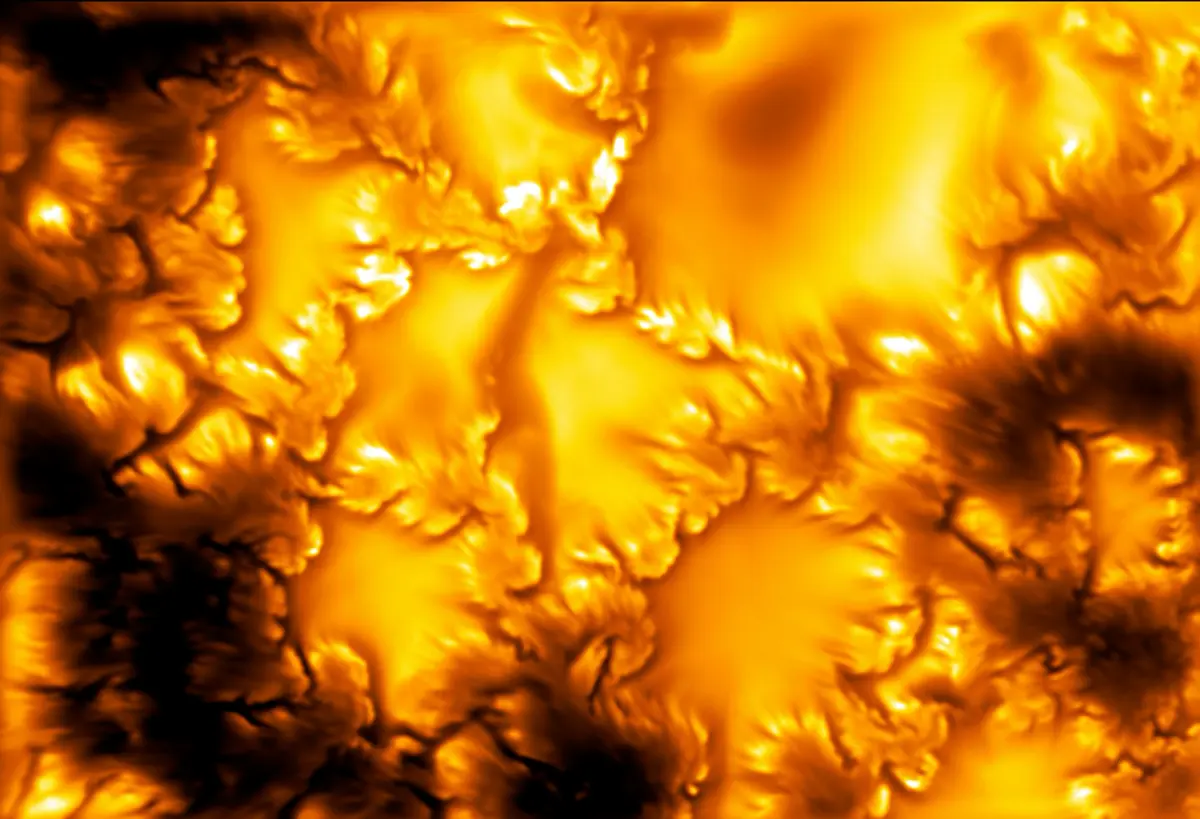
Humanity’s understanding of our nearest star has entered a radical new era. High-resolution video footage and advanced computational simulations of the sun’s surface have provided researchers with the most intimate, detailed look at the solar atmosphere ever achieved. Captured by the world’s most powerful solar observatory, these revolutionary images reveal the violent, mesmerizing dynamics of swirling plasma at a scale previously thought impossible to resolve from Earth.
At the heart of this breakthrough is the Daniel K. Inouye Solar Telescope (DKIST), perched 10,000 feet above sea level on the summit of Haleakalā on the island of Maui, Hawaii. Appropriately, Haleakalā translates from the Hawaiian language as the "House of the Sun." Operated by the National Solar Observatory (NSO) and funded by the National Science Foundation (NSF), this engineering marvel features a 4-meter primary mirror that allows scientists to peer into the sun’s churning photosphere with astonishing clarity.
The newly released data focuses on complex, high-resolution visualizations of solar plasma behaving in ways that have long eluded confirmation. Most notably, the footage captures intricate fluid-dynamic interactions where liquids of varying densities flow past one another, churning and mixing in patterns strikingly similar to terrestrial hurricanes or oceanic wave dynamics. These observations provide vital, empirical evidence confirming long-standing theoretical models regarding plasma behavior, magnetic fields, and energy transfer on the sun’s surface.
Beyond their aesthetic brilliance, these findings carry profound practical implications. By decoding the chaotic mechanics governing the sun’s exterior, astrophysicists hope to significantly improve our ability to forecast "space weather." Specifically, understanding these surface-level fluid interactions is a crucial step toward predicting violent coronal mass ejections (CMEs)—massive expulsions of magnetized plasma and radiation that routinely blast out from the sun into the wider solar system.
When directed toward Earth, CMEs possess the destructive potential to overwhelm our planet’s protective magnetic field, threatening critical global infrastructure, including satellite communications networks, aviation systems, and wide-scale power grids.
Chronology of Solar Observation: From Galileo to Haleakalā
To fully appreciate the magnitude of the Inouye Solar Telescope’s recent achievements, it is essential to trace the historical trajectory of humanity’s attempts to study the sun.
Early Milestones (1609–19th Century)
The scientific study of the sun effectively began in the early 17th century when pioneering astronomers, most notably Galileo Galilei, turned newly invented telescopes toward the heavens. Despite the obvious risks to eyesight, early observers tracked sunspots, establishing that the sun is not a static, pristine sphere, but a dynamic body in constant rotation. However, for centuries, observations were limited by atmospheric turbulence and the crude optical technology of the era.
The Rise of Specialized Solar Observatories (Mid-20th Century)
By the mid-20th century, scientists recognized that studying the sun required specialized instruments capable of mitigating the distorting effects of Earth’s atmosphere. This realization led to the construction of high-altitude observatories, such as California’s Mount Wilson Observatory and the Sacramento Peak Observatory in New Mexico. Solar astronomers began utilizing specialized filters, such as H-alpha filters, to isolate specific wavelengths of light, allowing them to study solar flares and prominences with increasing fidelity.
The Space Age and Orbital Astronomy (1970s–2010s)
The limitations of ground-based viewing were dramatically altered with the advent of space exploration. Missions like Skylab, the Solar and Heliospheric Observatory (SOHO)—a joint venture between NASA and the European Space Agency launched in 1995—and NASA’s Solar Dynamics Observatory (SDO), launched in 2010, provided uninterrupted views of the sun free from atmospheric interference. These orbital platforms revolutionized solar physics, tracking the sun’s 11-year magnetic cycle and providing continuous, full-disk imagery.

The Inouye Era Begins (2020–Present)
Despite the successes of space-based telescopes, ground-based observatories retain a distinct advantage: the ability to house massive, heavy optical systems that cannot easily be launched into orbit. Planning for the Inouye Solar Telescope began in the late 1990s, with construction commencing in 2013 on Haleakalā.
Despite logistical challenges, including remote terrain, environmental protection protocols, and the disruptions of the COVID-19 pandemic, the telescope captured its first light in late 2019 and officially commenced operations in 2022. The latest video releases and plasma simulations represent the culmination of years of calibration, advanced adaptive optics deployment, and massive data processing pipelines.
Supporting Data and Technical Architecture
The breakthroughs achieved by the Inouye Solar Telescope are directly attributable to its unprecedented engineering specifications and the complex physics of the solar environment it observes.
The Engineering Marvel of DKIST
- Primary Mirror: 4.2 meters (165 inches) in diameter, making it the largest solar telescope in the world.
- Location: Haleakalā Observatory, Maui, Hawaii (Elevation: approx. 3,000 meters / 10,000 feet). The high altitude places the telescope above a significant portion of Earth’s turbulent atmosphere, reducing optical blur.
- Thermal Control: Because the telescope concentrates an immense amount of solar energy—enough to melt steel instantaneously—it utilizes an advanced cooling system featuring coolant lines running throughout the structure, alongside a specialized "heat stop" designed to absorb 13 kilowatts of concentrated solar power.
- Adaptive Optics: The telescope employs deformable mirrors that adjust hundreds of times per second to actively counteract the blurring effects of atmospheric distortion, producing images with a spatial resolution of roughly 20 to 30 kilometers on the sun’s surface.
Fluid Dynamics and Plasma Physics
The core of the recent discovery centers on Kelvin-Helmholtz instabilities and shear flows within the solar plasma. Plasma—an ionized gas composed of free-roaming ions and electrons—dominates the sun’s outer layers.
When layers of plasma with differing densities, temperatures, and magnetic field orientations flow past one another at varying speeds, the boundary between them becomes unstable. The resulting motion rolls into complex, swirling vortices that bear a striking resemblance to terrestrial weather systems, such as hurricanes or ocean waves breaking on a beach.
[Solar Interior]
       │
       ▼ (Convection Zone)
[Photosphere / Surface] ──► Differential Plasma Flows ──► Kelvin-Helmholtz Instabilities
       │                                                         │
       ▼                                                         ▼
[Coronal Heating] ◄─────────────────────────────── Magnetic Reconnection & Energy Transfer
Scientists have long hypothesized that these shear flows and micro-vortices play a critical role in the coronal heating problem—the long-standing astrophysical mystery of why the sun’s outer atmosphere (the corona) is millions of degrees hotter than its underlying surface (the photosphere). The high-resolution data from Inouye allows researchers to quantify the energy transferred by these swirling plasma structures for the very first time.
Official Responses and Expert Perspectives
The release of the high-resolution solar imagery has generated immense excitement within the global astrophysical community, prompting statements from key institutional leaders and lead researchers.
Dr. David Boboltz, program director for the National Science Foundation’s Division of Astronomical Sciences, emphasized the transformative nature of the facility:
"The Inouye Solar Telescope is now the premier ground-based facility for solar physics, and it is delivering on its promise to revolutionize our understanding of the sun. The detail we are seeing in these plasma simulations and videos is not just visually stunning; it provides the empirical keys needed to unlock mechanisms that have puzzled solar physicists for generations."
Dr. Thomas Rimmele, associate director at the National Solar Observatory and project director for DKIST, highlighted the technological hurdles overcome to capture the footage:

"Observing the sun from the ground is notoriously difficult due to the blurring caused by Earth’s atmosphere. Through a combination of state-of-the-art adaptive optics, precise thermal engineering, and the pristine atmospheric conditions atop Haleakalā, we have effectively removed that barrier. We are now looking at the sun with an unprecedented level of sharpness."
Educational and media producers have also underscored the public engagement value of these findings. Jesse Orrall, Senior Video Producer at CNET and co-creator of the accompanying video features, noted the importance of translating complex solar physics for a broad audience:
"When people think of the sun, they often picture a static, bright yellow circle in the sky. Bringing these extreme close-ups to the public shatters that illusion. Seeing plasma churn, twist, and behave with the chaotic beauty of an ocean storm makes the cosmos feel immediate, dynamic, and profoundly interconnected with our daily lives on Earth."
Implications for Earth and Space Weather
While solar physics is fundamentally a branch of pure science, the practical applications of research conducted at facilities like the Inouye Solar Telescope have massive implications for modern technological civilization.
The Vulnerability of Modern Infrastructure
Humanity has built a technological ecosystem uniquely susceptible to solar activity. Modern society relies heavily on:
- Electrical Power Grids: Long-distance transmission lines can act as conductors for geomagnetically induced currents (GICs) generated during severe solar storms, potentially triggering catastrophic transformer failures and continent-wide blackouts.
- Satellite Networks: Orbiting hardware providing GPS navigation, global telecommunications, and Earth observation data are directly exposed to high-energy particle radiation, which can degrade solar panels, disrupt electronics, and alter orbital trajectories.
- Aviation and Communication: High-frequency (HF) radio communications utilized by transpolar aviation routes and maritime operations are frequently disrupted during solar flare events, posing safety and navigation challenges.
Toward Predictive Space Weather Forecasting
Historically, space weather forecasting has been reactive. Satellites orbiting at the Lagrange point 1 (L1), roughly 1.5 million kilometers sunward from Earth, can detect incoming solar storms roughly 15 to 60 minutes before they impact our planet’s magnetosphere. While valuable, this provides a dangerously narrow window for grid operators and satellite managers to take protective measures.
By leveraging the high-resolution observations and fluid dynamics models enabled by the Inouye Solar Telescope, scientists aim to move from reactive warning to predictive modeling. Understanding the root causes of magnetic field generation, plasma instabilities, and energy buildup on the sun’s surface allows researchers to identify the precursor signatures of solar flares and CMEs days before they erupt.
As data streams from Haleakalā continue to feed into advanced machine learning models and supercomputer simulations, humanity moves one step closer to establishing a robust, early-warning framework for space weather—securing our technological future against the immense, beautiful volatility of our local star.
